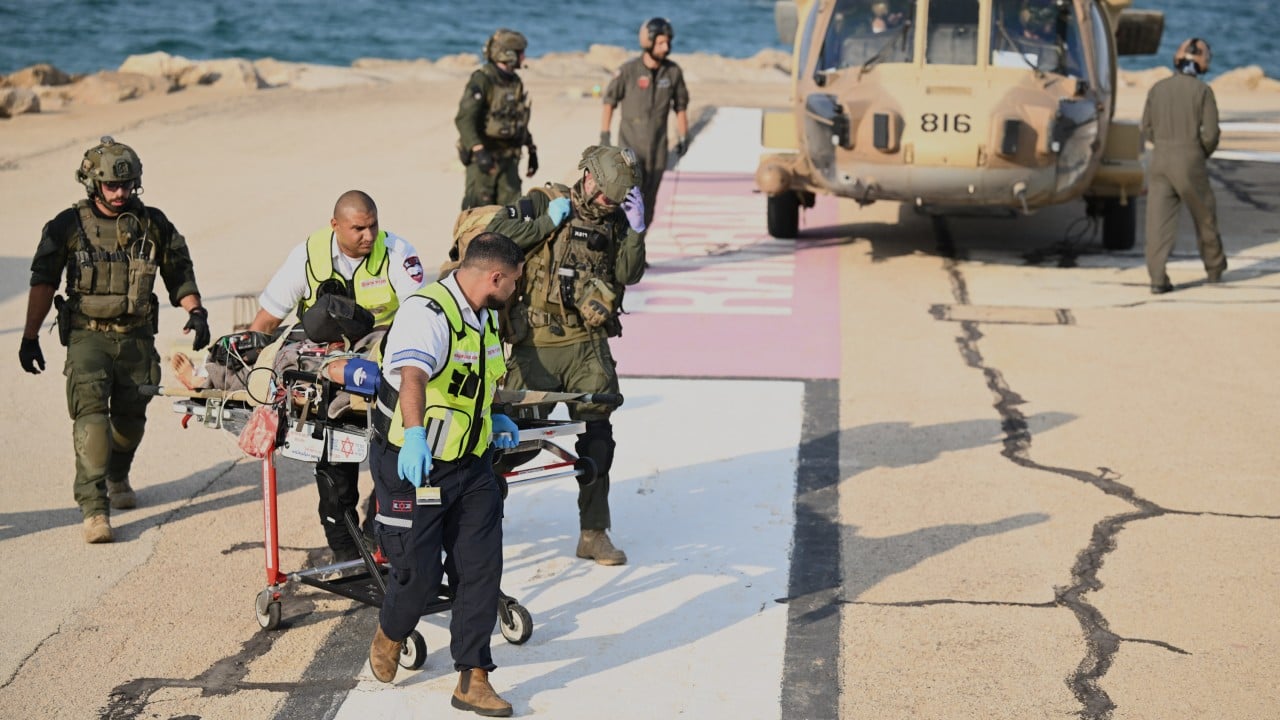
Unexploded ordnance represents a permanent engineering failure disguised as a temporary artifact of conflict. When a munition enters an operational environment and fails to detonate upon impact or timed command, it transitions from an active military asset into an uncontrolled hazard characterized by high energy density and extreme material degradation. The recent detonation of residual explosive material in Israel, resulting in fatalities and multiple injuries among civilians, highlights the systemic risks associated with unexploded munitions in post-hostility zones. Evaluating this risk requires shifting from qualitative reporting to a rigorous structural analysis of failure modes, environmental degradation pathways, and the systemic bottlenecks governing remediation operations.
The lifecycle of any military munition is divided into three distinct operational phases: transport and arming, terminal ballistics, and final payload delivery. A failure event at the terminal stage indicates a breakdown in the kinetic or electronic initiation chain. In conventional artillery shells, mortar rounds, and dropped munitions, detonation relies on a fuze mechanism containing a firing pin, a primer, and a booster charge. When a round impacts soft soil, urban rubble, or mud, the deceleration forces may fall below the mechanical threshold required to drive the firing pin into the primer. Alternatively, environmental cushioning can prevent an electronic fuze from closing its internal circuit. The munition remains structurally intact but mechanically primed, converting every square meter of contaminated soil into a volatile latent hazard.
Material degradation accelerates the volatility of unexploded ordnance over time. Standard military explosives such as RDX, TNT, and Composition B are chemically stable under sealed storage conditions, but exposure to weathering alters their structural integrity. Subsurface moisture infiltration corrodes the metal casing of the shell, creating microscopic fissures. As moisture interacts with the explosive fill, hydrolytic degradation can occur, while temperature fluctuations induce thermal expansion and micro-fracturing within the explosive grain. This physical breakdown increases the sensitivity of the compound to friction, shock, and static discharge. A mechanical impact that would have left a factory-fresh shell dormant can trigger a degraded, hyper-sensitive charge decades after initial deployment.
The geography of unexploded ordnance distribution is governed by environmental density and target profiling. Urban environments present complex recovery matrices due to subterranean infrastructure, structural collapse, and deep penetration into reinforced concrete or dense fill materials. When munitions fail to detonate in urban rubble, they frequently become obscured by debris, rendering visual sweeps ineffective. The probability of civilian interaction with residual ordnance correlates directly with population density and the return rate of displaced populations to formerly contested sectors. The absence of systematic clearance prior to re-occupation creates a systemic vulnerability where the civilian population assumes the burden of ordnance detection through accidental physical contact.
Clearance operations face severe economic and logistical bottlenecks that limit the speed of hazard mitigation. Manual clearance utilizing metal detectors and mechanical excavation is constrained by high operational risk, low throughput rates, and high financial costs per cleared hectare. Advanced technological interventions, including ground-penetrating radar, magnetometer arrays mounted on unmanned aerial vehicles, and multispectral imaging, offer theoretical improvements in detection velocity. However, these technologies struggle with false-positive rates driven by metallic debris scatter typical of damaged urban environments. Every anomaly identified by a sensor array requires manual physical verification, establishing a hard ceiling on daily clearance capacity.
The economic cost function of unexploded ordnance extends far beyond immediate emergency response. It encompasses agricultural abandonment, infrastructure delays, and long-term healthcare liabilities associated with trauma care and prosthetic rehabilitation. Traditional policy frameworks often treat post-conflict clearance as an auxiliary humanitarian afterthought rather than an integrated component of regional infrastructure stabilization. This misallocation of capital delays recovery and maintains high baseline hazard levels across affected zones.
To mitigate residual munition risks effectively, remediation protocols must transition from reactive clearance to proactive, predictive hazard mapping. Authorities must implement continuous environmental monitoring of contaminated sectors using integrated drone-based sensor suites combined with historical strike data to model degradation timelines. Concurrently, clearance operations require automated sorting algorithms capable of distinguishing unexploded ordnance signatures from general metallic clutter in real time, drastically reducing the verification bottleneck. Policy frameworks must mandate comprehensive ordnance clearance certification as a non-negotiable prerequisite for civil re-entry and structural reconstruction in post-conflict zones.