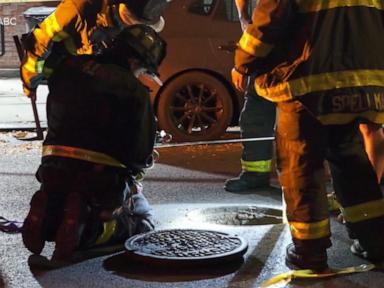
Recent urban surveillance footage capturing unauthorized individuals descending into and emerging from municipal sewer networks across Manhattan highlights a critical breakdown in physical access control. While viral media frames these occurrences through the lens of pop-culture novelty, an operational analysis of the Manhattan subterranean grid reveals severe security and safety vulnerabilities within municipal infrastructure management.
The systemic exposure stems from three primary operational failures: legacy hardware vulnerabilities, structural monitoring deficits, and the inherent friction between public safety enforcement and subterranean anonymity.
The Mechanics of Subsurface Ingress
Municipal sewer infrastructure relies on standardized cast-iron manhole covers designed for rapid municipal access during utility maintenance or emergency response. These heavy closures rely primarily on gravity and friction rather than biometric or cryptographic locking mechanisms.
When unauthorized actors target these access points, the operational expenditure required to breach the perimeter is near zero. Standard pry bars or hooks provide sufficient mechanical advantage to displace a cover weighing upwards of one hundred pounds. Consequently, the urban subsurface functions as an unmonitored lateral highway, bypassing standard perimeter security deployed at street level.
The Subterranean Cost Function
Entering municipal drainage systems introduces severe physiological and operational hazards. Beyond legal liabilities related to criminal trespass, unauthorized subterranean exploration exposes individuals to extreme environmental risks:
- Atmospheric Displacement: Subsurface spaces frequently accumulate toxic gases, including hydrogen sulfide, methane, and carbon monoxide, alongside oxygen-deficient pockets.
- Hydraulic Volatility: Urban drainage systems are engineered for rapid stormwater management. Sudden precipitation events trigger flash flooding within confined concrete channels, leaving negligible reaction time for evacuation.
- Pathogenic Exposure: Direct contact with untreated municipal waste introduces high densities of biological pathogens, creating immediate public health risks.
Systemic Failures in Infrastructure Surveillance
Law enforcement response to these urban penetrations relies heavily on retroactive video analysis rather than predictive intrusion detection. Because municipal networks span hundreds of miles of tunnels without continuous optical or thermal sensor arrays across secondary access nodes, unauthorized movements go undetected until civilian observers or closed-circuit traffic cameras record an emergence event.
This reactive posture creates an enforcement bottleneck. By the time municipal authorities or police departments mobilize resources to investigate a breach location, the perpetrators have typically dissolved back into street-level transit networks.
Strategic Remediation Framework
Securing metropolitan subsurface assets requires shifting from a passive physical model to an active defense strategy. Municipalities must implement tiered structural mitigations:
- Tamper-Evident and Locking Hardware: Upgrading critical utility corridors with mechanical locking manhole covers that require specialized tooling for displacement.
- Subsurface Sensor Deployment: Installing acoustic and gas-monitoring sensors within high-risk interceptor junctions to transmit real-time alerts upon unauthorized cover displacement.
- Inter-Agency Data Synchronization: Correlating street-level automated license plate readers with historical transit timestamps around major manhole emergence zones to identify logistical support networks utilized by trespassers.
The mitigation of underground breaches depends entirely on eliminating the asymmetry between the ease of physical ingress and the latency of municipal response. Until access control standards match the security requirements of modern urban centers, municipal utility networks will remain vulnerable to clandestine exploitation.


