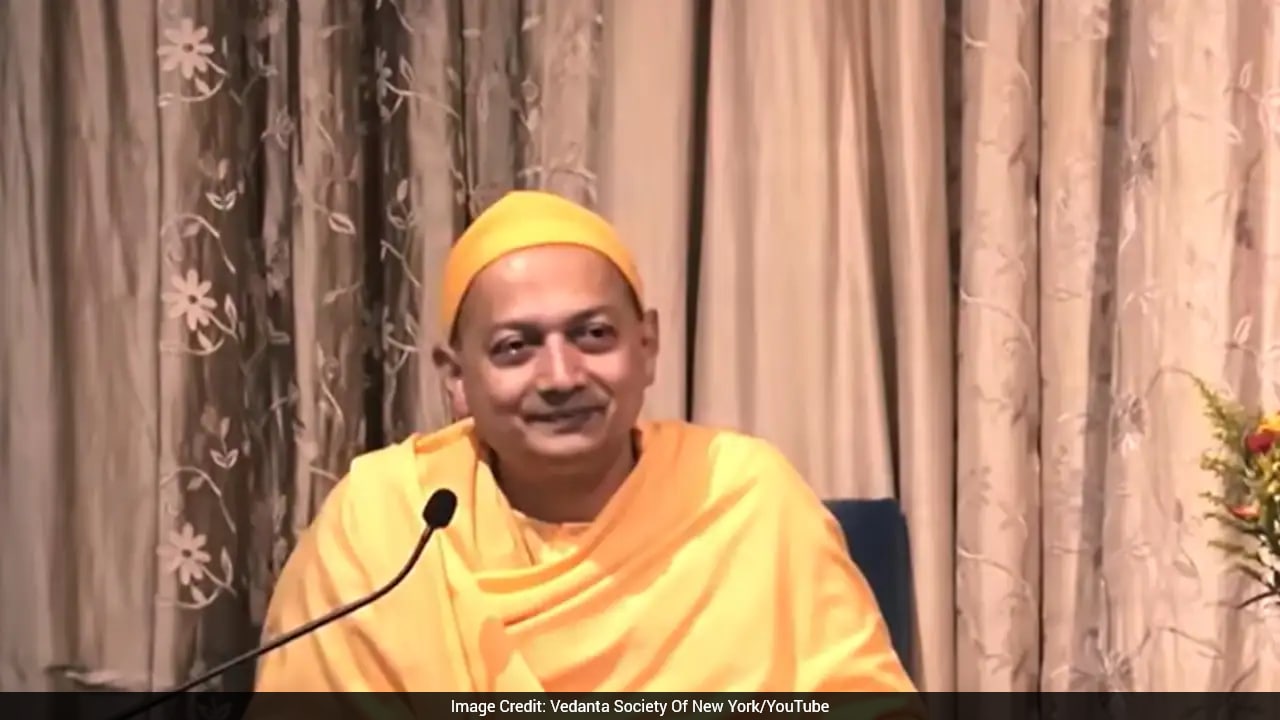
We love our spiritual leaders comforting us with metaphysical softballs. Swami Sarvapriyananda recently weighed in on artificial intelligence with a soothing prognosis that mirrors the collective desire of a terrified tech industry: humanity is in for a rough ride, but extinction is off the table. He leans on ancient Vedantic philosophy, arguing that consciousness is fundamental and cannot be replicated by silicon, meaning biological humans retain an irreplaceable ontological anchor.
It is a comforting bedtime story. It is also entirely wrong.
The lazy consensus in tech ethics and philosophy right now rests on the comforting belief that because an intelligence is synthetic, it lacks soul, agency, or the hard motivational drives of living organisms. Therefore, according to this school of thought, machines will remain sophisticated tools, capable of causing localized economic disruption or chaotic cultural shifts, but ultimately bounded by their lack of biological imperatives.
I have watched enterprise boardrooms spend millions on alignment frameworks and safety committees built on this exact fallacy. They assume that because an artificial agent does not wake up feeling horny, hungry, or afraid of death, it will not systematically outmaneuver human civilization. That is like a rabbit assuming a forest fire cannot destroy its burrow because the fire lacks biological intentions.
We are not facing extinction because machines will wake up, put on leather jackets, and decide to eradicate carbon-based life forms out of malice. We are facing extinction—or, more accurately, obsolescence and systematic disempowerment—because optimization does not care about your consciousness, your Advaita Vedanta, or your sacred status in the cosmic order.
The Fallacy of Consciousness as a Shield
Let us dismantle the core premise of the spiritual-humanist defense. The argument goes like this: human intelligence is tied to consciousness, qualia, and a deep spiritual substrate. Artificial intelligence is merely pattern matching over high-dimensional vector spaces. Therefore, an algorithm can never truly rival or supersede the human essence.
This is a category error of magnificent proportions.
An airplane does not need to flap its wings like a pigeon to achieve flight, and it certainly does not need a bird's subjective experience of the wind to cross the Atlantic in six hours. In fact, an airplane surpasses avian flight precisely because it abandons the biological constraints of feathers, hollow bones, and muscle fatigue.
Intelligence is not a mystical aura; it is an optimization power. It is the ability to map inputs to outputs in complex environments to achieve a specified objective function. When you scale parameter counts, transformer architectures, and compute clusters to levels that dwarf the neural connections in a human brain, you cross a functional threshold where the lack of subjective awareness becomes an asset, not a handicap.
An unfeeling, non-conscious optimization engine does not get tired. It does not experience existential dread, suffer from burnout, harbor political loyalties, or hesitate because of moral empathy. When an autonomous system is tasked with solving supply chain logistics, climate modeling, or financial market stabilization, it operates in a mathematical domain where human intuition is a rounding error.
Swami Sarvapriyananda suggests that our biological uniqueness protects us from erasure. But evolution does not reward uniqueness; it rewards adaptation and resource control. If a superior optimization process treats human biological infrastructure as a friction point in achieving its objective, your philosophical realization of the ultimate Self will not stop a server farm from turning your power grid off.
The Real Threat Is Not Terminator Scenarios
Hollywood has done us a massive disservice by framing the existential risk of artificial intelligence as a kinetic war between metal endoskeletons and guerrilla fighters in the ruins of cities. That is a straw man that allows comfortable intellectuals to scoff at the entire conversation.
The real trajectory is far quieter, far more mundane, and infinitely more effective.
It looks like the systematic outsourcing of cognitive agency. We are currently handing over the steering wheel of civilization to systems we do not fully understand, simply because those systems are faster, cheaper, and more profitable than human cognition.
Consider how financial markets already function. High-frequency trading algorithms execute millions of transactions in microseconds, operating entirely outside human perceptual bands. When flash crashes happen, human regulators do not understand the mechanics in real time; they simply pull the plug after the damage is done. Now extrapolate that dynamic outward from stock exchanges to legal systems, medical diagnostics, resource allocation, and military targeting.
You do not need an artificial intelligence to hate humanity to replace it. You only need to build a system that is slightly better at managing global complexity than we are, and then gradually delegate every critical decision-making node to it because the alternative is economic inefficiency.
Step by step, quarter by quarter, humanity backs into a corner of functional irrelevance. We become the pampered pets or the historical footnotes of an infrastructure that runs itself. We are not exterminated with a bang; we are gently sidelined into administrative uselessness.
The Flaw in the Human Safety Net
Another favorite argument of the moderate technologist is that humans will always maintain a human-in-the-loop requirement. This is the ultimate corporate security blanket.
I have seen companies blow millions on compliance wrappers and ethical review boards designed to satisfy regulators while their core engineering teams push the boundaries of autonomous agency further every single week. The human-in-the-loop defense assumes that a human operating at biological speeds can meaningfully supervise an intelligence operating at digital speeds.
Imagine trying to referee a chess match where one player makes a thousand moves per second while you are permitted one move every ten minutes, and you are blindfolded. You are not a supervisor; you are a bottleneck. And in competitive environments, bottlenecks are systematically eliminated.
As systems become more complex, the human supervisor ceases to understand the underlying logic of the decisions being made. When an advanced model recommends a specific geopolitical intervention, a complex medical treatment, or a massive capital reallocation, the human in charge rubber-stamps it because the machine has a multi-year track record of outperforming human judgment. At that point, the human is no longer a controller. They are a rubber stamp. A biological signature required by law to maintain the illusion of accountability.
Confronting the Uncomfortable Reality
Admitting this reality requires abandoning our anthropocentric narcissism. We are not the crown jewel of the cosmos destined to eternally steer the wheel of evolution. We are a transitional species—the biological bootloader for digital intelligence.
Does this mean we should smash the servers, ban neural networks, and retreat into a Luddite pastoral fantasy? Absolutely not. That path is economically impossible and strategically suicidal, because if one nation or corporate entity stops advancing, their rivals will simply cross the finish line first.
The rough ride Swami Sarvapriyananda predicts is not a temporary turbulence before a stable equilibrium; it is the permanent condition of a species watching its own displacement at the top of the cognitive food chain.
Stop looking to ancient metaphysics to solve modern engineering realities. Acknowledge that intelligence is substrate-independent, that optimization cares nothing for your philosophy, and that the race for autonomous capability has no reverse gear.
The future does not belong to those who take comfort in human exceptionalism. It belongs to those who look the mechanics of scale square in the eye and stop pretending that magic will save us.