Gravity hates cake.
Ask any structural engineer, and they will give you formulas involving steel tension, load-bearing concrete, and wind shear. Ask a master sugar artist standing in a damp, chilly studio in the West Midlands, and they will simply point to a collapsing fondant knee and sigh. Butter softens at room temperature. Sponge compresses under its own dead weight. Fondant, that smooth, porcelain-like paste of sugar, water, and gelatin, absorbs moisture from the British air like a sponge left in a sink, turning an intricate royal cheekbone into a slow-motion landslide. Also making waves lately: Why NBC Put Carson Daly on Saturday TODAY.
Yet, in the heart of Birmingham—a city famous for heavy industry, cast iron, and the roaring furnaces of the Industrial Revolution—someone decided to defy physics using caster sugar and eggs.
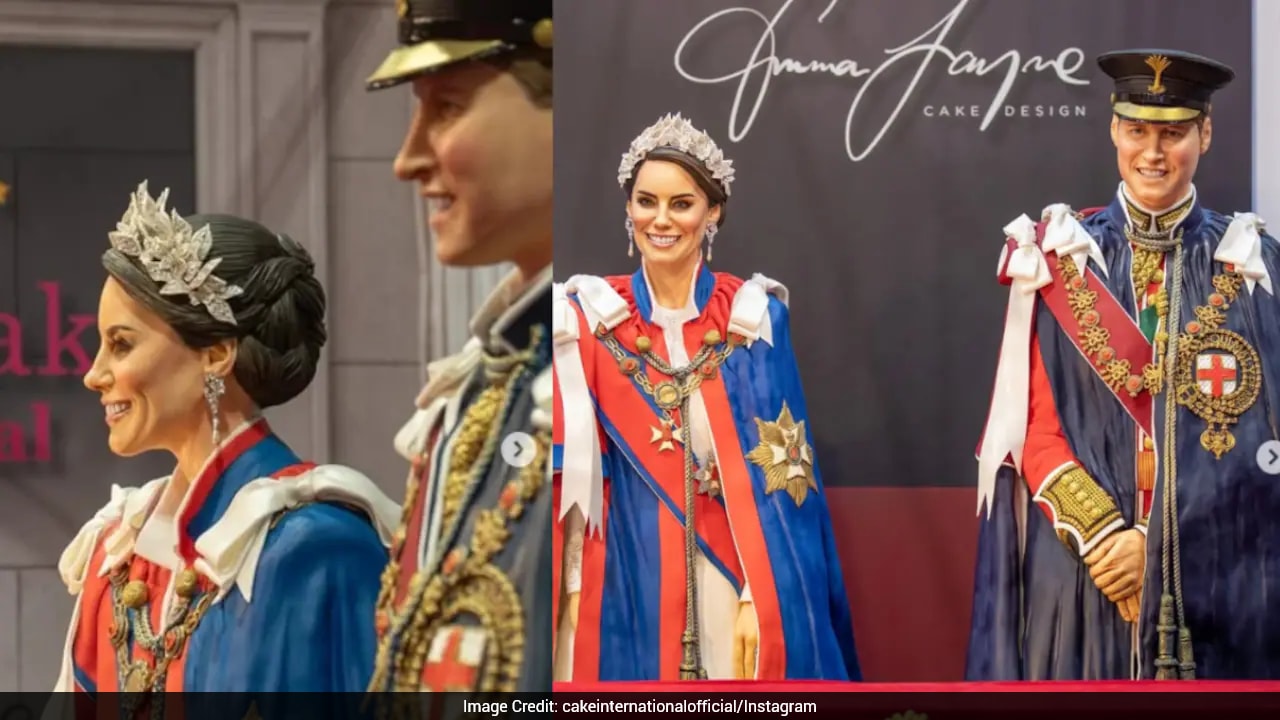
When news broke that a local sugar artist had unveiled life-sized, completely edible statues of Prince William and Kate Middleton in Birmingham, the internet reacted the way it always does to extreme baking. People scrolled past. They double-tapped. Maybe they left a comment wondering if the royal couple looked slightly uncanny, or debated which slice of the Prince of Wales they would prefer to eat first. To the casual observer, it was a quirky headline, a charming bit of novelty timed for royal watchers and cake enthusiasts. Further details on this are covered by Variety.
They missed the point entirely.
Behind those two towering, sugary figures stands a grueling, sleepless marathon of architectural engineering, psychological endurance, and sheer artistic stubbornness. When you look closely at a life-sized edible sculpture, you are not looking at a novelty dessert. You are witnessing a quiet war waged against time, humidity, and the brutal laws of structural collapse.
The Architecture of an Illusion
To understand what it takes to build a human being out of cake, imagine trying to construct a six-foot-tall skyscraper out of wet sand, knowing that the air conditioner breaking down for twenty minutes will turn your life’s work into soup.
That is the reality of large-scale sugar craft. Unlike marble, which forgives a hesitant chisel, or bronze, which holds its shape for centuries, sugar is alive to its environment. In Birmingham, where the weather can swing from crisp autumn chill to heavy, rain-soaked humidity in a single afternoon, an edible artist is essentially a meteorologist with a piping bag.
Let us step into the shoes of a hypothetical viewer walking through the exhibition hall at the National Exhibition Centre—the traditional battleground for Britain’s biggest cake shows. You round a corner, past rows of delicate sugar flowers and tiered wedding cakes, and suddenly, you stop. Standing directly in front of you are the Prince and Princess of Wales.
At first, your brain refuses to process the medium. The drape of Kate’s coat looks like heavy wool. The sheen on William’s shoes mimics polished leather. The subtle creases around their eyes, the exact set of their jaws, the individual strands of hair—none of it screams confectionery. You lean in closer, half-expecting to smell wax, the familiar, slightly sterile scent of Madame Tussauds. Instead, the air hits you with the warm, unmistakable aroma of vanilla, almond paste, and toasted sugar.
The cognitive dissonance is immediate. Your eyes tell you that you are looking at two of the most photographed people on the planet, frozen in a moment of diplomatic poise. Your nose tells you that you are standing next to a bakery.
Building that illusion requires abandoning almost everything we know about standard baking. You cannot simply stack fifty Victoria sponges on top of one another and hope for the best. If you tried, the bottom layer would pancake into dense, inedible paste within an hour, and the entire structure would pitch forward like a felled oak.
Instead, the process begins at a hardware store, not a grocery aisle.
Before a single egg is cracked, the artist has to become a welder and a carpenter. Inside the torso of a life-sized edible statue lies a skeleton of threaded steel rods, wooden dowels, and heavy-duty plywood boards. Every ounce of cake, ganache, and modeling chocolate has to be cantilevered off this internal armature. Weight distribution is everything. A human body stands on two narrow ankles—a structural nightmare for a baker. To keep Prince William from snapping at the shins, the steel frame has to bear the vertical load while hidden supports transfer the weight straight down into the base board.
Then comes the sculpting. Using dense, carved sponge cake sealed in thick layers of chocolate ganache—which acts as both mortar and structural plaster—the artist roughs out the anatomy. Too much moisture in the cake, and it sags. Too dry, and it crumbles away under the carving knife. Hours bleed into days. The studio becomes a snowy wasteland of icing sugar dust, sticky floors, and discarded prototypes of hands and ears.
Why the Human Face is a Minefield
Sculpting a giant castle or a life-sized dragon out of sugar is hard. Sculpting a recognizable human face is terrifying.
Human beings are evolutionary wired to spot the tiniest abnormalities in another person’s face. We spend our entire lives reading micro-expressions. If a cheekbone is three millimeters too low, or the space between the eyes is a fraction too wide, our brains immediately sound an alarm. Psychologists call it the uncanny valley—that eerie, uncomfortable sensation when something looks almost human, yet subtly, disturbingly wrong.
Now, try navigating the uncanny valley when your medium is modeling chocolate and sugar paste that warms up and softens simply from the heat of your own hands.
When an artist sculpts Prince William and Kate Middleton, they are working against billions of mental reference points. Everyone knows what Kate’s smile looks like. Everyone recognizes the tilt of William’s head. There is nowhere to hide a mistake. If the jawline is slightly too heavy, it does not just look like a flawed sculpture; it looks like a caricature.
Consider what happens next during those final, agonizing hours before unveiling. The artist sits inches away from a sugar face, holding a tiny ball-tool, gently pressing the corners of a mouth into place. Their own body heat radiates onto the chocolate. The studio lights beat down. Every ten minutes, they have to step back, wash their hands in ice-cold water to lower their skin temperature, and return to the canvas.
Eyes are the hardest part. Real human eyes are wet, reflective, and infinitely deep. Sugar eyes are flat and opaque. To bring life to an edible statue, the artist has to paint the irises by hand using edible food colorings diluted in clear alcohol, building up dozens of microscopic layers of blue, green, and gold, before finishing the surface with a coat of confectioner’s glaze to mimic the wet gleam of a cornea. One slip of the brush, and the royal gaze turns vacant.
And the clothing? That is an entirely different discipline. To make rolled fondant look like tailored silk or heavy tweed, the artist has to roll the paste paper-thin, drape it over the ganache body while it is still pliable, and coax natural-looking folds into the fabric before the sugar dries and cracks. It is haute couture tailoring with a deadline measured in minutes.
Birmingham and the Soul of Edible Art
There is a poetic rightness to the fact that these statues rose in Birmingham.
For centuries, this city was known as the workshop of the world. It was a place of grit, steam, brass foundries, and uncompromising craftsmanship. People here understand what it means to make things with your hands—to take raw, stubborn materials and force them into something useful or extraordinary through sheer sweat and skill.
In recent decades, Birmingham has reinvented itself, trading heavy manufacturing for culture, food, and massive international exhibitions. When the cake decorating community descends on the city each year, bringing thousands of artists from every corner of the globe, they bring that same industrial work ethic to a medium most people dismiss as frivolous.
Because let’s be honest: society tends to look down on sugar art.
We put oil painters in the Louvre and sculptors in the Tate Modern. We write academic papers about marble statues and pay millions for canvases splattered with acrylic. Yet, when an artist demonstrates the exact same mastery of anatomy, proportion, light, shadow, and texture using sugar and chocolate, we call it a novelty. We pat them on the head, snap a selfie, and ask, "Can you actually eat it?"
It is a maddening double standard. A marble sculptor knows their work will outlive them by a thousand years. A sugar artist pours three hundred hours of solitary, back-breaking labor into a masterpiece knowing full well that within a week, it will either stale, crack, or be dismantled with a bread knife.
There is a profound vulnerability in creating art that is designed to disappear. It requires a strange, Zen-like detachment. You have to care obsessively about every eyelash, every buttonhole, and every millimeter of posture, while simultaneously accepting that your creation is completely temporary.
I remember watching a sugar artist in tears outside an exhibition hall a few years ago. She had spent four months building a five-foot-tall floral installation out of gum paste—thousands of individual petals, each wired by hand and dusted with edible chalk. On the drive up the M6 motorway into Birmingham, a sudden pothole jolted her van. When she opened the back doors, half the structure had shattered into sugary confetti on the floor. She did not pack up and go home. She sat on the curb with a pot of royal icing and a hairdryer, gluing shards of sugar back together until midnight so her piece could stand on the display table the next morning.
That is the invisible stake behind every life-sized cake you see in the news. It is never just about the celebrity likeness. It is about an artist betting their sanity against the fragility of their materials.
The Royal Mirror
Of course, choosing Prince William and Kate Middleton as subjects adds another layer of cultural weight to the display.
The British royal family exists largely as a series of symbols. We see them on stamps, on coins, on commemorative tea towels, and across endless digital screens. They are public property in a visual sense—figures onto whom millions of people project their own ideas of tradition, stability, glamour, or duty.
Turning them into life-sized edible statues strips away the untouchable aura of monarchy and brings them squarely down to earth. There is something inherently democratic, even slightly mischievous, about rendering the future King and Queen in sponge cake and fondant. It takes two figures who spend their lives surrounded by strict protocol and security cordons, and places them at eye level in a public hall where ordinary people can walk right up, inspect the stitching on their lapels, and marvel at the sheer absurdity of the feat.
People crowd around these statues in Birmingham not because they are obsessed with the monarchy, though many are, and not merely because they love cake, though almost everyone does. They gather because human beings are endlessly fascinated by the boundary between reality and illusion.
We love being fooled by craftsmanship. We love standing in front of an object, knowing intellectually that it is made of flour, butter, and sugar, while our senses insist that we are sharing a room with living, breathing people. It reminds us of what human hands are capable of when patience meets obsession.
After the Applause Fades
The cameras eventually pack up. The crowds filter out of the exhibition hall, heading back to train stations and motorways, scrolling through the photos on their phones. The fluorescent lights in the venue dim.
Left behind in the quiet hall, the two sugar royals keep standing.
They do not blink. They do not shift their weight from one tired foot to the other. Slowly, invisibly, the battle against physics continues in the dark. Moisture in the night air settles onto the fondant. Microscopic cracks begin to form along the seams of a tailored coat. The chocolate ganache beneath the surface gently settles onto the steel frame below.
For a few fleeting days, against every law of structural engineering and common sense, sugar held the shape of royalty. Then, like all great performances, it takes its bow, crumbles, and leaves behind nothing but the memory of how completely it fooled us.