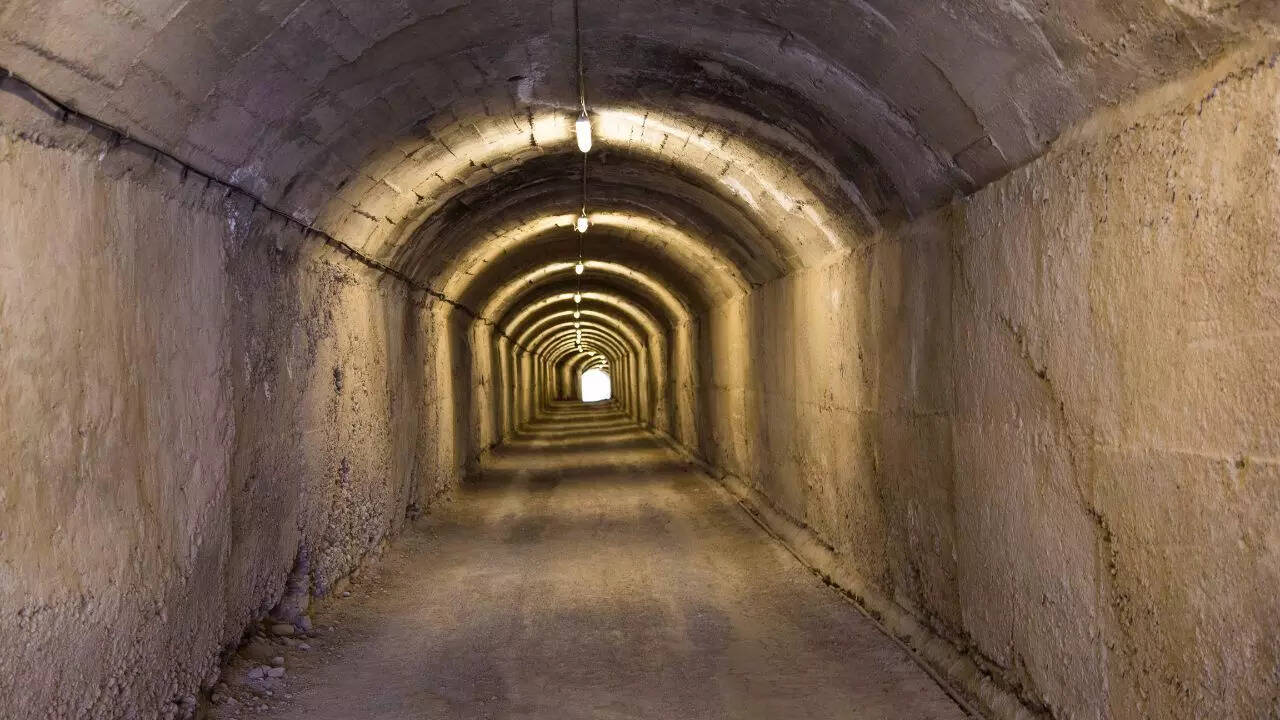
Switzerland is the only country on earth capable of sheltering its entire population behind reinforced concrete and steel at a moment’s notice. This isn't a result of recent geopolitical jitters or a sudden influx of wealth. It is the product of a decades-long, obsessive engineering project driven by a unique legal mandate that requires a protected spot for every single citizen. While other nations dismantled their Cold War relics, the Swiss doubled down, creating a subterranean shadow nation that remains fully operational today.
The scale is staggering. There are over 360,000 private and public shelters scattered across the Alpine landscape. From the outside, the country looks like a postcard of neutrality and calm. Beneath the surface, it is a hardened shell designed to survive a direct nuclear strike. This infrastructure was born from a 1963 law passed during the height of the Cuban Missile Crisis, decreeing that every inhabitant must have a place in a shelter near their home.
The Law of Survival
Most nations view civil defense as a suggestion. In Switzerland, it is a structural requirement. If you build a house in Zurich or a chalet in St. Moritz, you are legally obligated to include a fallout shelter or pay a substantial tax to secure a spot in a communal one. This isn't just a basement with extra canned goods. These are regulated bunkers with thick armored doors, ventilation systems equipped with gas filters, and independent radio links.
The Federal Office for Civil Protection (FOCP) oversees this massive inventory. They don't just track the number of doors; they mandate regular inspections. If a vent is rusted or a seal is cracked, the homeowner gets a bill for the repairs. It is a massive, decentralized bureaucracy of survival. The state essentially offloaded the cost of national defense onto the private citizen, making the "bunker tax" a standard part of Swiss life.
Engineering the Alpine Redoubt
The philosophy behind this goes back to the Réduit national, the Swiss military strategy during World War II. The plan was never to win a border war against a superpower. Instead, the Swiss military intended to retreat into the Alps, turn the mountains into a honeycomb of cannons and barracks, and make an invasion so costly that no aggressor would bother.
This mentality shifted from the military to the civilian sector in the 1960s. The focus moved from hiding soldiers to protecting the workforce. The crown jewel of this effort is the Sonnenberg Tunnel in Lucerne. Until its partial decommissioning, it was the largest civilian nuclear shelter in the world. In less than 24 hours, this massive motorway tunnel could be sealed by four 350-ton concrete doors, transforming it into a subterranean city for 20,000 people.
Inside, the logistics were a nightmare of efficiency. It contained a hospital, a radio station, and a command center. However, the reality of living in such a space is grim. Test runs revealed that the psychological toll of cramming thousands of people into a concrete tube with limited air and no privacy would likely cause a breakdown in social order long before the radiation cleared.
The Hidden Economic Burden
Maintaining a second, underground version of a country is expensive. Critics argue that the billions of francs poured into concrete and ventilation filters could be better spent on healthcare or climate resilience. The Swiss taxpayer pays for this security twice: once when they build their home, and again through federal taxes that fund the maintenance of massive public bunkers.
There is also the matter of space. In a country where buildable land is at a premium, the requirement to dig deep adds significant costs to every construction project. Architects often find their designs constrained by the need to integrate a blast-proof box into the foundation. It is a hidden tax on the Swiss lifestyle that most residents simply accept as the price of their celebrated neutrality.
Neutrality Through Strength
The world often mistakes Swiss neutrality for passivity. It is actually a heavily armed, deeply paranoid stance. The bunkers are a physical manifestation of the "Armed Neutrality" doctrine. By proving that the population can survive an attack, the Swiss remove the incentive for an enemy to use weapons of mass destruction against them. It is a passive-aggressive form of deterrence.
The Modern Pivot
As the memory of the Cold War faded in the early 2000s, there was a movement to scrap the shelter requirement. The government considered it an expensive relic. Then came the 2011 Fukushima disaster and renewed tensions in Eastern Europe. The mood shifted instantly. The Swiss government reaffirmed the "one person, one spot" rule, proving that the fortress mentality is baked into the national DNA.
Today, these bunkers are being repurposed for the 21st century. Some have become high-security data centers for global banks, leveraging the same blast protection meant for humans to protect servers. Others have been converted into "null-star" hotels, where guests pay to sleep on military cots in windowless rooms for the novelty of the experience.
The Psychological Fortress
Living on top of a bunker changes a person's perspective on the world. There is a quiet, underlying readiness in Swiss society. While the rest of the world debates the "what if" of a global catastrophe, the Swiss have already checked the seals on their ventilation fans. This preparedness creates a unique form of social cohesion. Everyone knows where they will go if the sirens wail.
However, this readiness also breeds a certain insularity. When your entire national strategy is based on retreating into a hole in the ground, you tend to view the outside world as a source of threats rather than opportunities. The bunkers are more than just architecture; they are a mindset that prioritizes self-preservation above all else.
The Reality of Modern Warfare
Questions remain about whether these 1960s-era designs can withstand modern weaponry. Hypersonic missiles and advanced bunker-busters change the math of survival. A shelter designed to withstand a Hiroshima-sized blast may crumble under the pressure of modern thermobaric warheads. The FOCP continues to update its guidelines, but the race between concrete and explosives is one the concrete rarely wins.
Despite this, the Swiss continue to dig. They are currently upgrading the filters in thousands of communal shelters to account for newer chemical and biological threats. It is a never-ending cycle of fortification.
The Great Underground Conversion
The most fascinating aspect of this infrastructure is its invisibility. You can walk through a pristine Swiss village and never realize that beneath the manicured lawns lies enough steel to rebuild a city. The vents are disguised as garden ornaments; the heavy blast doors are hidden behind wood paneling in suburban garages.
This duality defines the nation. Switzerland presents a face of luxury watches, chocolate, and diplomatic peace, while sitting atop a massive, ready-to-use war machine. It is a country that has effectively hedged its bets against the end of the world.
Check your own basement. If you live in a Swiss apartment building, look for the heavy steel door with the massive lever. That isn't just a storage unit. It is your assigned seat for the apocalypse, maintained by law and paid for by decades of quiet, focused paranoia. If you haven't checked the expiration date on the emergency rations stored behind those doors, you are already behind the Swiss curve.
Go to the basement and inspect the ventilation crank manually to ensure the gears haven't seized since the last federal audit.