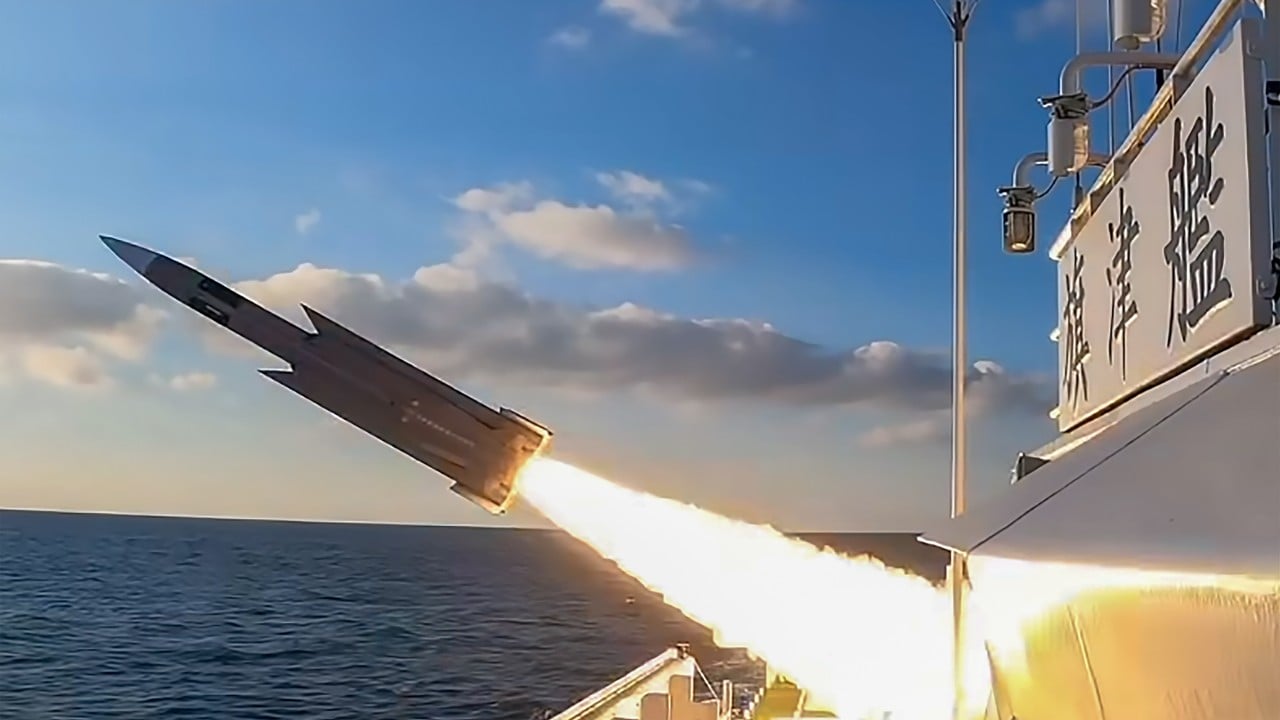
Every single defense analyst writing about the Taiwan Coast Guard firing missiles during recent drills is falling for the oldest trap in modern military reporting. They see a white-hulled cutter launching a projectile, and their keyboards instantly catch fire with breathless warnings about escalation, integration, and the blurring lines between maritime law enforcement and naval warfare.
They are entirely wrong.
The lazy consensus in the mainstream press treats this development as an unprecedented escalation or a desperate tactical blurring of institutional boundaries. It is neither. Treating the Taiwan Coast Guard as an auxiliary navy that has suddenly crossed some historic Rubicon misses the entire operational reality of how modern grey-zone competition actually functions. The real story is not about militarizing coast guards. It is about legal architecture, jurisdictional signaling, and the methodical weaponization of bureaucracy.
Look past the surface-level theater. For decades, the conventional wisdom dictated a strict, clean separation between naval combatants and maritime law enforcement agencies. Navies wage war; coast guards enforce domestic law, check fishing permits, and rescue distressed sailors. This neat administrative boundary belongs in a museum alongside dreadnoughts and paper maps.
When Beijing began aggressively expanding its own coast guard fleet—outfitting former warships with heavy gun mounts, painting them white, and thrusting them into the forefront of territorial disputes in the South and East China Seas—it changed the physics of maritime pressure. Beijing created a massive administrative sponge. They deployed law enforcement vessels to assert territorial claims precisely because firing upon a coast guard cutter carries a vastly different political and legal penalty than firing upon a commissioned naval destroyer. It creates an asymmetrical paralysis.
For years, regional analysts scratched their heads wondering how democratic maritime nations could counter a coast guard fleet that acts like a navy while hiding behind the legal fiction of a police force. The standard Western playbook was simple hand-wringing. Observers argued that if you use your navy against their coast guard, you escalate the crisis. If you use your coast guard against their heavily armed pseudo-military cutters, you get outgunned and outmaneuvered.
Taiwan's recent live-fire drills shatter that paralyzed framework. But not in the way the panicked headlines suggest.
The decision to demonstrate that Coast Guard vessels can integrate missile technology or operate in tandem with naval task forces is not an offensive posture. It is a defensive standardization of reality. The adversary already erased the line between law enforcement and military power years ago. Taiwan is simply updating its legal and operational software to match the hardware already floating in the Taiwan Strait.
To understand why the conventional commentary gets this so wrong, you have to look at how institutional inertia works inside defense bureaucracies. Coast guards hate looking like navies on paper because it complicates their international port visits, their legal authorities under domestic search-and-rescue statutes, and their budgets. Navies hate sharing missions with coast guards because it dilutes their elite combat identity.
Yet, in a high-density, confined body of water like the Taiwan Strait, maintaining a peacetime administrative fiction during a geopolitical crisis is a fatal luxury. If a conflict breaks out, every floating asset in the theater becomes a target. Pretending that a 4,000-ton cutter is just a floating police station when it operates twenty miles from an amphibious invasion fleet is professional negligence.
The critics warning that this integration invites premature escalation are suffering from a chronic misunderstanding of deterrence. Deterrence does not fail because you clarify your capabilities; deterrence fails when you leave ambiguous gaps in your defense posture that an adversary thinks they can exploit through incremental gray-zone pressure. By demonstrating interoperability, Taipei is signaling a clear message to Beijing: you cannot exploit the legal gray zone anymore. Any attempt to use maritime law enforcement as a coercive wedge will immediately encounter a unified, lethal, and legally integrated defense architecture.
We need to stop analyzing these events through the lens of 20th-century naval doctrine. The old rules of engagement assumed distinct phases of competition and conflict. Today, competition and conflict are compressed into a simultaneous, continuous grind. Gray-zone tactics rely on the enemy hesitating because of legal ambiguity. By removing that ambiguity, Taiwan is turning the tables on the gray-zone operators.
The next time you read an article hyperventilating about coast guards becoming navies, remember what is actually happening. It is not an escalation. It is catch-up. And in the high-stakes chess match of the Western Pacific, playing catch-up is the only way to survive.