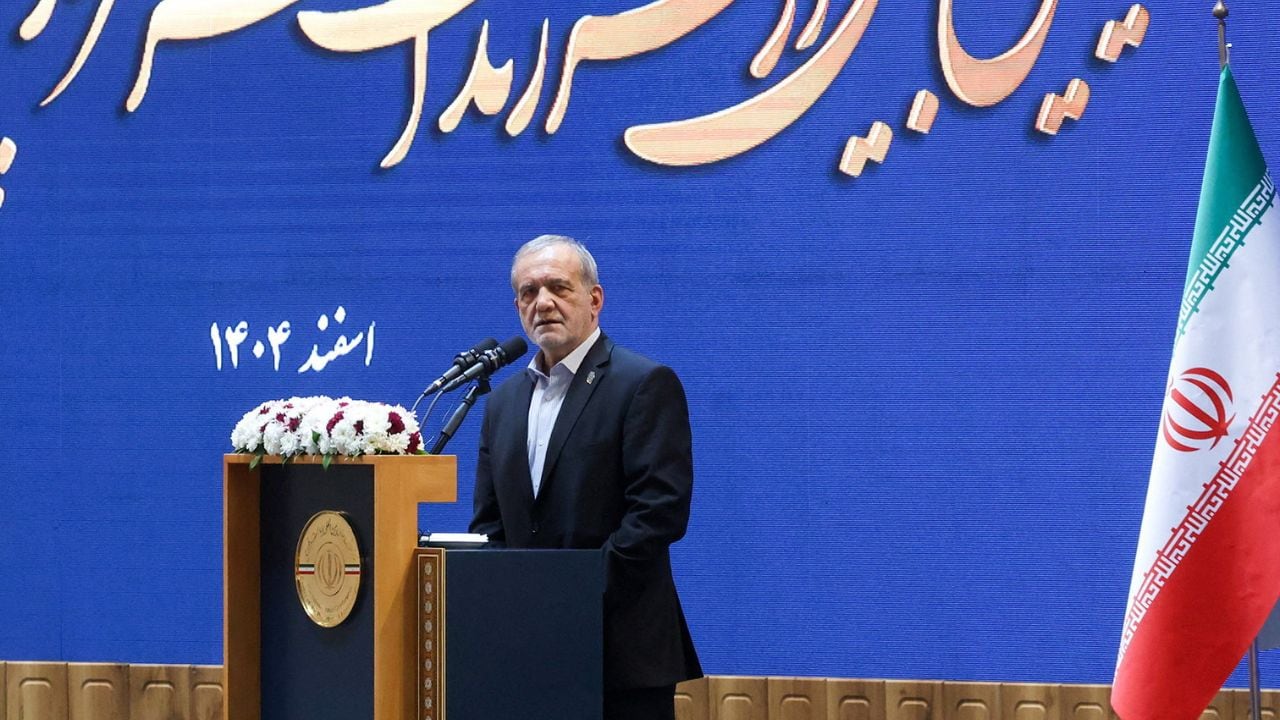
The internal gears of the Iranian state have shifted from cautious diplomacy to a hardline posture of inevitable confrontation. When President Masoud Pezeshkian stood before the microphones to declare that avenging the death of Supreme Leader Ali Khamenei is a "legitimate duty and right," he wasn't just recycling revolutionary rhetoric. He was signaling the collapse of the reformist bridge he was elected to build. This statement marks a fundamental break in the geopolitical calculus of the Middle East, moving the region out of a shadow war and into the territory of open, high-stakes state conflict.
For decades, Tehran operated through a doctrine of strategic patience. They used proxies to bleed opponents while keeping the Iranian heartland insulated from direct strikes. That era is over. By framing the assassination of the Supreme Leader as a violation of national sovereignty that demands a direct response, Pezeshkian has boxed himself into a corner where inaction would be seen as a terminal weakness. The "duty" he describes is not just moral; it is a survival mechanism for a regime that cannot afford to lose its aura of internal invincibility. You might also find this connected article insightful: Strategic Asymmetry and the Kinetic Deconstruction of Iranian Integrated Air Defense.
The Shattered Red Line
Assassinating a head of state or a supreme religious authority is the ultimate escalation. In the grim arithmetic of international relations, this isn't just another tactical strike. It is a decapitation of the national identity. When the Supreme Leader—a figure who holds absolute power over the military, the judiciary, and the media—is removed from the board, the state’s response cannot be measured in simple military tit-for-tat.
Pezeshkian’s rhetoric reflects an internal consensus within the Supreme National Security Council. The debate in Tehran is no longer about if they should strike, but how to do so without triggering a full-scale invasion that could topple the government. They are looking for a Goldilocks zone of violence: enough to satisfy a furious domestic base and the Revolutionary Guard (IRGC), but calibrated to avoid a nuclear-backed response from the West or its regional allies. As highlighted in latest coverage by Al Jazeera, the implications are widespread.
The problem is that this "middle path" of retaliation no longer exists. The intelligence failures that allowed such a high-profile assassination to occur suggest that the Iranian security apparatus is compromised at the highest levels. To avenge the leader, they must first purge their own ranks, a process that usually leads to paranoia and erratic decision-making.
A President Under Siege
Masoud Pezeshkian was supposed to be the man who talked to the West. His election was a signal—or so we were told—that Iran wanted to renegotiate the nuclear deal and ease the crushing weight of economic sanctions. Now, he finds himself acting as the chief mourner and the primary advocate for a potentially catastrophic war.
This transition from a "moderate" to a "war president" happened in a heartbeat. It reveals a brutal truth about the Iranian presidency: the office is a tool of the clerical establishment, not a check on it. By adopting the language of the IRGC, Pezeshkian is attempting to insulate himself from accusations of being "soft" or "treacherous." If he fails to deliver a "crushing blow," his presidency will be effectively over, and the hardliners will move to consolidate power with a ferocity we haven’t seen since 1979.
The rhetoric of "legitimate right" is also a legalistic play. Tehran is attempting to build a case at the United Nations and among the BRICS nations that any upcoming military action is an act of self-defense under Article 51 of the UN Charter. They are framing their future missiles as tools of justice, not aggression.
The Proxy Paradox
For years, Iran’s strength lay in its "Axis of Resistance." From Hezbollah in Lebanon to the Houthis in Yemen, Tehran had a remote control for regional instability. But the death of the Supreme Leader changes the relationship between the patron and the clients.
- Hezbollah is currently bogged down in its own survival struggle, facing intense aerial bombardment and internal political pressure.
- The Houthis are effective at disrupting trade but lack the precision to deliver the kind of symbolic "justice" Tehran requires.
- Iraqi Militias provide a proximity advantage but lack the sophisticated hardware to pierce advanced missile defense shields.
Tehran knows that delegating this "duty" to a proxy would be seen as a coward's move. To truly "avenge" Khamenei, the missiles must bear the Iranian flag. This requirement for direct attribution is what makes the current situation more dangerous than the 2020 response to the killing of Qasem Soleimani. Back then, the response was a telegraphed strike on an empty airbase. This time, the stakes are the very legitimacy of the Islamic Republic’s theological foundation.
Economic Suicide or Existential Necessity
The Iranian economy is a tinderbox. Inflation is rampant, the rial is in a tailspin, and the youth population is largely disillusioned with the aging clerics. A major war would likely be the final nail in the coffin for the Iranian middle class. Yet, the regime appears willing to gamble everything.
Why? Because they believe the alternative—total irrelevance—is worse. If they do not respond to the killing of their highest authority, they signal to every dissident group inside Iran that the state is a paper tiger. The fear of an internal uprising is perhaps the strongest driver of their external aggression. They need a foreign enemy to justify the inevitable crackdown on domestic dissent that follows any period of instability.
The "right to avenge" is therefore a domestic policy disguised as a foreign one. It is a call for national unity under the banner of grief and rage.
The Intelligence Black Hole
The most overlooked factor in this crisis is the depth of the security breach. To kill a figure as protected as the Supreme Leader requires months, if not years, of high-level infiltration. The "how" behind the killing suggests that the IRGC is riddled with informants or that its technical capabilities have been completely bypassed.
Before Iran can launch a credible military strike, it must address the fact that its "secure" communications are likely being monitored in real-time. Any plan for retaliation discussed in the halls of power is probably on a desk in Washington or Tel Aviv within minutes. This creates a massive tactical disadvantage. If Tehran launches a predictable strike, it will be intercepted, making them look weak. If they attempt something truly novel, they risk a miscalculation that ends in the total destruction of their nuclear and energy infrastructure.
Tactical Realities of the Promised Retaliation
What does a "legitimate" strike look like in the eyes of the Iranian military? We are likely looking at a multi-domain operation. It won't just be a swarm of Shahed drones or a volley of ballistic missiles. Expect a heavy emphasis on:
- Cyber Warfare: Targeting civilian infrastructure in the West to prove they can touch the "untouchable" from a distance.
- Maritime Interdiction: A complete or partial shutdown of the Strait of Hormuz, forcing the global economy to pay the price for the assassination.
- High-Value Targeting: An attempt to mirror the assassination by targeting a high-ranking Western or regional official of equivalent stature.
The third option is the most volatile. It moves the world into a cycle of assassinations that has no clear exit ramp.
The Global Chessboard
Russia and China are watching this with calculated detachment. For Moscow, a major conflict in the Middle East is a welcome distraction that drains Western resources away from the Ukrainian front. For Beijing, it is a nightmare that threatens the energy supplies necessary for its industrial engine.
Pezeshkian’s claim of a "right" to avenge puts these allies in a difficult position. They cannot openly condemn Iran's right to defend its leaders without undermining their own sovereignty arguments. However, they are not coming to Tehran's rescue. Iran is essentially alone in its "duty." This isolation usually breeds one of two things: a desperate retreat or a suicidal charge. Given the rhetoric coming out of the President’s office, the latter is looking increasingly probable.
The world is waiting for the other shoe to drop. But in Tehran, the leadership isn't just looking for a shoe; they are looking for a way to burn the entire floor. The "legitimate duty" Pezeshkian speaks of is a commitment to a path that has no winners, only survivors.
Watch the movement of the IRGC's mobile missile launchers in the coming nights. Their positioning will tell you more about Iran's "duty" than any press conference ever could. When the silence finally breaks, it will be with the sound of a regime trying to prove it still exists.
Check the readiness levels of regional missile defense batteries immediately; the window for a diplomatic off-ramp has effectively slammed shut.