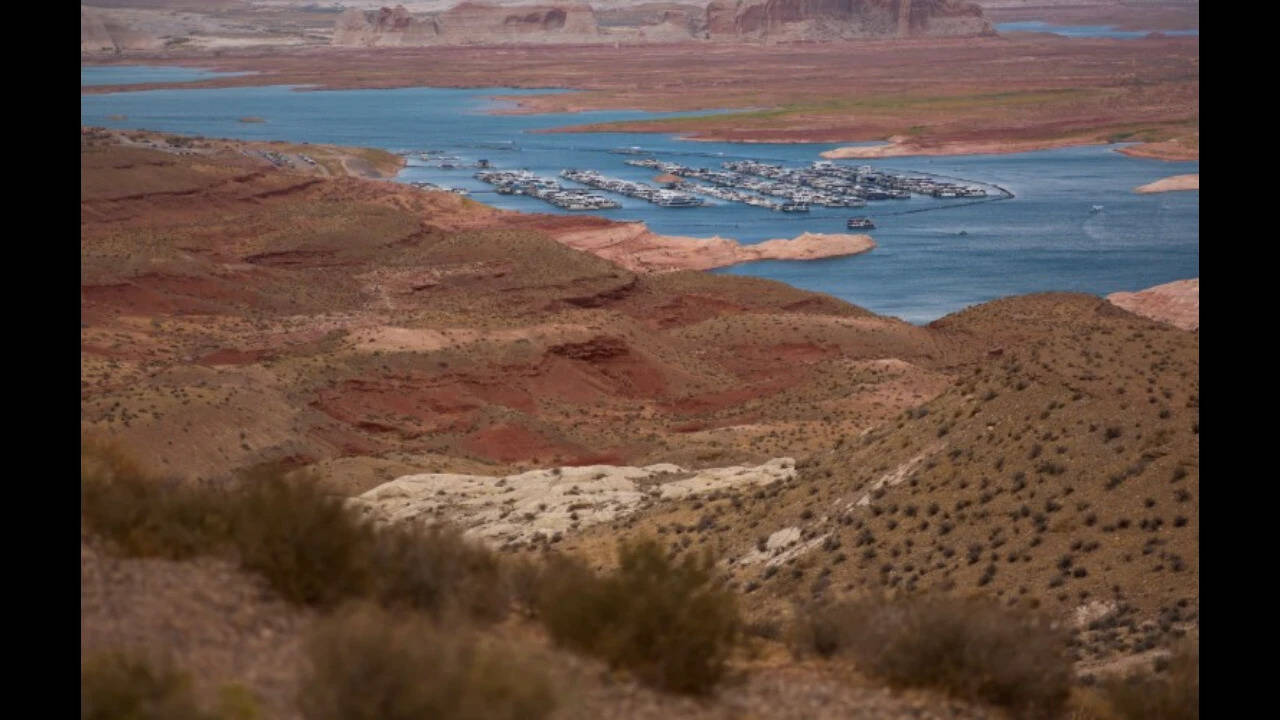
The Colorado River basin is currently gasping for air. As of August 2026, Lake Powell has reached a historic nadir, hovering precariously above the threshold required for its turbines to spin. This is not merely a seasonal fluctuation or an unfortunate dry spell. It is the visible expiration of a century-old water management strategy that was built on a foundation of mathematical fiction and hubris.
Federal agencies and state leaders are frantically deploying stopgap measures to keep the reservoir above its “minimum power pool” of 3,490 feet. By draining upstream assets like the Flaming Gorge Reservoir, authorities hope to buy time. Yet, these maneuvers are little more than shifting deck chairs on a sinking vessel. The fundamental truth remains: the river system is currently asked to deliver more water than it produces, and that imbalance has finally shattered the infrastructure meant to contain it.
The Illusion of Control
For decades, the Bureau of Reclamation and the seven states sharing the Colorado River have functioned under a convenient delusion. The 1922 Colorado River Compact, which divided water allocations between the Upper and Lower Basins, was signed during a decade of uncommonly high precipitation. Even at the time, hydrologists and skeptical observers noted the estimates were overly optimistic. A century later, the climate has shifted toward a hotter, drier state. The annual flows of the river have dropped roughly 20 percent compared to twentieth-century averages, yet the legal entitlements to that water have remained largely static.
When water levels drop, the instinctive response from regional leadership is to prioritize preservation of existing infrastructure. Utah Governor Spencer Cox has been vocal about the need to maintain Lake Powell, insisting that now is not the time to abandon the reservoir. This position is politically understandable. Millions of people, from agricultural giants in California to urban centers in Arizona, rely on the power and storage provided by Glen Canyon Dam. However, this commitment to the status quo ignores the reality of “deadpool” scenarios, where water levels fall so low that the dam can no longer move water through its standard outlets.
The Cost of Propping Up a Ghost
The current strategy for Lake Powell relies on inter-basin transfers. By forcing water out of the Flaming Gorge Reservoir in Wyoming and Utah, managers are sacrificing the stability of smaller, localized ecosystems to pad the statistics of the larger reservoir. This is an expensive game of musical chairs.
Imagine a family facing a permanent, long-term reduction in their income. Instead of downsizing their home or changing their spending habits, they decide to pay the mortgage by liquidating their retirement savings and selling off their furniture piece by piece. Eventually, the furniture is gone. The savings account is empty. The problem remains, but now the family has fewer options to address it.
That is exactly where the basin states find themselves. The act of drawing down upstream reservoirs to keep Powell at operational levels leaves the entire regional grid more brittle. It depletes the emergency reserves that might be needed if next year’s winter snowpack—already at historic lows in 2026—fails again. It is a high-stakes gamble against the climate, and the house is currently winning.
A Fractured Political Landscape
The desperation in the basin is further fueled by the expiration of current operating guidelines at the end of 2026. Negotiations for what comes next have been characterized by gridlock and finger-pointing. Lower Basin states, facing the brunt of the necessary cuts, have signaled a refusal to accept the burden alone. Meanwhile, Upper Basin representatives argue that their consumption is already dictated by the natural variability of the river, suggesting that they have less room to cut than the downstream giants.
This tension is likely to move from negotiating rooms into federal courts. If the states cannot arrive at a binding agreement that reconciles human demand with the physical limitations of the watershed, the federal government will be forced to impose a solution. Historically, whenever the federal government is forced to step in and unilaterally distribute shortages, the result has been years of litigation and lingering resentment.
The most dangerous aspect of this crisis is the refusal to accept that the era of abundance has ended. Politicians speak of “stabilization” and “flexibility,” terms that imply a return to normal once this particular drought cycle passes. But this is not a cycle. It is a transformation. The aridification of the West is a long-term trend, one exacerbated by rising temperatures that turn potential runoff into vapor before it ever reaches the reservoir.
The Breaking Point
The technical threshold of 3,490 feet is a wall. If the water drops below that point, the Glen Canyon Dam ceases to be a functional partner in the West’s water and power delivery. The consequences would include structural stress on the dam’s outlet works, the loss of massive amounts of carbon-free hydropower, and a chaotic scramble for alternative power and water sources.
Rather than doubling down on the effort to maintain arbitrary elevation targets, the focus must shift to demand-side management that mirrors the reality of a shrinking river. This means retiring inefficient agricultural practices, incentivizing the permanent removal of non-functional turf in urban areas, and acknowledging that some current water rights are, in practice, impossible to fulfill.
The water will continue to flow into the canyons, but it will never again support the scale of ambition that dictated the twentieth-century growth of the American West. The dams were designed for a river that no longer exists. The sooner the policy reflects that, the less catastrophic the eventual reconciliation with nature will be. The water is gone. It is time to stop pretending it is coming back.