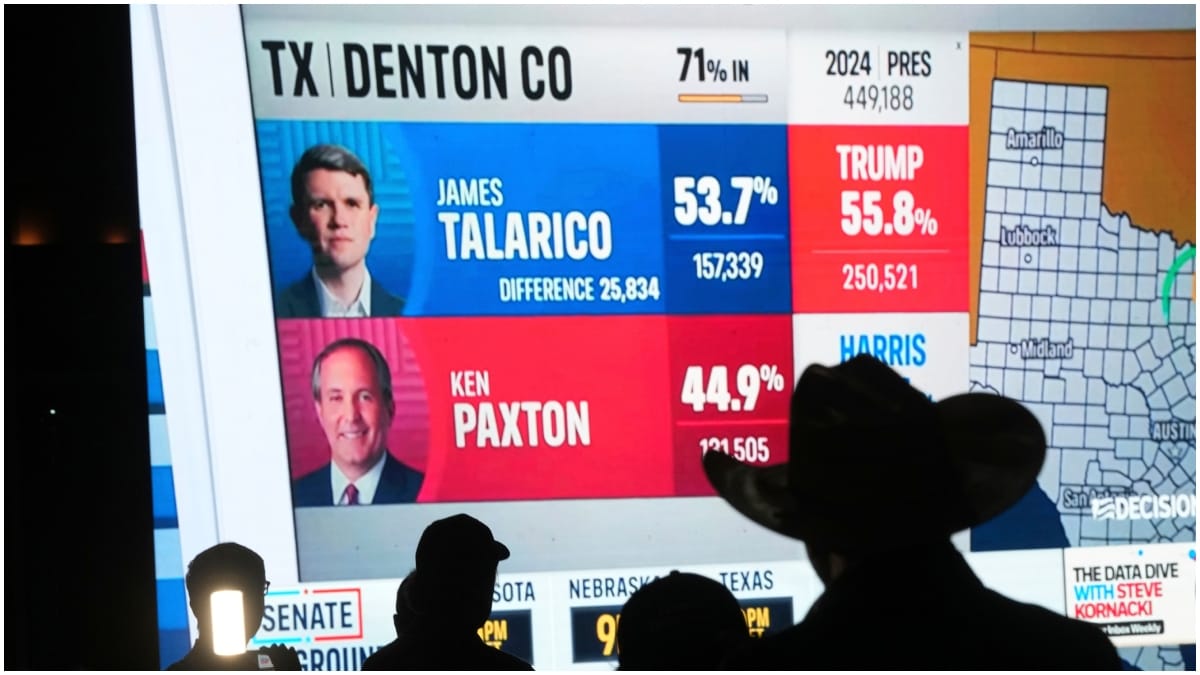
No, Texas hasn't turned blue. Not even close.
If you looked at the headlines after Democrat James Talarico defeated Republican Ken Paxton in the 2026 Texas Senate race, you probably saw pundits losing their minds. They're calling it a seismic shift. They're dusting off the old "Blexas" talking points that have burned national Democrats for twenty years.
They're wrong.
What happened in November 2026 wasn't an ideological conversion of the Lone Star State. It was a perfect storm of an exceptionally flawed Republican nominee colliding with a uniquely disciplined, faith-forward Democrat who knew exactly how to neutralize GOP attack ads. Understanding the difference between a candidate-specific collapse and a structural realignment matters if you want to make sense of American politics heading into 2028.
Why Ken Paxton Lost a Race Republicans Usually Win Easily
Let's be honest about who Ken Paxton is. Before he ever stepped onto the general election stage in 2026, the former Texas Attorney General carried more political baggage than a cross-country freight train.
You don't survive an impeachment trial in the Texas House, years of securities fraud indictments, a whistleblower settlement that cost taxpayers millions, and bitter public feuds with members of your own party without leaving bruises. In a GOP primary—especially after Paxton knocked off incumbent Senator John Cornyn by leaning hard into populist grievances—that baggage acts like armor. Primary voters love a fighter.
General election voters? Not so much.
In suburban counties like Collin, Denton, Tarrant, and Williamson, college-educated conservatives who reliably vote Republican for governor, comptroller, and state legislature simply couldn't stomach pulling the lever for Paxton. I've spent years watching Texas precinct-level data, and the pattern here is unmistakable. Ticket-splitting isn't dead when one candidate triggers a visceral character veto.
Thousands of Texans voted straight Republican down the ballot and either left the Senate line blank or crossed over for Talarico. Paxton didn't lose because Texas suddenly embraced progressive tax policy or strict gun control. He lost because swing voters in the Dallas-Fort Worth metroplex and the Austin-San Antonio corridor decided he was too corrupt to represent them in Washington.
Who Is James Talarico and How Did He Pull This Off
If you haven't been paying close attention to the Texas House of Representatives over the last few terms, James Talarico might seem like he came out of nowhere. He didn't.
A former middle school public school teacher from Round Rock and a Presbyterian seminarian, Talarico built a massive digital footprint long before launching his Senate bid. While other Democrats were writing dry press releases, he was cutting sharp, viral clips from House committee hearings—grilling officials on school vouchers, public education funding, and Christian nationalism.
The Faith Factor That Broke the GOP Playbook
Here's where Talarico completely outmaneuvered the Republican machine. Standard GOP strategy in Texas relies on painting any statewide Democrat as a coastal, secular radical who hates religion and wants to dismantle traditional values.
That attack bounces right off a guy who quotes Matthew 25 on the House floor and actually studies theology at Austin Presbyterian Theological Seminary.
Talarico didn't run away from Christianity. He reclaimed it. He argued relentlessly that public education funding, healthcare access, and living wages are moral imperatives rooted in scripture. When Republican PACs tried to brand him as an anti-family extremist, suburban churchgoers in places like Katy and Frisco didn't buy it. He sounded like their youth pastor, not a San Francisco activist.
Focusing on Kitchen-Table Economics Over Culture Wars
Watch how Talarico campaigned in rural and exurban counties where Democrats usually get crushed by forty points. He didn't show up to lecture voters on social issues. He talked about property taxes, failing rural hospitals, teacher pay, and the Texas power grid.
He also refused to play defense on border security, acknowledging real strain on border communities while attacking Paxton for using border chaos as a fundraising prop rather than fixing broken systems. By cutting Paxton's margins in rural Texas from catastrophic to merely bad—losing counties by 25 points instead of 40—Talarico created the math he needed to win statewide through massive turnout in Harris, Dallas, Travis, and Bexar counties.
The Hard Numbers Behind the 2026 Texas Election Map
To see why "Texas is blue now" is a bad take, you have to look at the rest of the 2026 ballot.
While Talarico was edging out Paxton, Republicans still dominated statewide races across Texas. Conservative judicial candidates won comfortably. Republican congressional incumbents in competitive districts largely held their seats, and the GOP maintained firm control over the Texas Legislature.
Look at the historical context of Texas statewide races over the past decade:
- 2018 Senate Race: Beto O'Rourke came within 2.6 percentage points of unseating Ted Cruz in a massive blue-wave midterm year, fueled by sky-high enthusiasm and Cruz's polarizing reputation.
- 2020 Presidential Race: Donald Trump carried Texas by 5.6 points, proving that 2018 was largely about Cruz rather than a permanent shift.
- 2022 Gubernatorial Race: Greg Abbott crushed O'Rourke by nearly 11 points, winning back huge chunks of Hispanic voters in the Rio Grande Valley.
- 2024 Presidential Race: Trump widened his Texas margin again, reaffirming that the state's baseline lean remains solidly right-of-center.
Talarico's victory fits squarely into the 2018 pattern—except he had an even weaker opponent than Ted Cruz and ran a much more disciplined, message-focused campaign than Beto O'Rourke did. In 2018, O'Rourke alienated moderate Texans with high-profile stances on guns and cultural flashpoints. Talarico avoided every single one of those traps.
What Happened in South Texas and the Suburbs
Two geographic shifts made the difference in 2026, and neither of them proves Texas has flipped permanently.
First, look at the Texas Triangle—the massive urban and suburban mega-region anchored by Dallas-Fort Worth, Houston, Austin, and San Antonio. Roughly three-quarters of Texans live inside this triangle. Growth here isn't slowing down, and the new arrivals aren't uniformly conservative. More importantly, longtime suburban Republicans in places like Fort Bend County and Williamson County have grown increasingly exhausted by hard-right primary politics. Paxton was the ultimate symbol of that exhaustion.
Second, look at the Rio Grande Valley. Democrats have been bleeding Hispanic support in Starr, Hidalgo, and Cameron counties since 2020. Talarico didn't magically restore 2012 Obama-era margins in South Texas—economic conservatism and border concerns are still very real there. What he did was stop the bleeding. By centering working-class economics, public schools, and Catholic-adjacent social justice themes, he clawed back just enough ground in South Texas to keep Paxton from running up the score.
What National Democrats Usually Get Wrong About Texas
Every time a Texas Democrat overperforms, national donors and Beltway consultants draw the exact wrong lesson. They assume Texas is just one more voter-registration drive away from turning into California or Illinois.
That mindset is poison for Texas Democrats.
Texas has a distinct political culture built on skepticism of federal overreach, fierce pride in local identity, and deep religious roots. When national party figures parachute into Austin and try to run a generic coastal campaign, Texans reject it immediately. Talarico won because he ran a Texas campaign. He understood that you can't shame Texas voters into changing their minds—you have to meet them inside their own moral framework and show them how your policies protect their families and communities.
If national Democrats take Talarico's win as a green light to push maximalist progressive messaging in Texas in 2028, they will get steamrolled by 8 to 10 points again.
What This Actually Means for 2028 and Beyond
So if Texas isn't blue, what is it?
Texas is a competitive red state with a massive candidate-quality sensitivity.
That's a huge distinction. For decades, having an "R" next to your name on a Texas statewide ballot was a guaranteed ticket to victory, regardless of scandals, indictments, or extreme rhetoric. Ken Paxton's defeat proves that era is over. Demographic growth in the suburbs has narrowed the Republican margin for error to roughly four or five points.
When Texas Republicans nominate a mainstream, business-friendly conservative—someone like a traditional governor or a disciplined policy-focused leader—they will still win Texas comfortably. The state's underlying voter registration, economic conservatism, and rural turnout base still favor the GOP.
When Texas Republicans nominate an indicted, scandal-plagued hardliner through a low-turnout primary, they are now actively putting statewide seats in play.
For voters, strategists, and political observers watching what happens next, stop looking at top-line national partisan labels in Texas and start watching three concrete indicators instead:
- GOP Primary Dynamics: Watch whether Texas Republicans course-correct toward electable general-election candidates in 2028 or double down on ideological purity tests that alienate suburban moderates.
- Suburban Split-Ticket Rates: Track the gap between the top of the ticket and down-ballot races in Collin, Denton, Tarrant, and Montgomery counties—that gap tells you whether voters are rejecting a party or just rejecting a person.
- Democratic Candidate Recruitment: Pay attention to whether Texas Democrats recruit more local, culturally fluent pragmatists like Talarico rather than media-driven national fundraising stars.
James Talarico pulled off one of the biggest political upsets in modern Texas history by running a near-flawless campaign against a uniquely damaged opponent. Calling Texas a blue state misses the whole point—it's still red, just no longer forgiving.


