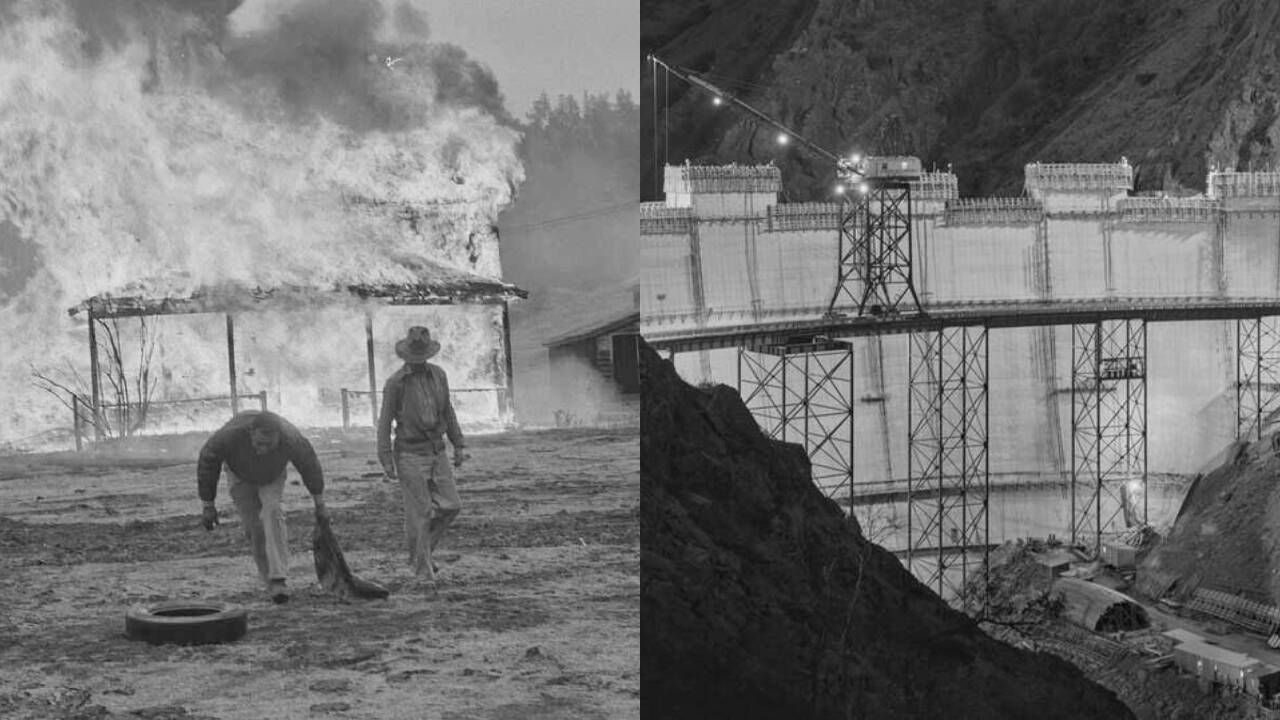
The water does not remember the bakeries. It does not remember the hitching posts, the slow-spoken arguments on the courthouse steps, or the deep, sweet smell of summer dust kicking up behind a Model A. It only weighs down.
Sixty feet beneath the glittering emerald surface of Lake Berryessa, the town of Monticello is still there.
If you dive down deep enough, past the thermocline where the water turns cold and heavy as a vault door, the ghost of a place remains. Chimneys still stand like broken teeth. Paved orchards stretch out into the silt where pears once ripened in the fierce Northern California sun. Street grids, plotted with absolute human confidence in the 1860s, lie covered in layers of fine, undisturbed mud.
Progress has a body count. We just prefer to bury it underwater.
To understand why a thriving community of hundreds was fed to the bottom of a man-made reservoir in 1956, you have to look at the relentless thirst of a state that refused to stay small. The post-war California boom was roaring. Tract homes were sprouting across the dry valleys like kudzu. Agriculture was scaling into an industrial beast. The valley north of San Francisco needed water, and the Putah Creek, wild and seasonal, was an untapped vein waiting to be drained.
Enter the Solano Project.
The Bureau of Reclamation didn't whisper when they came for Monticello. They measured. They mapped. They calculated cubic feet and acre-feet, reducing generations of family history into columns of arithmetic. The Berryessa Valley, cradled by the Vaca Mountains, was a textbook geological bowl. Plug the southern end with concrete, and the whole fertile valley would fill up like a bathtub.
There is a strange, hollow violence in watching your hometown get turned into a statistic.
Imagine standing on your front porch in the spring of 1956. You built this porch. Your grandfather planted the oaks lining the dirt road. The morning paper has arrived, smelling of ink and damp paper, but the headlines are all about your eviction. appraisers have already walked through your kitchen, tapping the baseboards, assigning a dollar value to the place where your children took their first steps.
The state offered money. The state always offers money, because money is the only thing the state understands as an equivalent for a soul. But you cannot spend a reimbursement check on a memory. You cannot plant a new orchard in a checkbook.
By the time the final residents packed their belongings and drove out of the valley for the last time, the grief was already hardening into folklore. Some families watched from the surrounding ridges as the heavy machinery moved in. They saw the orchards bulldozed. Not because the trees would rot underwater—plenty of timber was left behind, an eerie, drowned forest that would snag the lines of future fishermen—but simply to clear the way for the basin.
Then came the Monticello Dam.
The concrete poured. The gates closed. Putah Creek stopped flowing downstream and began backing up, pooling, swelling, reaching hungrily for the doorframes and church steeples. It took months for the valley to completely disappear. Day by day, the water crept higher, swallowing the fence posts, creeping up the trunks of the valley oaks, until only the top of the schoolhouse roof broke the surface. Then, silence.
Today, Lake Berryessa is known as a recreational playground. Speedboats carve white scars across the surface on hot July afternoons. Jet skis whine. Campers pitch tents along the arid shores, grilling burgers and drinking cold beer, oblivious to the fact that they are partying on top of a graveyard of a community.
Except for the glory hole.
Every few years, when the winter rains swell the lake past its limits, a massive concrete funnel swallows the excess water. Officially known as the Morning Glory Spillway, this colossal drain drops water straight down a vertical shaft 28 feet wide, roaring into a tunnel that exits on the other side of the dam. Standing at the edge of that gaping maw, watching millions of gallons of water violently churn and plunge into the concrete dark, it is impossible not to feel a shiver. It looks like a portal to another world.
In a way, it is. It is the drainpipe of a drowned world.
Diving Lake Berryessa is not for the faint of heart. The visibility can be abysmal, dropping to a few feet in the summer silt. Flashlights cut feeble yellow cones through the green gloom. Divers who have explored the submerged ruins report an unsettling stillness. The wooden structures have largely rotted away, leaving behind concrete foundations, rusted farm implements, and the faint, haunting outlines of old property lines.
It feels wrong to be down there. An intrusion into a private sorrow.
We treat our landscape like a whiteboard, erasing whatever was written yesterday to make room for today’s urgent scribble. We pave over creeks. We level hills. We drown towns so that cities eighty miles away can water their lawns and fill their swimming pools.
The people of Monticello are mostly gone now, taking their firsthand memories of the Berryessa Valley with them into old age. Their children and grandchildren carry the shorthand of the loss—stories told around holiday tables about a place that exists only on faded sepia postcards and in the cold depths of a federal reservoir.
Next time you stand on the shore of a glittering man-made lake, skip a stone across the glassy surface. Watch the ripples spread, concentric rings fading into nothing.
Remember what lies beneath the splash.
-copy.jpeg?width=1200&auto=webp&trim=17%2C192%2C547%2C1)

