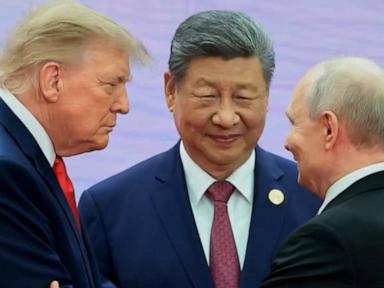
Great-power diplomacy rarely produces breakthroughs in open session; instead, a trilateral summit among Donald Trump, Xi Jinping, and Vladimir Putin functions as a live stress test of global deterrence, trade routing, and institutional legitimacy. When Washington, Beijing, and Moscow convene at a single table, the primary output is not the televised handshake or the initial communique, but the recalibration of bilateral leverage among three asymmetric actors. Standard media coverage treats the opening of such a meeting as a theatrical spectacle—focusing on body language, seating arrangements, and surface-level pleasantries. That framing misses the structural mechanics driving the room. Each leader enters the negotiation with a distinct utility function, a specific set of domestic constraints, and an acute awareness that any two parties can implicitly align to extract concessions from the third.
To understand what actually happens when the doors close on a Trump-Xi-Putin summit, analysts must strip away diplomatic rhetoric and examine the underlying game theory. In international relations, a three-player negotiation differs fundamentally from bilateral diplomacy because it introduces coalition dynamics. In a two-player game, concessions are zero-sum or mutually beneficial along a single axis. In a three-player game, the dominant strategy for every participant is to prevent the other two from forming a blocking coalition while maximizing individual extraction.
The Structural Asymmetry of the Three Delegations
A rigorous breakdown of the summit requires defining the precise operational objectives and vulnerabilities of each state. Treating the three powers as equivalent peers obscures the reality that each leader is managing a different macroeconomic and security portfolio.
Washington's Transactional Bilateralism
Donald Trump's diplomatic doctrine rejects multilateral institutionalism in favor of direct, leader-to-leader transactionalism. According to analyses of U.S. foreign policy doctrine by institutions such as the Council on Foreign Relations and the Brookings Institution, this approach treats alliances, tariffs, and security guarantees as variable inputs rather than fixed commitments. At a trilateral table, Washington's primary instruments of leverage are access to the U.S. consumer market, control over dollar-denominated financial clearing systems, and the deployment posture of American military assets in Europe and the Indo-Pacific.
The strategic objective for the United States in a combined meeting is to decouple the Moscow-Beijing alignment. By engaging Putin directly on European security architecture and energy markets, Washington attempts to reduce Russia's structural dependence on Chinese capital and industrial goods. Simultaneously, by confronting Xi on bilateral trade deficits, intellectual property enforcement, and supply chain localization, the U.S. delegation seeks to isolate Beijing economically while signaling to Moscow that alternative diplomatic off-ramps exist. The primary constraint on Washington is domestic political polarization and the institutional friction within the U.S. national security apparatus, which limits how rapidly executive promises can be converted into durable statutory or treaty commitments.
Beijing's Systemic Hedging and Status Quo Preservation
Xi Jinping approaches a trilateral summit from the position of an export-driven manufacturing superpower navigating domestic structural headwinds, including demographic contraction and real estate deleveraging. As documented by researchers at the Center for Strategic and International Studies (CSIS) and Chatham House, Beijing's overarching priority is regime stability and the preservation of an external environment conducive to technological self-reliance and trade continuity.
In this three-way configuration, China acts as the systemic balancer. Beijing benefits from friction between Washington and Moscow because U.S. strategic bandwidth diverted to Eastern Europe or energy sanctions reduces the concentration of American military and economic pressure in the Western Pacific. However, China cannot afford a total collapse of Western consumer demand or secondary sanctions that sever Chinese banks from global financial networks. Consequently, Xi's operational goal at the table is to prevent a U.S.-Russian rapprochement that would leave China isolated against a unified Western front, while simultaneously restraining Putin from actions that trigger severe economic retaliation against Chinese entities. Beijing leverages its position as Russia's primary economic lifeline and the world's indispensable industrial supply hub to enforce a disciplined, cautious tempo on the proceedings.
Moscow's Asymmetric Disruption and Security Revisionism
Vladimir Putin enters the room with an economy heavily oriented toward state-directed defense production and commodity exports, operating under extensive Western sanctions. Security analysts at organizations like the Carnegie Endowment for International Peace and the Royal United Services Institute (RUSI) emphasize that Moscow's core objective is the formal recognition of a sphere of influence along its periphery and the erosion of U.S.-led security architectures, specifically NATO's forward posture.
Lacking the consumer market size of the United States or the industrial manufacturing scale of China, Russia relies on asymmetric leverage: strategic nuclear parity, regional military escalation dominance, and control over critical raw materials, including hydrocarbons, enriched uranium, and fertilizers. At a trilateral summit, Putin's primary tactical aim is to trade de-escalation in contested theaters for sanctions relief, territorial recognition, and institutional parity. By sitting as an equal alongside the leaders of the world's two largest economies, Putin achieves an immediate symbolic victory—demonstrating to domestic audiences and the Global South that diplomatic isolation has failed. His vulnerability lies in the growing asymmetry of his relationship with Beijing; prolonged reliance on Chinese markets and dual-use technology risks reducing Russia to a junior economic partner unless Moscow can reopen diplomatic and commercial channels with Washington.
The Three-Body Problem of Great-Power Diplomacy
When these three utility functions collide in a single room, the negotiation transforms into what international relations theorists call a strategic triangle—a framework formalized by political scientist Lowell Dittmer. The stability of any agreement reached during the summit depends entirely on which of the three potential configurations emerges from the closed-door sessions.
- The Romantic Triangle (Pivot Dynamics): One actor maintains positive, functional relations with both of the other two, while the remaining two remain locked in hostility. In this scenario, the pivot player extracts maximum concessions from both sides because each rival fears the pivot will align with its adversary. Washington historically occupied this position during the 1970s following the Sino-Soviet split. At a contemporary summit, both Trump and Xi compete to occupy the pivot seat—Trump by dangling sanctions relief to Moscow while pressuring Beijing, and Xi by positioning China as the indispensable mediator between Washington and Moscow.
- The Marriage (Two-Against-One Coalition): Two actors form a tight alignment against the third. Over the past several years, the "no-limits" partnership between Beijing and Moscow approximated this structure, forcing Washington to expend resources across two theaters simultaneously. Trump's willingness to convene a trilateral meeting is a direct attempt to fracture this coalition by introducing bilateral incentives that appeal to Russian national interests independently of Chinese preferences.
- The Unit Veto (Mutual Deterrence): All three actors remain mutually suspicious, preventing any two from forming a durable pact. In a unit-veto configuration, the summit yields minimal concrete agreements, serving instead as a mechanism for crisis management and communication deconfliction.
The televised opening of the summit provides zero visibility into which configuration is taking hold, because public posture is designed to obscure private bargaining positions. The real indicators of the summit's trajectory lie in the technical working groups operating parallel to the leaders' plenary session.
Four Operational Variables Determining the Outcome
To evaluate whether the meeting produces substantive geopolitical shifts or merely theatrical posturing, observers must track four measurable variables rather than diplomatic rhetoric.
1. Sanctions Architecture and Financial Clearing Mechanisms
The most immediate test of U.S.-Russian-Chinese bargaining is the treatment of secondary sanctions and cross-border payment rails. Russia's exclusion from SWIFT and restrictions on dollar clearing have forced Moscow and Beijing to conduct bilateral trade predominantly in yuan and rubles, while exploring alternative settlement mechanisms through BRICS frameworks. If Washington seeks concessions from Moscow on European security or energy production, the specific currency of exchange is targeted relief from Treasury Department sanctions—such as unfreezing sovereign assets, lifting restrictions on Russian financial institutions, or easing technology export controls. Conversely, if Washington maintains or tightens secondary sanctions on Chinese financial institutions facilitating Russian defense procurement, it signals that the U.S. delegation is prioritizing containment over triangulation.
2. Energy Flows and Global Commodity Pricing
Energy represents the clearest intersection of domestic economic priorities for all three leaders. Trump's domestic platform prioritizes lower energy costs to combat inflation and stimulate industrial output, alongside expanding U.S. liquefied natural gas (LNG) exports. Putin relies on hydrocarbon revenues to fund state expenditures and maintain fiscal stability. Xi requires cheap, secure, and diversified energy imports to power China's manufacturing sector without vulnerability to maritime chokepoints like the Strait of Malacca.
A substantive outcome from the summit would involve tacit or explicit coordination on global oil and gas supply. For example, Washington could tolerate the reintegration of specific Russian energy flows into global markets—suppressing crude prices globally—in exchange for Moscow moderating its alignment with OPEC+ production cuts or altering its posture in regional conflicts. Such a move would lower input costs for both American consumers and Chinese factories, creating a rare zone of overlapping economic interest while testing the cohesion of Western sanctions regimes.
3. Force Posture and Arms Control Frameworks
With the expiration and suspension of legacy bilateral treaties such as the Intermediate-Range Nuclear Forces (INF) Treaty and New START, strategic nuclear stability has entered an unregulated phase. China's rapid expansion of its nuclear warhead stockpile, as documented in annual Pentagon reports, has rendered traditional U.S.-Russian bilateral arms control obsolete from Washington's perspective.
A trilateral summit creates the institutional venue to address three-way strategic stability. The core friction point is asymmetry: Washington demands that Beijing enter formal transparency and warhead limitation frameworks, while Beijing argues that its arsenal remains significantly smaller than those of the U.S. and Russia, insisting that Washington and Moscow must first make deeper reductions. Simultaneously, Putin links any strategic nuclear dialogue to conventional force deployments in Europe and missile defense architectures. Progress on this variable is measured not by immediate disarmament treaties, which require years of technical verification, but by the establishment of military-to-military crisis hotlines, missile launch notification protocols, and working groups on artificial intelligence in command-and-control systems.
4. Tariff Regimes and Supply Chain Bifurcation
The bilateral economic friction between the United States and China operates on a structural timeline that outlasts individual summits. Washington's imposition of broad tariffs, export controls on advanced semiconductors, and restrictions on outbound investment are designed to prevent Beijing from achieving dominance in foundational technologies. Beijing responds with targeted export restrictions on critical minerals—such as gallium, germanium, and rare earth processing—alongside regulatory scrutiny of U.S. firms operating in China.
In a trilateral setting, trade negotiations rarely yield comprehensive structural reform because China's state-subsidized industrial model is central to the Chinese Communist Party's governance strategy. Instead, any movement on this front manifests as tactical stabilization: calibrated tariff suspensions, expanded agricultural and energy purchase commitments by Beijing, or licensing exemptions for non-sensitive dual-use technologies. Putin has minimal direct leverage over U.S.-China trade terms, except insofar as Russian raw materials provide Beijing with non-Western supply alternatives that blunt the impact of American export controls.
Structural Limitations and Execution Risks
Even if the three leaders reach broad conceptual understandings during their private sessions, translating executive agreements into durable state policy faces severe structural friction.
First, credibility and time-inconsistency problems plague trilateral diplomacy. In the United States, executive orders and tariff adjustments can be reversed by subsequent administrations, whereas major treaties require a two-thirds majority in the U.S. Senate—a high threshold in a polarized legislative environment. Both Xi and Putin discount long-term American commitments that lack statutory backing, leading them to demand front-loaded concessions rather than promises of future cooperation.
Second, alliance and partner backlash constrains each leader's room for maneuver. Washington cannot unilaterally trade away European security architectures or Indo-Pacific deterrence commitments without triggering severe crises of confidence among NATO allies, Japan, South Korea, and Taiwan. If allies perceive that Washington is cutting a grand bargain with Moscow and Beijing over their heads, they may accelerate independent nuclear hedging or pursue separate accommodations with Beijing, eroding the very alliance network that gives the United States its global force projection capability. Similarly, Moscow must manage the expectations of regional partners such as Iran and North Korea, which have supplied Russia with critical munitions and technology and would view a sudden U.S.-Russian thaw as a strategic betrayal.
Third, verification deficits limit the scope of enforceable agreements. High-level diplomatic frameworks frequently collapse during the implementation phase when technical teams attempt to define compliance metrics. Whether monitoring end-use restrictions on dual-use microelectronics, verifying nuclear warhead dismantlement, or enforcing intellectual property protections, the absence of intrusive, mutually trusted inspection regimes ensures that all three states will continue to hedge against defection.
Strategic Forecast and Analytical Indicators
Observers assessing the aftermath of the Trump-Xi-Putin meeting should ignore joint statements emphasizing "constructive dialogue," "mutual respect," or "shared commitment to global stability." Those phrases are standard diplomatic placeholders used to mask unresolved deadlocks.
Instead, track three concrete downstream indicators over the 90 days following the summit to determine which actor successfully shifted the strategic triangle in its favor:
- Treasury Department OFAC Licensing Directives: Watch for quiet issuances of general licenses or targeted delistings affecting Russian energy, banking, or agricultural entities. Any relaxation of enforcement without corresponding legislative action indicates an executive-level tacit understanding between Washington and Moscow.
- People's Bank of China Currency and Reserve Adjustments: Monitor shifts in yuan-ruble settlement volumes and Chinese Treasury holdings. An acceleration in non-dollar bilateral trade mechanisms signals that Beijing and Moscow are hardening their insulation against U.S. financial leverage despite the summit's optics.
- Defense Department and Theater Command Deployment Schedules: Track changes in the tempo of Freedom of Navigation Operations (FONOPs) in the South China Sea, joint U.S.-allied military exercises in Eastern Europe and the Western Pacific, and strategic bomber rotations. A measurable reduction in operational tempo indicates a mutual de-escalation agreement; an unchanged or accelerated schedule confirms that the summit functioned strictly as a communication channel while underlying deterrence competition continues unabated.
The fundamental reality of a trilateral summit among Washington, Beijing, and Moscow is that structural rivalry cannot be eliminated through personal chemistry. The meeting operates as an auction of leverage where each leader tests the cohesion of the opposing dyad. Until concrete shifts appear in sanctions enforcement, tariff schedules, and military force posture, the opening handshake remains an exercise in strategic signaling rather than a realignment of the international order.


