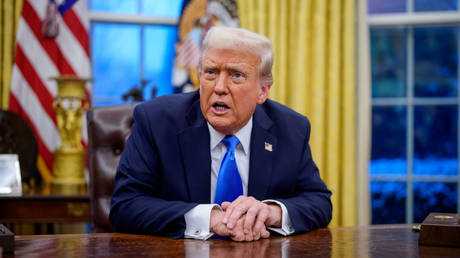
Public rhetoric dismissing foreign military assistance to Tehran conflates formal state-to-state defense pacts with deniable commercial, dual-use, and technical networks. To understand whether Moscow and Beijing are aiding Iran, analysts must separate three distinct layers: direct sovereign intervention, dual-use industrial supply chains, and energy-market bargaining. Treating public denials by political leaders as a complete empirical verdict misses how modern procurement bypasses formal attribution while still altering battlefield endurance.
Deconstructing the Competitor's Logic
Standard news coverage of presidential pushback against aid allegations typically follows a linear sequence: a public figure dismisses critics, a brief nod is given to prior intelligence caveats or sanctions, and recent diplomatic or energy talks are cited as context. That structure treats the dispute as a clash of personalities or political spin rather than a contest over verification and leverage.
Three analytical gaps weaken that surface narrative:
- Binary framing of "aid": Treating assistance as either full-scale state backing or zero involvement ignores low-signature transfers, commercial brokers, and technical advisory work that operate below the threshold of a formal policy shift.
- Conflating detection capability with policy intent: Asserting that Washington would quickly spot covert support assumes that visibility automatically translates into public disclosure or immediate enforcement, even when intelligence officials withhold details to protect sources and methods.
- Treating energy deals as proof of non-involvement: Bilateral energy negotiations or sanction relief on fuel exports can coexist with continued private or semi-official procurement channels.
Known Facts Versus Educated Hypotheses
Separating verified reporting from analytical inference prevents overclaiming on either side of the debate.
Known facts establish friction between public dismissals and enforcement actions. Public statements rejecting claims of Russian or Chinese help to Iran have coincided with U.S. Treasury sanctions targeting entities in China, Hong Kong, Russia, and elsewhere accused of supporting Iranian weapons procurement or logistics networks. Media reporting has also pointed to Chinese entities supplying dual-use electronics, components relevant to missiles and drones, or commercial satellite imagery, alongside reporting on Russian technical specialists engaging with Iranian missile work. At the same time, senior defense and military officials have cited classified limits when asked to detail the scope of foreign enablement, and Beijing has denied providing military aid. Parallel diplomatic and energy tracks—including discussions over refined fuel, sanction waivers on Russian diesel exports, and high-level summits—have run alongside these enforcement measures.
Educated hypotheses address what cannot yet be proven from open sources. One plausible hypothesis is that state leaders tolerate or under-police gray-zone commercial networks when doing so costs little diplomatically, while keeping high-visibility state commitments constrained to preserve bargaining room with Washington. A second hypothesis is that Tehran's ability to replenish stockpiles from pre-existing reserves still faces bottlenecks in specialized tooling and microelectronics, making even fragmented external inputs disproportionately valuable at the margin. A third hypothesis is that leaders framing aid claims as exaggerated are managing domestic and allied expectations during sensitive negotiations rather than declaring the supply chain closed.
The Three Pillars of External Enablement
When evaluating external support to a sanctioned military-industrial base, analysts should examine three operational pillars rather than relying on broad labels.
1. Dual-Use Hardware and Precision Inputs
Modern missile, drone, and command systems rely heavily on commercial-off-the-shelf electronics, sensors, machining tools, and propulsion precursors. Because these items have civilian applications, export control enforcement faces a high false-positive burden and relies on shell companies, transshipment hubs, and modified invoices. Even when a supplier is not a state arsenal, steady access to precision components relieves assembly bottlenecks once domestic stockpiles thin out.
2. Technical Advisory and Information Inputs
Physical hardware is only one constraint; system integration, targeting data, and engineering troubleshooting often limit output just as severely. Commercial imagery or specialist advice carries lower visible tonnage than heavy weapons shipments while offering high operational utility. From an analytical standpoint, information and advisory inputs are harder to interdict at customs checkpoints than physical cargo.
3. Financial and Logistical Routing
Procurement networks depend on payment rails, freight forwarders, aviation or maritime cover, and jurisdiction shopping. When authorities sanction specific firms or front companies, resilient networks replace nodes faster than regulators can map them, shifting registration across jurisdictions or routing goods through third countries.
The Cost Function of Sanctioning and Interdicting Networks
Why do policymakers frequently sound ambivalent when discussing foreign enablement? Because every enforcement action carries a cost function across economic, diplomatic, and intelligence dimensions.
The first cost is market and energy feedback. Tightening pressure on suppliers or energy exporters can spill into global fuel prices, refining margins, or shipping lanes, creating domestic political headwinds for the enforcing government. When energy stability is a priority, policymakers face a trade-off between maximum supply-chain disruption and short-term price containment.
The second cost is diplomatic linkage across theaters. Confronting Beijing or Moscow sharply over secondary procurement can complicate parallel negotiations on trade, regional security, or crisis management. Leaders often weigh whether public escalation on one file jeopardizes leverage on another.
The third cost is source exposure. Publicly detailing how specific transfers were detected can alert procurement networks to compromised communication channels or monitoring methods, prompting adversaries to adapt their tradecraft.
Cause-and-Effect Chains Standard Coverage Misses
Surface reporting often treats diplomatic reassurance and covert procurement as mutually exclusive, overlooking second-order effects that shape strategic stability.
Consider how sanctions evasion adapts to pressure. When enforcement targets named firms, intermediaries reorganize into smaller entities and lengthen supply chains. That adaptation raises transaction costs for the buyer, yet it also slows down attribution for investigators, creating a lag between procurement activity and public designations.
Consider also the link between rearmament pace and escalation risk. If external components and technical know-how allow a sanctioned actor to rebuild missile or drone stocks faster than expected after a truce or clash, deterrence calculations shift. Faster replenishment lowers the perceived cost of renewed launches and raises the risk of a wider cycle of strikes and retaliation.
Finally, consider the mismatch between leader rhetoric and bureaucratic enforcement. A chief executive may publicly downplay external aid to project confidence or protect talks, while treasury, commerce, and intelligence agencies continue tracking and sanctioning illicit networks behind the scenes. Reading public statements alone without tracking enforcement actions produces an incomplete picture of actual policy.
Tactical Framework for Evaluating Aid Claims
To assess any new report or official denial on this topic without getting pulled into partisan noise, apply a five-step verification sequence:
- Identify the specific capability: Separate vague claims of "help" from concrete items such as inertial navigation parts, airframe composites, fuel additives, or imagery.
- Trace the legal status of the actor: Distinguish between a formal defense ministry transfer, a state-linked enterprise, and a private broker operating in a gray zone.
- Check corroborating enforcement: Look for aligned actions—such as entity designations, export warnings, or maritime/aviation restrictions—that indicate sustained institutional concern rather than an isolated rumor.
- Assess bottleneck impact: Ask whether the item in question unlocks a stalled production line or merely substitutes for a more expensive alternative.
- Account for negotiation timing: Note whether statements occur right before or after summits, ceasefires, or energy agreements where signaling carries tactical value.
Limitations of This Analytical Approach
No analytical framework eliminates uncertainty in counter-proliferation and sanctions tracking. Open-source reporting lags classified intelligence, and intelligence assessments themselves are probabilistic rather than omniscient. Furthermore, dual-use goods can reach an end user through multiple legitimate-looking intermediaries, making final intent difficult to prove to a legal standard. Analysts should therefore treat conclusions about the scale of foreign assistance as bounded ranges rather than exact figures.
Strategic Recommendation
Decision-makers and analysts should anchor policy and risk assessments on supply-chain choke points rather than public rhetoric, pairing targeted financial and export-control enforcement against dual-use brokers with clear diplomatic red lines on high-end missile and drone technologies—while recognizing that energy-market trade-offs will periodically constrain how aggressively those levers are pulled.
Trump Questions Claims Of Russian And Chinese Aid To Iran
This video provides direct coverage of President Trump's public remarks questioning claims of Russian and Chinese assistance to Iran, offering useful context alongside the structural supply-chain analysis above.