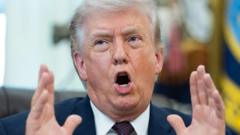
If you think Donald Trump's latest threats to abandon NATO are just more of the same campaign trail bluster, you're missing the shift in the room. This isn't 2016 or even 2020. It's April 2026, and the "paper tiger" comment he dropped recently to British reporters wasn't just an insult—it was a diagnostic report on an alliance that's currently fracturing under the weight of a war in the Middle East that half the members didn't sign up for.
The core of the issue is simple: Trump feels the U.S. was "there for them" in Ukraine, but when he asked for help securing the Strait of Hormuz against Iran, Europe blinked. Now, he's explicitly stating that U.S. withdrawal is "beyond reconsideration." That’s a massive escalation from his previous "pay your bills" rhetoric.
The Spending Trap and the 5 Percent Target
For years, the magic number was 2%. Trump spent his first term obsessed with it. Ironically, he won that battle. According to the NATO 2025 Annual Report released by Secretary General Mark Rutte, every single one of the 32 member nations finally hit the 2% GDP spending target last year. Even perennial laggards like Belgium, Spain, and Italy are now paying their share.
But here’s the kicker: as soon as they hit 2%, the goalposts moved. At the Hague Summit, the alliance committed to a staggering 5% of GDP target by 2035. Trump's argument is that even with more money, the alliance lacks "will." He’s effectively calling their bluff. If everyone is spending more but nobody wants to fight where the U.S. says the fight is, what is the point of the alliance in his eyes?
Article 5 is No Longer a Guarantee
The most dangerous part of the current rhetoric involves Article 5—the "attack on one is an attack on all" clause. It's the bedrock of Western security. Trump’s recent comments suggest he views it as a conditional contract rather than a sacred vow. By calling NATO a "paper tiger," he's signaling to adversaries like Vladimir Putin that the U.S. might just sit the next one out if the victim hasn't been "friendly" enough.
Think about what that does to a country like Estonia or Poland. They've done everything right—they spend way over the 2% minimum, they’ve hosted U.S. troops, and they’ve been the loudest voices against Russian aggression. But in Trump’s new transactional framework, their safety is tied to how much Keir Starmer in the U.K. or Emmanuel Macron in France supports U.S. operations against Iran. It's a "collective punishment" model for diplomacy.
The Greenland Grudge and the Tariff War
You can't talk about NATO in 2026 without mentioning the bizarre but very real tension over Greenland. Trump’s renewed interest in acquiring the territory—and the subsequent snub from Denmark and other allies—has morphed into a trade war. We’re currently seeing a 15% tariff on most EU imports and 10% on U.K. goods.
This isn't just about fish or aluminum. It’s a message: if you don't play ball on territory and military support, the U.S. will treat you like a competitor instead of a partner. This "America First" mercantilism is eroding the trust that takes decades to build. When the U.S. President calls the British Prime Minister's navy "too old" and mocks their aircraft carriers, the diplomatic glue is basically gone.
What a U.S. Exit Actually Looks Like
If the U.S. pulls out, NATO doesn't just get smaller; it effectively ceases to be a global power projection tool. The U.S. provides the vast majority of the "heavy lift" capabilities:
- Satellite intelligence and high-altitude surveillance.
- Strategic airlift (moving tanks and troops across continents).
- The nuclear umbrella that deters large-scale strikes.
- Advanced missile defense systems.
Europe is currently scrambling to build a "European Pillar" of defense. You've got German and French lawmakers calling for joint EU military drills and independent command structures. But honestly, they're years—maybe decades—away from being able to defend the continent without the U.S. backbone. They’re basically trying to build a fire department while the house is already smoldering.
How to Prepare for the Post NATO Era
The era of assuming the U.S. will always be there is over, regardless of who wins the next election. The "reliability gap" is now a permanent feature of transatlantic relations.
- Watch the Strait of Hormuz: If European nations continue to refuse naval support there, expect Trump to ramp up the "withdrawal" rhetoric even further. This is the current litmus test for alliance loyalty.
- Monitor the 5% Target: Look for which countries actually start putting the 5% goal into their national budgets. If they don't, it'll give Trump more ammunition to claim they're "freeloading" on a new level.
- Diversify your exposure: If you're in business, stop assuming "Western stability" is a given. The tariff wars between the U.S. and EU are likely to get worse before they get better.
The alliance is currently at its highest level of funding and its lowest level of trust. That’s a volatile mix. Trump isn't just complaining about money anymore; he's questioning the very utility of the partnership. If the "paper tiger" doesn't find a way to show its teeth in a way the U.S. respects, the U.S. might just walk away from the cage entirely.