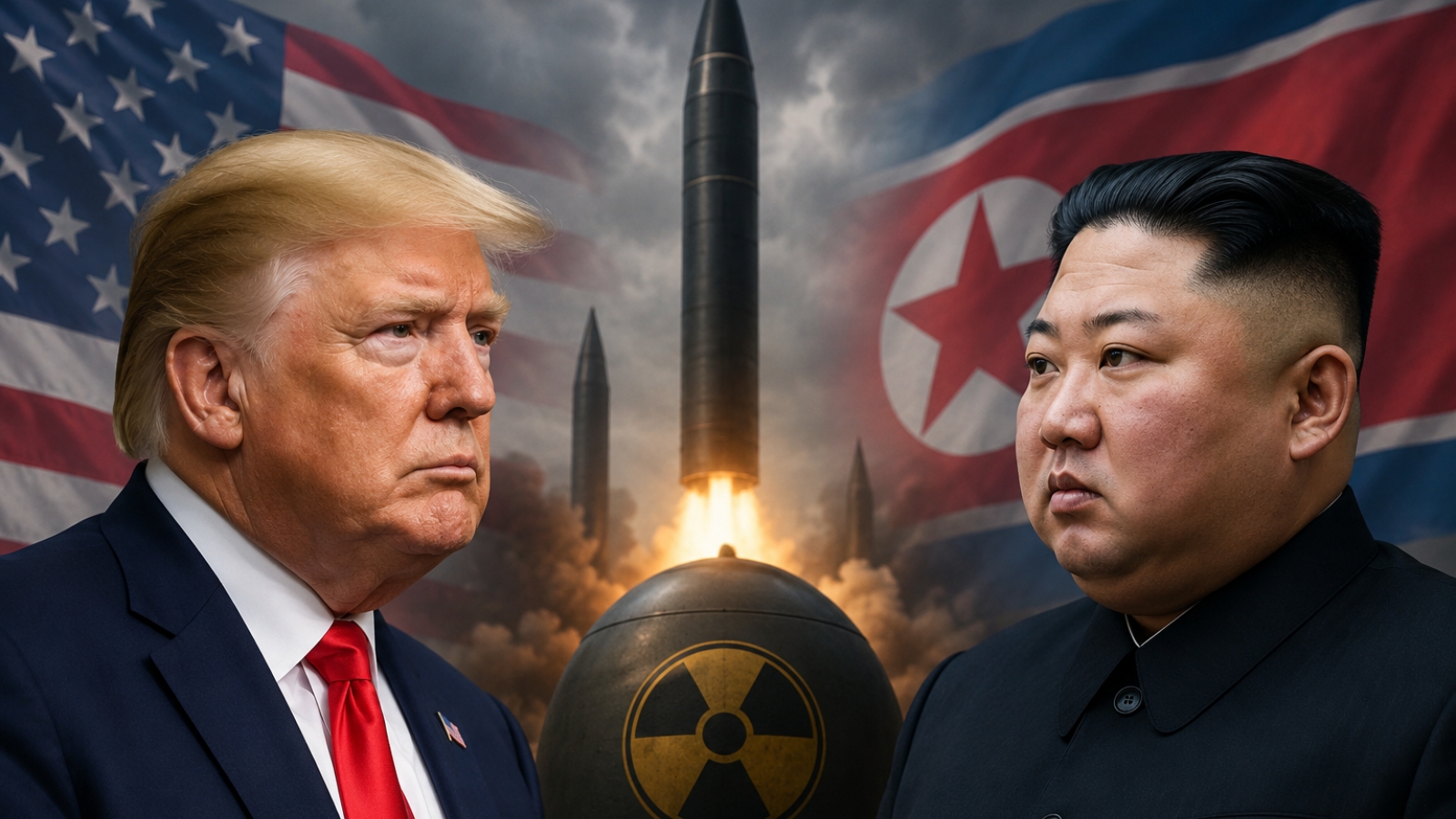
The math behind North Korea’s nuclear arsenal has become a public point of friction between Washington and Seoul. Just this week, U.S. President Donald Trump publicly claimed that Pyongyang possesses 57 "very powerful" nuclear weapons. Within hours, South Korean defense officials countered that figure, estimating the stockpile to be between 80 and 120 warheads. This isn't just a rounding error. It highlights a widening gap in how the two allies view the threat sitting on the Korean Peninsula.
North Korea didn't wait long to punctuate this disagreement. On Thursday, August 20, 2026, the North launched approximately 10 short-range ballistic missiles toward the sea. The timing was pointed. These launches occurred just one day after President Trump ordered a significant reduction in the annual Ulchi Freedom Shield military exercises with South Korea, attempting to soften the atmosphere for potential new diplomatic talks with Kim Jong Un.
The Disconnect in Intelligence
Why does the U.S. report 57 while Seoul insists on a range as high as 120? Discrepancies in nuclear accounting are common, but they usually happen behind closed doors. When these numbers spill into public discourse, it shows that the underlying intelligence assessments—or the political motivations behind them—are drifting apart.
President Trump’s claim seems rooted in a desire to frame his personal relationship with Kim as a manageable geopolitical reality. If the stockpile is fixed at a lower, "contained" number, it supports the narrative that his diplomatic outreach has limited the growth of the regime's capability.
South Korea’s higher estimate, voiced by Defense Minister Ahn Gyu-back, reflects a much grimmer reality for those living in the immediate line of fire. Seoul’s military planners must assume the worst-case scenario. If they underestimate the size of the arsenal, they leave their population vulnerable. They aren't interested in the diplomatic optics; they're interested in defense readiness.
Missiles as a Reality Check
Pyongyang’s decision to fire 10 missiles immediately following Trump’s "goodwill" gesture—the reduction of joint drills—sends a clear message. Kim Yo Jong, the North Korean leader’s sister, dismissed the scaling back of military exercises as a meaningful gesture. She labeled the drills "provocative" regardless of whether they last 11 days or five.
This behavior proves that the North Korean leadership isn't playing by the rules of traditional Western diplomacy. Every time the U.S. or South Korea tries to create "conditions for dialogue," Pyongyang tends to answer with a hardware demonstration. They aren't looking for a seat at the table to talk about disarmament. They are looking to solidify their status as an irreversible nuclear state.
What the Numbers Actually Mean
Beyond the debate between 57 and 120, the broader picture is concerning. Independent organizations like the Stockholm International Peace Research Institute (SIPRI) have historically hovered around 60 warheads, with enough fissile material for at least 30 more.
Whatever the exact count, the qualitative improvements are what matter most. We aren't just talking about a static stockpile sitting in a warehouse. We are seeing:
- Increased missile variety, from short-range tactical weapons to ICBMs capable of reaching the U.S. mainland.
- Continuous development of fissile material production.
- A strategic shift to label South Korea as their "most hostile" enemy, moving away from past goals of reunification toward a policy of confrontation.
How to View the Current Tensions
If you are trying to make sense of the headlines, look past the specific numbers. The real story isn't the disagreement over whether it is 57 or 120 warheads. The story is the breakdown of a unified strategy.
When the U.S. President and the South Korean government openly contradict each other on basic security data, it creates an opening for Pyongyang. They see the daylight between Washington and Seoul. They know that if they push hard enough, they can exploit these differences to continue their nuclear expansion without facing a truly coordinated response.
The next steps for regional security are murky at best. Seoul is signaling that it won't be swayed by U.S. diplomatic overtures if those moves compromise its safety. Meanwhile, Washington remains focused on the potential for a new summit later this year. Expect more missile tests, more confusing rhetoric, and a continued push by North Korea to prove that its nuclear deterrent is not a bargaining chip, but a permanent fixture of the regional order.
If you want to track where this goes, don't focus on the potential for summits. Focus on whether the U.S. and South Korea can align their assessments. Until they agree on the size and nature of the threat, they won't be able to mount a response that actually changes Kim Jong Un’s calculations.