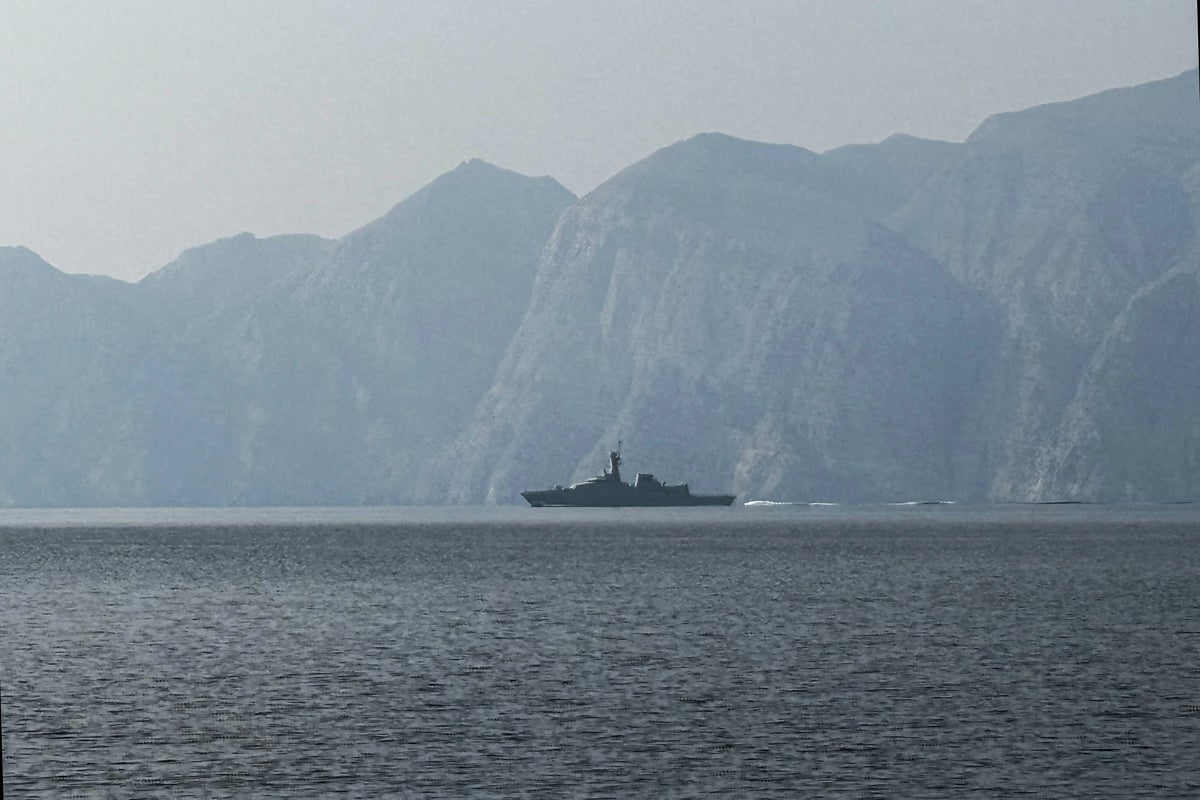
A captain stands on the bridge of a Very Large Crude Carrier (VLCC) named the Oceanic Grace. Beneath his boots, three hundred thousand tons of crude oil sit in steel bellies, a cargo worth roughly $20 million depending on the mood of the markets in London and New York. To his left, the jagged, sun-bleached cliffs of Oman rise like broken teeth. To his right, the hazy silhouette of Iran’s Larak Island shimmers in the heat distortion.
He is entering the Strait of Hormuz.
At its narrowest point, the shipping lane is only two miles wide. If the captain veers slightly off course, he enters contested waters. If a fast-attack boat from the Islamic Revolutionary Guard Corps (IRGC) decides to buzz his bow, his heart rate climbs. He isn't just navigating a ship; he is threading a needle that holds the global economy together.
Most people don't think about the Strait of Hormuz until their local gas station changes the numbers on the plastic sign overnight. They don't see the silent, constant procession of steel giants carrying 21 million barrels of oil every single day. That is roughly 20% of the world's liquid petroleum consumption. One-fifth of the world’s energy passes through a gap of water so small you could cross it in a rowboat in an afternoon.
The Geography of Anxiety
To understand why this stretch of water creates such a visceral tightness in the chests of Pentagon planners and energy CEOs, you have to look at the map. The Strait is a "chokepoint" in the most literal sense. It is the only exit for the oil-rich tankers leaving the Persian Gulf. Saudi Arabia, the United Arab Emirates, Kuwait, Iraq, and Qatar all rely on this single door.
Iran sits on the northern shore, watching the door.
When tensions flare between Washington and Tehran, the first threat is always the same: "We will close the Strait."
But closing the Strait isn't as simple as locking a gate. It involves a sophisticated, terrifying dance of asymmetric warfare. Imagine a hypothetical scenario—let’s call it Operation Black Tide—where a series of "smart" sea mines are dropped into the shipping lanes. These aren't the rusty globes from old movies. They are silent, acoustic-triggered hunters that wait for the specific sound signature of a tanker’s propeller.
Suddenly, the Oceanic Grace isn't a ship anymore. It's a target.
Once a single tanker is hit, the insurance markets in London go into a frenzy. Rates skyrocket. Companies refuse to send their vessels into the Gulf. The door doesn't need to be physically blocked by a sunken ship to be "closed." It only needs to become too expensive to risk.
The Invisible Stakes in Your Pocket
We often talk about "oil prices" as an abstract graph on a screen. But for a father in Ohio driving a delivery van, or a factory owner in Shenzhen trying to keep the lights on, the Strait of Hormuz is a direct tether to their survival.
When the Strait is threatened, the "risk premium" kicks in. Traders buy oil futures not because there is a shortage today, but because they fear a vacuum tomorrow.
$$P_t = E[P_{t+1} | \Omega_t]$$
The price today ($P_t$) is a reflection of the expected price tomorrow, given the current information ($\Omega_t$). If that information includes images of Iranian missiles or U.S. carrier strike groups moving toward the Gulf of Oman, the expectation is chaos.
Consider the "tanker war" of the 1980s. During the Iran-Iraq conflict, both sides targeted each other's exports. Hundreds of ships were attacked. The U.S. eventually had to re-flag Kuwaiti tankers and escort them with warships. It was a slow-motion catastrophe that proved how fragile the system truly is.
Today, the stakes are higher. The world’s "just-in-time" supply chain means we don't keep massive stockpiles of everything anymore. We rely on the flow. If the flow stops for a week, the ripples reach the grocery store. If it stops for a month, the ripples become waves that can topple governments.
The Ghost of a Blockade
Is the Strait of Hormuz closed right now? No.
Is it likely to be closed? Physically, it is nearly impossible for Iran to hold it shut indefinitely. The U.S. Fifth Fleet, based in nearby Bahrain, exists almost entirely to ensure that doesn't happen.
However, the "shadow war" is very real. Over the last few years, we have seen mysterious limpet mines attached to hulls, drones striking tankers, and the temporary seizure of vessels like the Stena Impero. These aren't full-scale invasions; they are messages. They are reminders that the hand on the door can squeeze whenever it wants.
Think of it like a hostage situation where the hostage is the global economy.
Iran knows that a full closure would be an act of war, likely resulting in the destruction of their own navy and port infrastructure. They also need to export their own oil to survive. But the threat of closure is a powerful diplomatic lever. It is a way to say, "If we suffer, the world suffers with us."
The Technological Countermeasures
Navies are no longer just looking for big ships. They are looking for "swarms."
The IRGC utilizes hundreds of small, fast boats that can overwhelm a large destroyer’s targeting systems. It’s the difference between trying to swat a single fly and trying to fight a cloud of gnats. To counter this, the U.S. and its allies have turned to AI-driven surveillance and unmanned surface vessels.
These "ghost ships" patrol the Strait 24/7, using high-resolution cameras and sensors to track every movement. They don't get tired. They don't get bored in the 110-degree heat. They provide a digital canopy over the water, trying to turn the "fog of war" into a transparent data set.
Yet, technology has a ceiling. At the end of the day, the safety of the Strait relies on the psychology of the men on the bridges of those ships.
The Long Way Around
Saudi Arabia and the UAE have spent billions trying to build a "back door." They have constructed massive pipelines that cut across the desert to the Red Sea or the Gulf of Oman, bypassing the Strait of Hormuz entirely.
These pipelines are engineering marvels, but they are insufficient. They can only handle a fraction of the total volume. There is no replacement for the Strait. There is no Plan B that doesn't involve a massive drop in global supply.
This reality creates a strange, forced intimacy between enemies. Every country involved knows that a total collapse of transit in the Strait would be a "lose-lose" scenario. This is why, despite the heated rhetoric and the occasional skirmish, the tankers keep moving.
The Human Element in the Hull
Back on the Oceanic Grace, the captain watches a small green blip on his radar. It’s an Iranian patrol boat. It’s five miles away. It hasn't changed course.
He knows that if a conflict breaks out, his ship is a sitting duck. He is sitting on a bomb that can't move faster than 15 knots. He thinks about his family in Manila or Odessa. He thinks about the silence of the engine room if a torpedo were to strike the engine casing.
The world sees the Strait of Hormuz as a geopolitical chess piece. He sees it as a narrow, dangerous hallway he has to walk through every few weeks.
The Strait is more than a shipping lane. It is the physical manifestation of our collective vulnerability. We live in a world where our comfort, our mobility, and our very stability depend on the continued peace of twenty-one miles of salt water.
We are all passengers on that tanker, whether we know it or not. The pulse of the world beats in that narrow channel, rhythmic and heavy, a constant reminder of how thin the line is between the light of the modern world and the cold dark of a dry pump.
The blip on the radar turns away. The Oceanic Grace moves forward, deeper into the heat, carrying the lifeblood of a dozen nations through the eye of a needle.