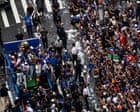
The baseline at Madison Square Garden vibrates differently when the Knicks are winning. It is a physical frequency, a low rumble that starts in the concrete tunnels of Pennsylvania Station and climbs through the floorboards of the world's most famous arena. When a major victory triggers an impromptu, multi-thousand-fan march down Seventh Avenue, casual observers see a flash mob of sports euphoria. They see a viral moment. But look closer at the crowd blocking traffic, scaling lampposts, and chanting in unison, and you see something entirely different. This is a generational release valve.
To understand why a regular-season or early-round playoff victory by the New York Knicks handles the emotional weight of a championship parade anywhere else, you have to dissect the decades-long drought that preceded it. New York sports culture does not operate on patience. It operates on a ledger of unfulfilled expectations and high-priced failures. When the team wins big, the city does not just celebrate a sporting victory. It reclaims a collective identity.
The Economics of a Seventh Avenue Shutdown
Spontaneous parades do not happen in a vacuum. They are built on a volatile mix of high ticket prices, economic gatekeeping, and the democratization of the sidewalk.
For the past twenty years, attending a game at Madison Square Garden has transformed from a blue-collar tradition into a luxury experience. Corporate suites and investment bankers replaced the fans who grew up on the 1970s championship squads or the gritty 1990s roster. When the final buzzer sounds on a monumental win, the celebration immediately migrates outward. The street becomes the equalizer.
Fans who cannot afford the four-figure secondary market ticket prices gather in nearby bars or watch through store windows. The moment the victory is secured, they flood the asphalt. This is not a planned marketing activation. It is an organic hostile takeover of municipal space. The city infrastructure, usually rigid and unforgiving, bends to the sheer volume of human bodies. Traffic stops. City buses become stationary viewing platforms. The NYPD shifts from enforcement to containment, recognizing that trying to disperse a crowd fueled by twenty years of pent-up sports frustration is a logistical impossibility.
The Anatomy of the New York Fanbase
The modern Knicks fanbase is divided into two distinct factions that merge only during these street celebrations.
- The Survivors: Those who remember the Patrick Ewing eras, the heartbreak of the 1994 Finals, and the subsequent decade of administrative mismanagement. For this group, the public celebration is a form of vindication.
- The Believers: A younger demographic that grew up during the bleakest years of the franchise—the eras of shifting front offices and unfulfilled free-agency promises. They have never seen a parade banner hoisted, making their investment entirely based on hope rather than memory.
When these two groups meet on the pavement outside the arena, the traditional social barriers of New York dissolve. A Wall Street broker in a tailored suit high-fives a delivery worker from Queens. It is a fleeting, fragile ecosystem where the only currency that matters is the color of your jersey.
The Failure of the Corporate Sports Machine
The sudden bursts of public joy stand in stark contrast to how modern professional sports franchises are built. For years, front offices believed that winning could be bought through marquee names and flashy press conferences. New York was the ultimate destination for players looking to maximize their brand footprint.
But the city rejected the corporate, sanitized version of basketball.
The current resurgence succeeded precisely because it abandoned that philosophy. The roster was assembled not with transient superstars looking for a media market, but with players who mirrored the city's self-image—gritty, overlooked, and relentlessly stubborn. The fan base responds to labor, not luxury. When a player dives for a loose ball on the hardwood, the reaction in the upper deck is louder than it is for an uncontested breakaway dunk.
This brings us to the core friction of New York sports. The franchise is a multi-billion-dollar corporate entity, yet its emotional engine is fueled by working-class obsession. When the team wins, the fans take ownership of the victory because they feel they have paid for it with years of emotional tax. The impromptu parade is a literal manifestation of that ownership. They are taking back the team from the corporate sponsors and the luxury box holders, bringing the celebration back to the asphalt where the game was born.
The Logistical Reality of Street Euphoria
While the narrative of a spontaneous parade is romantic, the reality on the ground is loud, chaotic, and dangerous. Public transit hubs face immediate paralysis. Midtown Manhattan is not designed to absorb ten thousand static people celebrating on a random weekday evening.
Emergency vehicles are forced to reroute. Subways experience massive bottlenecks as human traffic clogs the stairwells. Local businesses face a double-edged sword; bodegas sell out of inventory within minutes, while high-end retail storefronts quickly lower their security gates to protect glass facades from the surge.
There is a distinct architecture to these gatherings. They always begin at the intersection of 33rd Street and Seventh Avenue, spilling outward toward Eighth Avenue and down into the Penn Station concourses. The crowd utilizes the urban landscape as props. Scaffolding becomes a jungle gym. Newsstands serve as stages. The chants are rhythmic, localized, and often directed at rival teams or national media figures who doubted the franchise's trajectory.
The Temporary Nature of the Neighborhood
The phrase "we family now" is tossed around frequently during these street gatherings. It is a sentiment born from shared suffering. In a city defined by isolation and hyper-competition, sports offer a rare moment of unmanufactured communion.
But this communion has an expiration date.
The morning after a massive street celebration, the city resets. The street sweepers wash away the discarded blue and orange confetti. The traffic lights resume their regular patterns, and the people who were embracing on the hoods of yellow cabs twelve hours prior pass each other on the sidewalk without making eye contact. The family unit disperses back into the anonymity of the five boroughs.
This does not diminish the value of the gathering; rather, it amplifies it. The temporary nature of the celebration is exactly what makes it potent. It is a brief, unauthorized holiday from the grinding reality of New York life, carved out of the middle of Seventh Avenue by thousands of people who decided, if only for an hour, that a basketball team was enough reason to stop the world.
The next time the Garden floor shakes and the crowd empties into the Manhattan night, do not look at it as a simple reaction to a game. Look at it as a city refusing to be priced out of its own joy. The parade will end, the traffic will move, and the reality of the standings will settle back in, but for that one hour, the street belongs to whoever is wearing the jersey.