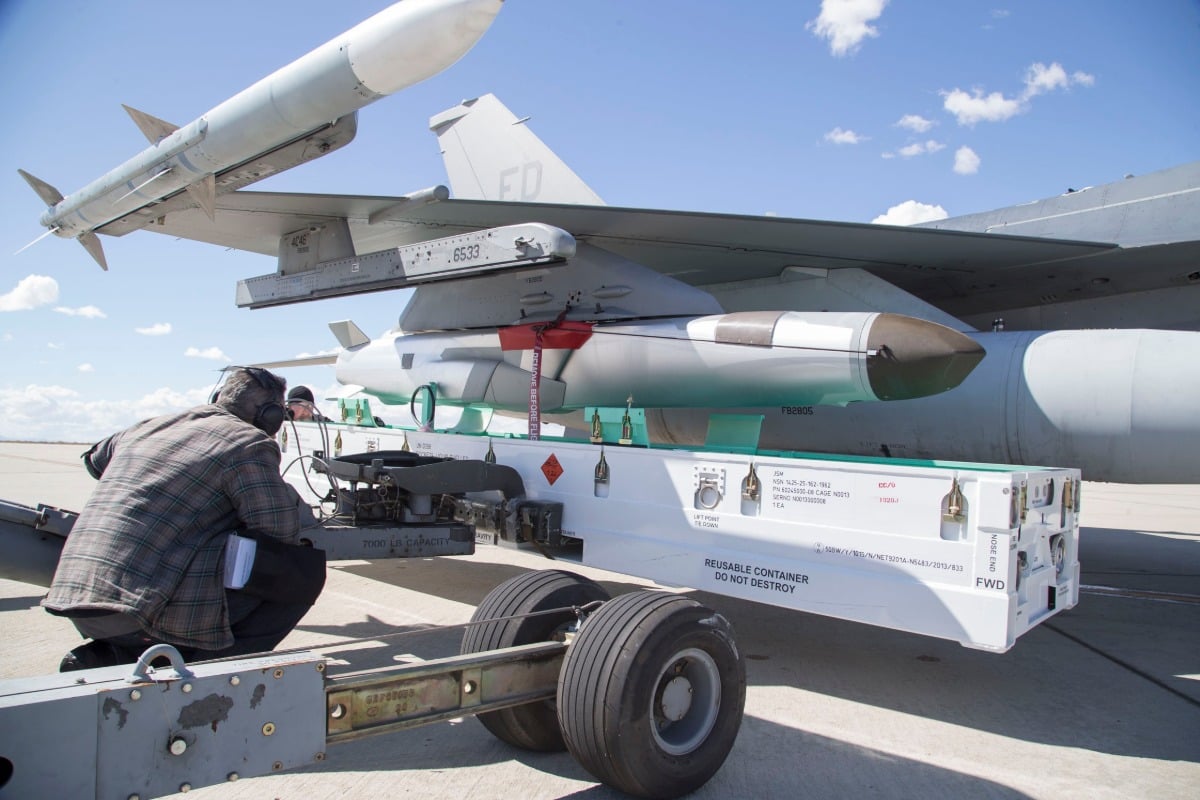
The United States Air Force officially committed $240.9 million to Norwegian defense contractor Kongsberg Defence & Aerospace for Lot 2 production of the AGM-184 Joint Strike Missile. This firm-fixed-price sole-source contract funding, drawing from fiscal years 2024 and 2025 procurement allocations, secures advanced cruise missiles tailored specifically for the internal weapons bays of the Lockheed Martin F-35A Lightning II. Delivery will continue through November 2028. The deal exposes a critical gap in domestic American missile manufacturing, forcing the Pentagon to look overseas to preserve the core combat capability of its premier fifth-generation fighter fleet.
The Fatal Flaw in American Stealth Tactics
Air superiority requires low visibility. When an aircraft hangs heavy ordinance from its wings, its carefully designed radar-evading shape disappears on adversary monitoring screens. External pylons catch radar waves and bounce them straight back to hostile tracking systems. If you liked this piece, you might want to look at: this related article.
For a decade, the Air Force possessed a lethal inventory of long-range strike options. The problem is that they are all too big.
The primary American stand-off weapons, the AGM-158 JASSM and its maritime cousin, the AGM-158C LRASM, are highly capable systems. They carry massive warheads and fly deep into hostile territory. However, they weigh roughly 2,500 pounds and feature dimensions that require external wing mounting on a fighter jet. Hanging a JASSM under an F-35 wing transforms a multi-billion-dollar radar-evading asset into an expensive target. For another angle on this development, check out the recent coverage from Ars Technica.
The Air Force faced a stark tactical dilemma:
- Fly close to hostile air defenses to drop small, internally carried smart bombs.
- Fire long-range missiles from the wings, throwing away the aircraft's radar-evading advantages.
Norway solved this problem because they had to.
Squeezing Lethality Into Small Bays
The Joint Strike Missile, or JSM, weighs a modest 917 pounds and measures exactly 156 inches in length. It was built from the ground up to fit inside the cramped internal weapons bay of the F-35A. This dimensional alignment enables a concept military strategists call double stealth. The aircraft remains entirely clean, hiding inside enemy radar blind spots while flying toward a destination. When it launches the JSM from its internal bay, the missile itself utilizes low-observable geometry and composite materials to continue the undetected approach.
The weapon carries a range exceeding 150 nautical miles, with operational profiles suggesting a maximum reach of 350 kilometers depending on flight paths. This allows pilots to fire at mobile radar installations or maritime threats well outside the engagement envelopes of modern surface-to-air missile batteries.
The Passive Sensor Advantage over Electronic Warfare
Modern air defense is no longer just about firing fast interceptors. It is about choking the electromagnetic spectrum. In any near-peer confrontation, standard GPS guidance signals will be jammed, falsified, or blocked entirely.
Most conventional Western missiles rely heavily on active radar seekers to find their targets during the final seconds of flight. Active radar works like a flashlight in a dark room; it illuminates the target, but it also reveals exactly where the missile is coming from. Modern electronic warfare suites detect these emissions instantly, deploying automated countermeasures, decoys, or directed jamming to blind the incoming weapon.
The JSM uses a different philosophy. It is quiet.
[Inertial / Terrain Mapping] ---> [Passive Imaging Infrared Seeker] ---> [Target Impact]
      (Zero Emissions)                    (Matches Visual Matrix)            (No Warning Given)
The weapon operates almost exclusively via passive tracking systems. It navigates using an internal inertial unit combined with terrain-following systems that scan the ground below, matching the geography against pre-loaded digital maps. It does not emit radio frequencies that hostile electronic warfare systems can track or jam.
Autonomous Visual Identification
When the weapon reaches its destination zone, it activates an imaging infrared seeker. Instead of looking for a radar signature, the seeker views the scene visually, matching the thermal and physical shape of the target against an internal three-dimensional database.
This enables Autonomous Target Recognition. If an enemy radar vehicle turns off its transmission equipment to hide, a standard anti-radiation missile loses track and misses. The JSM ignores the lack of radio signals. It sees the physical shape of the vehicle sitting in the tree line and strikes it anyway. This transforms the weapon from a tool that merely suppresses enemy air defenses into a system that permanently destroys them.
The Industrial Reality of Allied Supply Dependency
The Pentagon did not choose a Norwegian supplier out of geopolitical charity. It did so because domestic defense infrastructure failed to produce an equivalent option in time.
Norway joined the F-35 development program early as a tier-three partner. While American manufacturers focused on scaling up aircraft production and building heavy, long-range munitions for bombers, Kongsberg focused entirely on the integration needs of smaller fighter bays. This early specialization created a monopoly on internal long-range strike weapons for the F-35.
| Attribute | AGM-184 JSM (Norway) | AGM-158 JASSM (USA) |
|---|---|---|
| Weight | 917 lbs | 2,500 lbs |
| Carriage | Internal (Preserves Stealth) | External (Destroys Stealth) |
| Primary Seeker | Passive Imaging Infrared | Active Radar / Infrared |
| Primary Target | Maritime & Dispersed Land | Heavy Infrastructure / Fixed Land |
This contract highlights an escalating trend within Western defense circles: the standardization of foreign-designed hardware across the global F-35 enterprise. The Air Force is not the only branch buying in. Japan, Australia, Germany, and Norway have all integrated the weapon into their planning.
By purchasing Lot 2 from Kongsberg, the Air Force aligns its tactical options directly with key allies in both the European and Indo-Pacific theaters. This allows for shared munitions stockpiles, unified maintenance protocols, and seamless logistics during joint operations.
The Risk of Single Source Foreign Production
Relying on an international supplier for a front-line combat asset presents distinct industrial vulnerabilities. Every single round ordered under this $240.9 million agreement will be manufactured at Kongsberg facilities in Norway.
The timeline stretches out to late 2028. In a protracted global conflict, high-intensity operations deplete precision guided missile inventories within weeks rather than months. If manufacturing lines remain isolated in northern Europe, the Pentagon risks facing supply constraints that cannot be resolved by domestic industrial intervention.
To mitigate this, international production shifts are beginning to occur, such as Kongsberg establishing manufacturing infrastructure in Australia. However, for the immediate future, the United States remains structurally dependent on European factory output to keep its premier stealth fighter fully armed.
The procurement proves that local engineering agility often outpaces massive defense-industrial complexes. While American primes focused on legacy footprints, an ally built the exact tool the F-35 needed to survive. The Air Force had no choice but to write the check.