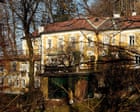
The collision between private capital expenditure and sovereign cultural asset preservation invariably exposes a structural pricing asymmetry. This market friction is acutely demonstrated by the sudden divestment of the Paschinger Schlössl, the 17th-century Salzburg estate historically known as the Stefan Zweig Villa. Purchased in 2020 by automotive magnate Wolfgang Porsche for €8.4 million, the property has been re-listed on the secondary market for €12.7 million. This 51.2% nominal appreciation does not reflect standard residential market trajectories. Instead, it represents the premiumization of a highly specific regulatory asset: a fully permitted, 500-meter private subterranean transit infrastructure project boring through the Kapuzinerberg mountain.
The abrupt transition of this asset from a highly contested private compound to the subject of an institutional acquisition campaign by the University of Salzburg highlights a critical breakdown in municipal utility allocation. It exposes the precise boundaries where private infrastructural utility runs into a wall of systemic reputational depreciation.
The Dual-Value Model of Culturally Significant Real Estate
To evaluate the strategic landscape of the Zweig Villa transaction, the asset must be decoupled into two distinct valuation frameworks that operate in direct opposition.
                  ┌────────────────────────────────────────┐
                  │      THE PASCHINGER SCHLÖSSL ASSET     │
                  └───────────────────┬────────────────────┘
                                      │
             ┌────────────────────────┴────────────────────────┐
             ▼                                                 ▼
┌─────────────────────────┐                       ┌─────────────────────────┐
│ PRIVATE UTILITY MATRIX  │                       │ CULTURAL EQUITY ENGINE  │
├─────────────────────────┤                       ├─────────────────────────┤
│ • Subterranean Access   │                       │ • Historical Provenance │
│ • Logistical Security   │                       │ • Public Accessibility  │
│ • Volatility Insulation │                       │ • Intangible Good-Will  │
└─────────────────────────┘                       └─────────────────────────┘
1. The Private Utility Matrix
For a private high-net-worth buyer, the baseline value of the property is governed by physical constraints and logistical security. The villa is historically defined by its topographical isolation on the Kapuzinerberg, accessible only via a steep 100-step pedestrian ascent. In its baseline state, the property exhibits severe disutility during winter sub-zero conditions, restricting vehicular ingress and egress.
The introduction of an approved engineering design—a 500-meter tunnel connecting the municipal Linzergasse parking garage directly to a subterranean nine-car gallery beneath the villa—fundamentally alters the property's cost function. The engineering project converts a highly restricted asset into a seamless, climate-insulated private compound. The €4.3 million premium added to the 2020 purchase price directly quantifies the capitalized value of this regulatory permission, which required a nominal €40,000 municipal right-of-way fee but carries an estimated execution cost of €10 million.
2. The Cultural Equity Engine
Conversely, the institutional value of the asset is derived entirely from its intangible provenance as a European cultural hub. Between 1919 and 1934, the estate functioned as an intellectual nexus, hosting figures such as Thomas Mann, James Joyce, and Richard Strauss, before the expropriation pressures of the Austro-fascist regime forced a predatory sale.
Under this framework, any physical alteration of the topography—specifically a heavy industrial boring project through a protected limestone hill—constitutes a negative externality that erodes the historical integrity of the monument. The intrinsic utility of the site to the public depends on the preservation of the exact physical hardships noted by Zweig: its romantic, car-inaccessible isolation.
The Infrastructure Bottleneck and Regulatory Expiration
The core driver of the current market window is not architectural, but regulatory. The planning permission secured by Porsche to construct the 500-meter tunnel is governed by a strict temporal decay function. The authorization is legally bound to an expiration date at the end of 2028.
This creates a structural bottleneck for any subsequent private purchaser. Because civil engineering projects of this scale within urban, protected limestone formations require extended lead times for geo-technical validation and machinery deployment, the option value of the tunnel permit decays exponentially as 2028 approaches. A private buyer purchasing the asset in 2026 possesses less than a 30-month operational window to execute the excavation before the €4.3 million regulatory premium evaporates completely.
This regulatory cliff has fundamentally altered the seller's strategic position. Facing severe public blowback—characterized by local political mobilization from the Green party and widespread civic protests against the privatization of municipal subsoil—the asset holder determined that the localized reputational risk exceeded the private utility of the completed infrastructure. By listing the property with the permit intact, the seller attempts to transfer the execution risk and temporal pressure to a secondary buyer.
The Institutional Consortium Strategy
In response to the re-listing, a public-institutional consortium led by the University of Salzburg has launched an acquisition campaign. The strategic objective is to short-circuit the private real estate market by converting the asset back into an institutional public good.
The mechanism relies on a multi-stage capital bridge:
- Interim Ownership Securitization: The University of Salzburg leverages its status as a stable public institution to act as the primary purchasing entity, mitigating the immediate risk of another private acquisition.
- Federal Sovereign Backing: The university is currently negotiating capital allocations with the Austrian Federal Ministry for Women, Science, and Research to underwrite the €12.7 million valuation.
- Permit Neutralization: Upon institutional acquisition, the consortium plans to let the 2028 tunnel permit lapse unexecuted. This structural move permanently eliminates the threat of industrial alteration to the Kapuzinerberg, defusing the political tension while refocusing the property's utility entirely on cultural preservation and academic seminars.
The fundamental limitation of this strategy is capital efficiency. The state is effectively forced to buy back an asset at a premium valuation that was inflated by the city’s own prior issuance of a controversial private drilling permit. The municipality's original decision to sell the subterranean right-of-way for a mere €40,000 has created a multi-million-euro fiscal burden for the federal government, which must now deploy significant public capital to reclaim the site's historical status quo.
Market Forecast and Strategic Recommendation
The disposition of the Stefan Zweig Villa will follow one of two structural pathways before the close of the current fiscal year.
The primary scenario points to a negotiated public-private handover. The University of Salzburg, backed by federal ministries and bolstered by international philanthropic fundraising campaigns, will likely secure the property. However, the state should not meet the €12.7 million asking price unconditionally.
The optimal strategic play for the public consortium involves a delayed-closing mechanism. Because the €4.3 million premium is tied entirely to the 2028 tunnel permit, and because local political pressure makes it highly improbable that any new private buyer could successfully execute the construction amid ongoing litigation and protests, the asset's private market liquidity is extremely low.
The institutional consortium should leverage this illiquidity, offering a structured buyout anchored closer to the baseline real estate value of €9 million, contingent on the immediate and permanent surrender of the subterranean development rights. This path preserves public capital, nullifies the ecological risk to the Kapuzinerberg, and restores the asset to its highest cultural utility.