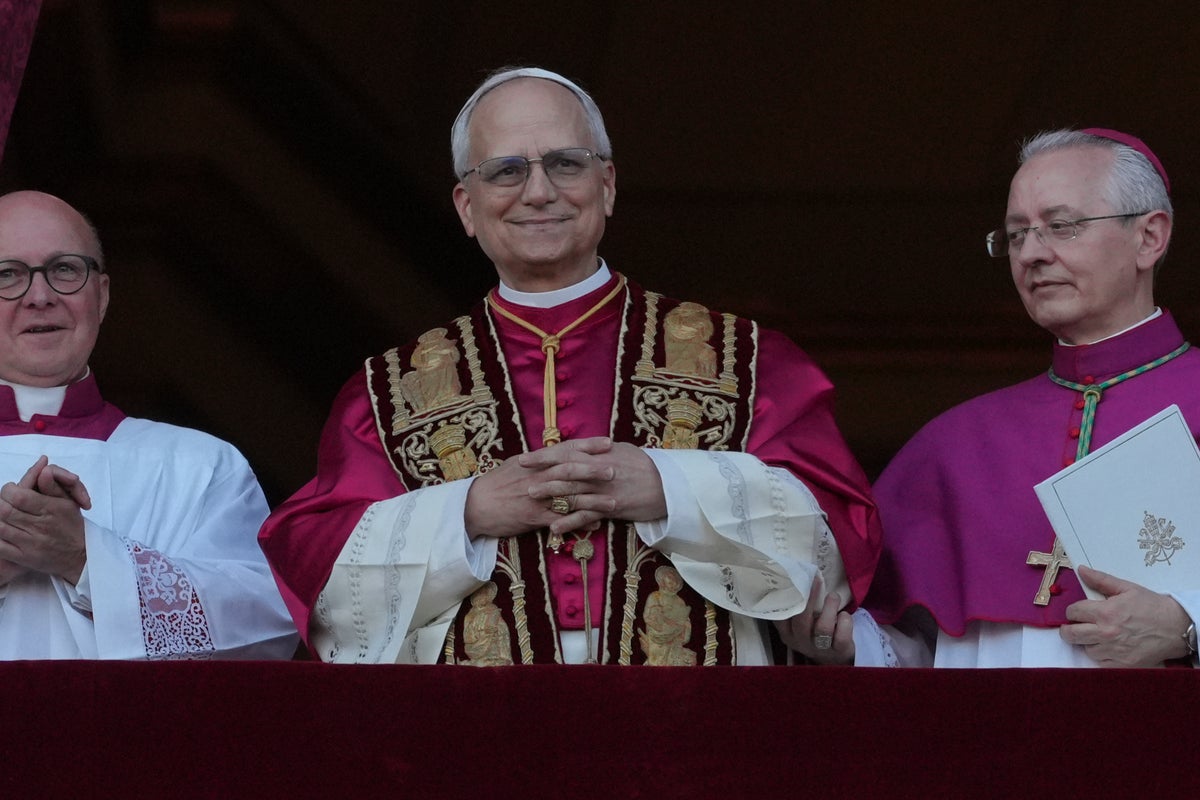
The elevation of Pope Leo, the first American to sit on the Throne of St. Peter, was widely misread by the D.C. establishment as a diplomatic win for American soft power. Instead, it has triggered the most significant rupture in Holy See-Washington relations since the Cold War. As the White House intensifies its military posture against Tehran, Leo has transitioned from a spiritual leader to a relentless geopolitical antagonist. This is not the typical "peace and prayers" rhetoric usually issued by the Secretariat of State. It is a targeted, surgically precise campaign to dismantle the moral and legal justifications for an American-led war in Iran.
Pope Leo understands the American psyche better than any of his predecessors because he was molded by it. He knows that the American public’s appetite for "forever wars" is at an all-time low, and he is using the pulpit to weaponize that fatigue. By framing the escalating conflict not just as a strategic blunder but as a fundamental violation of the Just War theory, Leo has backed the administration into a corner where they are fighting a war on two fronts: the Persian Gulf and the moral high ground of the Western world. For an alternative look, check out: this related article.
The Just War Trap
For centuries, the Catholic Church has adhered to a set of criteria to determine whether military action is morally permissible. Pope Leo is now using these criteria—specifically the principles of last resort and proportionality—as a checklist to disqualify the current administration’s actions.
When the White House argues that surgical strikes are necessary to prevent Iranian nuclear proliferation, Leo counters with the reality of "collateral" human suffering. He isn't talking about abstract theology. He is highlighting the specific logistics of regional destabilization. The Vatican’s intelligence network, often overlooked, is one of the oldest and most extensive in the world. Through parish networks and diplomatic Nuncios on the ground in Baghdad, Beirut, and Tehran, the Pope is receiving real-time data that contradicts the sanitized briefings coming out of the Pentagon. Related coverage on this matter has been shared by The New York Times.
The core of Leo’s argument rests on the fact that modern warfare, with its reliance on economic sanctions and drone technology, often hits the most vulnerable populations long before it touches the ruling elite. He has characterized the current sanctions regime against Iran as a "silent siege," arguing that denying a population access to medicine and basic commerce is an act of aggression that precludes any claim to moral superiority.
A New Breed of Roman Diplomacy
In the past, the Vatican operated through quiet backchannels and delicately worded encyclicals. Leo has scrapped that playbook. He is the first "social media Pope" who actually understands the mechanics of the digital cycle. He bypasses traditional media outlets to speak directly to the global Catholic population, which includes over 70 million Americans.
This direct-to-consumer approach has neutralized the usual lobbying efforts. When the State Department sends envoys to Rome to "clarify" their position, they find a Pope who has already released a video statement that has been shared millions of times in battleground states. This is a deliberate power play. Leo is forcing Catholic lawmakers in Washington to choose between their party's foreign policy and their standing with their constituents.
The Breakdown of the Neo-Con Alliance
For decades, there was a functional, if uneasy, alliance between the American religious right and the hawkish wing of the foreign policy establishment. That alliance is currently being shredded. Leo’s critiques have given cover to a growing faction of "Pro-Life" voters who are starting to apply that label to the victims of American foreign policy.
If you claim to be pro-life, Leo argues, you cannot be pro-war in a theater where civilian casualties are a mathematical certainty. This rhetorical shift has caused a massive headache for the administration's messaging. They are used to fighting secular anti-war activists; they are not prepared to fight the successor of St. Peter on the definition of what it means to value human life.
The Iranian Perspective Through a Roman Lens
One of the most controversial aspects of Leo’s papacy is his refusal to demonize the Iranian leadership. While he does not endorse the theocracy in Tehran, he recognizes it as a sovereign entity that has been consistently backed into a corner.
Vatican diplomats have been working a parallel track to the official UN negotiations. Their goal is to create a "Third Space" for dialogue that doesn't involve the threat of regime change. Leo’s logic is simple: you cannot negotiate with a gun to the other party's head and call the resulting agreement a "peace treaty."
This stance has led to accusations from some corners of Washington that the Pope is "soft on terror" or an "apologist for the Ayatollah." But those labels don't stick to a man who spent twenty years as a bishop in the American Rust Belt. He isn't an ivory-tower intellectual; he’s a street-level pragmatist who sees the body bags coming home to his former parishioners.
The Logistics of Dissent
The Pope is also leveraging the Church’s financial and institutional weight. There are whispers within the banking sector that the Vatican Bank (IOR) is looking at ways to facilitate humanitarian corridors that bypass some of the more restrictive American sanctions. If the Vatican begins to actively move funds or resources into Iran for medical relief, it would create a massive legal and diplomatic crisis. Would the U.S. dare to sanction the Holy See?
The mere possibility of such a move serves as a powerful deterrent. It forces the Treasury Department to be much more careful about how they define "illicit" transactions. Leo is essentially daring the American government to treat the Catholic Church as a hostile entity.
The Ghost of 2003
Leo frequently references the 2003 invasion of Iraq as the cautionary tale that Washington refuses to learn. He views the current trajectory toward Iran as a "beat-for-beat" repetition of the errors that led to the collapse of the Levant.
- Intelligence Failures: The Pope has publicly questioned the "certainty" of the intelligence reports used to justify the current buildup.
- Lack of Post-War Planning: He has asked point-blank what a "stable" Iran looks like after a military intervention, receiving no credible answer.
- Regional Spillovers: He warns that a conflict with Iran will not be contained; it will ignite a sectarian fire that consumes Lebanon, Iraq, and Syria.
By focusing on these practical, historical failures, he avoids being dismissed as a mere pacifist. He is speaking the language of a realist, and that is why he is so dangerous to the hawks in the Pentagon.
The Battle for the American Mind
Inside the Beltway, the reaction to Leo has been a mix of bafflement and rage. There is a sense that he has "betrayed" his country of birth. But Leo doesn't view himself as an American expatriate; he views himself as the head of a global institution that predates the United States by over 1,700 years.
He is leaning into the "Foreign Sovereign" aspect of his role to shield himself from American political pressure. When the President attempts to call him, the Pope often delegates the conversation to his Secretary of State, signaling that the White House is just another government, no more or less important than any other.
The Risk of a Schism
There is, of course, a significant risk to this strategy. A vocal minority of American bishops, many of whom are funded by conservative donors with ties to the defense industry, have started to publicly push back against Leo’s "interference" in state matters.
This internal friction is exactly what the administration is hoping to exploit. If they can frame Leo as a "radical" who is out of touch with the American Catholic experience, they can dull the impact of his critiques. However, the polling suggests this is a losing battle. Younger Catholics, in particular, are energized by a Pope who speaks out against the military-industrial complex with such ferocity.
The Weaponization of the Eucharist
In his most recent private consistory, Leo reportedly discussed the possibility of issuing an encyclical that specifically addresses the "Sin of Aggression" in the 21st century. Such a document would potentially make it a matter of confession for Catholic soldiers and contractors to participate in a war that hasn't met the Just War criteria.
This is the nuclear option of religious diplomacy. If the Church were to formally declare the war "immoral," it would create a crisis of conscience for the thousands of Catholics serving in the American military. The administration knows this, and it is the primary reason they are still trying to maintain a facade of cordiality with the Vatican. They cannot afford a mass desertion of the moral high ground.
Beyond the Rhetoric
The standoff between the American Pope and the American President is not just a clash of personalities. It is a fundamental disagreement about the nature of power in the modern world. Washington believes in the power of the carrier strike group; Leo believes in the power of the global moral consensus.
As the ships move into the Persian Gulf, the Vatican’s diplomatic machinery is moving in the opposite direction, building a coalition of nations—including many in the EU and the Global South—that are prepared to ignore Washington’s lead. This is the real "war" being fought: a struggle to determine whether the 21st century will be governed by the traditional rules of empire or by a new, more fragmented form of moral authority.
Leo has made his move. He has stripped away the religious and ethical justifications for a strike on Iran, leaving the administration to argue their case on the cold, hard grounds of imperial interest. In doing so, he has forced a level of transparency that D.C. usually avoids at all costs. The "American Pope" is the most effective check on American power that the world has seen in decades, and he is just getting started.
The administration’s next move will have to be more than just a PR pivot. They are facing a sovereign who doesn't need their votes, doesn't need their money, and isn't afraid of their fire. For a town built on leverage, that is the ultimate nightmare.