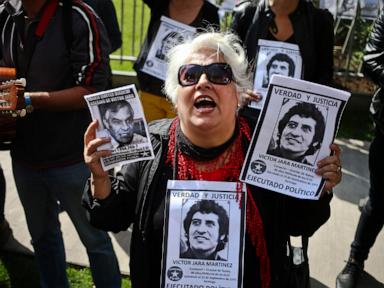
More than half a century passed before justice caught up with the killers of legendary Chilean singer-songwriter Víctor Jara. If you've been following historical war crimes or human rights law, you know that time usually protects the guilty. Dictatorships fall, documents vanish, and aging perpetrators slip away into quiet retirements. But history doesn't always let them off the hook.
Over the weekend, Chilean police finally arrested retired military colonel Nelson Haase Mazzei. He had spent three years as a fugitive after being convicted of kidnapping and murdering Jara and Littré Quiroga Carvajal, the former Director General of Prisons, during the brutal military dictatorship of General Augusto Pinochet.
The Brutal Reality of a Decades-Old Crime
Let's look at what actually happened. Víctor Jara wasn't just a musician. He was a cultural icon, a professor at the State Technical University, and a prominent voice of the "New Chilean Song" movement. When the military coup led by Pinochet overthrew President Salvador Allende on September 11, 1973, Jara became an immediate target.
Just five days after the coup, troops arrested Jara on campus and hauled him to Chile Stadium—now renamed Víctor Jara Stadium. Nearly 5,000 prisoners were crammed into that grim arena. Jara was singled out, taken to a private area, and subjected to horrific torture. When investigators finally documented his death, they found multiple fractures and a staggering 44 bullet wounds.
For decades, impunity reigned. The Pinochet regime shielded its agents, and the transition back to democracy moved at a snail's pace. Truth commissions were formed, reports were written, and families waited.
Why This Arrest Matters Now
Haase Mazzei was originally convicted in 2018 alongside several other military officers. In 2023, an appellate court increased his sentence to 25 years and two days in prison. Instead of surrendering to serve his time, the 80-year-old former colonel chose to run. He became a fugitive from justice, hiding out while his co-conspirators began their sentences.
His capture by Chilean authorities marks a turning point. Judge Paola Plaza of the Santiago Court of Appeals ordered his immediate imprisonment, making him the final convicted official from this specific case to be put behind bars.
Yet, the victim's family warns us not to celebrate too quickly. Amanda Jara, the musician's daughter, published a letter noting that while the arrest is appreciated, calling it true justice is difficult. Half a century is a lifetime to wait for a prison cell door to close.
The Broader Reckoning in Chile
Chile's legal system is still processing the ghosts of a 17-year dictatorship that left roughly 40,000 victims, including thousands of executions and forced disappearances. Courts have convicted hundreds of state agents and civilians over the years, but tracking down aging fugitives remains an ongoing battle.
The country launched the National Search Plan to unify records and track down missing detainees whose whereabouts remain unknown. It's a massive, exhausting effort carried out largely by the families of victims who refuse to let the past fade into obscurity.
Accountability doesn't have an expiration date. When perpetrators think they've outrun their crimes, cases like this prove that institutions can still catch up, no matter how many years tick away.