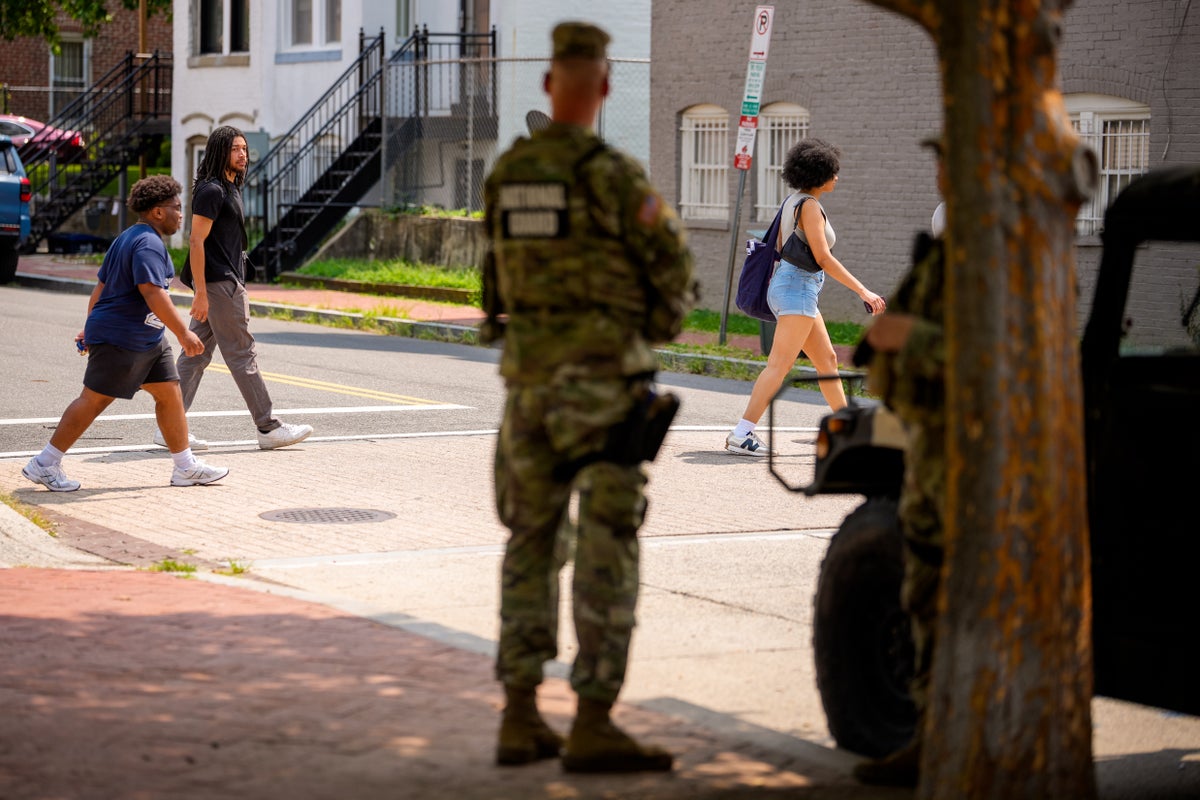
The concrete of Pennsylvania Avenue remembers the sound of heavy boots. It remembers the rhythmic, indifferent stamp of thousands of service members stepping in unison, a sudden vertical forest of camouflage sprouting against the marble facades of Washington. They arrived with cargo trucks, zip ties, and the heavy gravity of an emergency decree. Yet, the air in the neighborhoods a few miles away remained unchanged.
Consider what happens when a city is treated like a combat zone while its actual fractures lie elsewhere.
On paper, the deployment of thousands of National Guard troops to the District of Columbia looks like an absolute exertion of sovereign muscle. It reads as a definitive line drawn in the sand against rising unrest and urban decay. But statistics tell a quieter, more stubborn story. Crime rates in an urban center do not yield to the mere presence of rifles and tactical vests if those assets are deployed far from the complex socio-economic roots of the problem.
The boots stand on corners where no threat breathes. Meanwhile, the real mechanics of community violence unfold in private living rooms, dimly lit alleyways, and neglected corridors far from the patrolled avenues.
To understand the disconnect, look at how urban security actually functions. A soldier is trained to secure a perimeter, to defend a strategic objective, to project state power against an identifiable adversary. Street crime, however, is not an invading army. It is a chronic illness born of systemic poverty, fractured mental health safety nets, and generational disinvestment. You cannot intercept a desperate domestic dispute with a Humvee. You cannot deter a late-night robbery on a residential side street by stationing a platoon outside a federal monument three miles away.
The strategy relies on optics rather than outcomes.
Residents living in the District during these high-profile surges often describe a strange, suffocating duality. They see military vehicles idling beneath streetlights, yet emergency response times for civilian 911 calls remain stretched thin. The hardware is overwhelming, but the human infrastructure—the social workers, the community outreach teams, the localized youth intervention programs—starves for resources.
The uniform becomes a symbol of protection that protects nothing in particular. It acts as a theatrical balm for national television audiences while leaving local communities to navigate their daily vulnerabilities alone.
History shows that saturating a capital city with military personnel creates a temporary illusion of control. It alters the skyline. It shifts traffic patterns. It reassures distant lawmakers who look out their office windows and feel momentarily insulated from the complexities of the municipality outside. But once the orders change and the troops pack their duffel bags to return home, the underlying metrics of community safety remain stubbornly static.
The real work of safety is painfully slow. It is built block by block, relationship by relationship, through investments that never make the evening news.
The trucks eventually roll away. The tactical vests are stored in armories. The avenue returns to its ordinary rhythm, carrying the weight of a city that was watched closely, but never truly seen.