The Water Was Warm
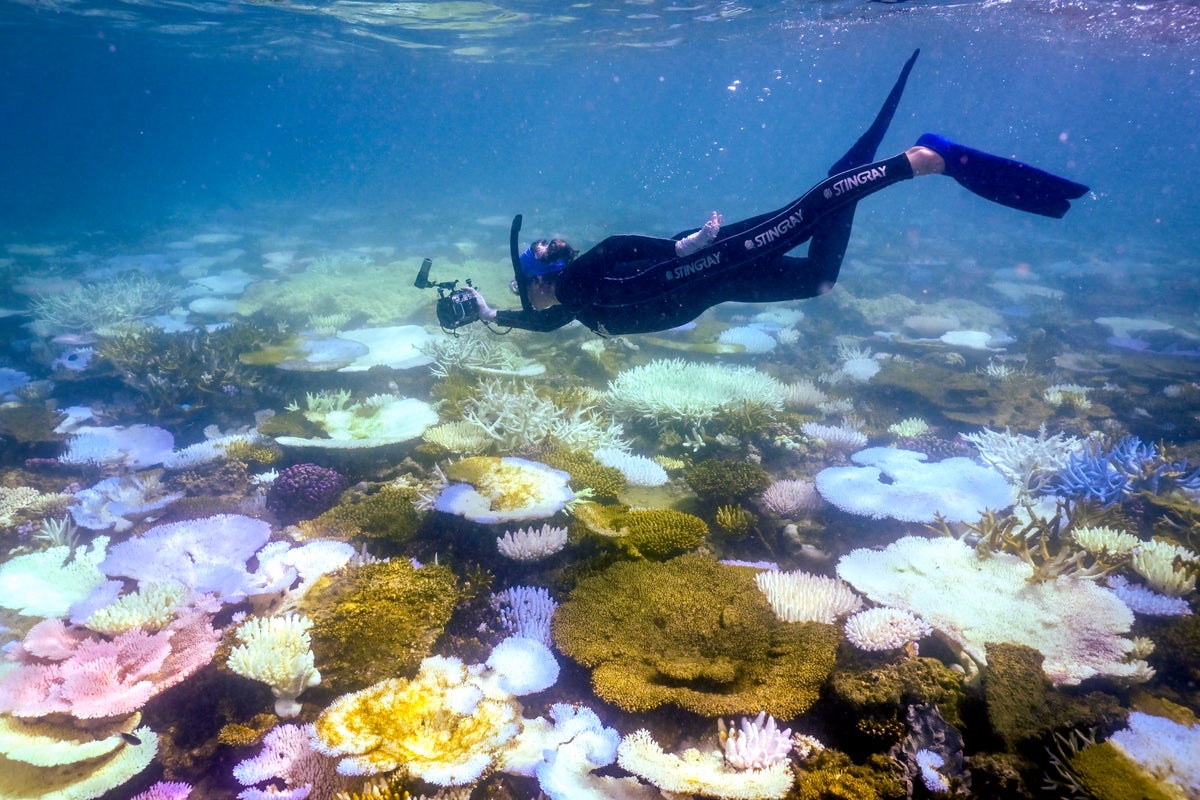
Dr. Maya Lin adjusted her dive mask, took a breath through her regulator, and tipped backward off the stern of the boat into the Coral Sea.
She expected the familiar rush of cool ocean water. Instead, it felt like sliding into a lukewarm bath.
That single sensation, felt through a neoprene wetsuit eight miles off the coast of Queensland, carried a terrifying realization. Maya had spent twenty-two years studying the Great Barrier Reef. She knew the precise threshold where marine life thrives, and she knew the precise fraction of a degree where it begins to die.
When she reached the ocean floor that morning, the vibrant metropolis she had documented for decades had turned ghost-white.
The clownfish were still there, darting neurotically between bleached tentacles that offered no cover. The sea turtles glided past, looking for familiar feeding grounds that had burned out overnight. Beneath the surface, an invisible mass destruction was underway, driven by record ocean temperatures and a relentless El Niño weather cycle.
It was not a distant warning for the next century. It was happening right now.
How a Living City Turns White
To understand what happens during a mass bleaching event, consider a simple metaphor: imagine the reef as an intricate city where the buildings themselves are alive, and the residents pay rent by providing food.
Corals are soft-bodied animals that build hard limestone skeletons around themselves. They live in a delicate partnership with microscopic algae called zooxanthellae. These tiny organisms live inside the coral's tissues, capturing sunlight and converting it into nourishment. In return, the coral provides a safe home. It is one of the most successful arrangements in biological history.
Until the heat arrives.
When water temperatures rise just one or two degrees above the historical summer maximum for sustained periods, the coral's metabolism goes into overdrive. The microscopic algae begin producing toxic compounds instead of food.
In response, the coral panics. It expels its algae partners, stripping itself of its color and its primary source of life. What remains is a translucent tissue over a stark white skeleton.
The coral is not dead yet. It is starving.
If the water cools down quickly enough, the coral can recruit new algae and recover. But if the heat stays—if the marine heatwave stretches over weeks or months—the starvation becomes permanent. The tissue rots away. Microscopic turf algae covers the skeleton in a dull brown slime.
The city collapses.
The Invisible Stakes Behind the Glass Bottom Boats
It is easy to view the Great Barrier Reef as a postcard destination—a splash of turquoise ocean filled with colorful fish, existing solely for tourists and nature documentaries.
That perspective ignores the sheer economic and human weight anchored to these limestone structures.
The numbers tell part of the story, but human lives tell the rest. Along the Australian coast, thousands of families depend entirely on the health of these waters. Dive operators, boat captains, researchers, hospitality workers, and local Indigenous communities who have cared for these sea countries for tens of thousands of years all face the same looming reality.
Consider a hypothetical local charter captain named Tom. For thirty years, Tom has taken visitors out to the outer reefs. His livelihood relies on a healthy ecosystem. When a reef bleaches, tourists do not just see a ecological crisis; they stop coming. The local economies that rely on millions of annual visitors begin to bleed out long before the dead coral breaks down under the surf.
Beyond tourism, the reef acts as a massive physical barrier. It absorbs the energy of ocean waves, protecting hundreds of miles of coastline from severe storm surges and coastal erosion. Strip away the living coral, and coastal towns become far more vulnerable to the violent cyclones that brew in the warming Pacific.
The Weight of Record Heat
Scientists tracking atmospheric patterns watched the climate signals align like a threat.
El Niño, a natural climate pattern characterized by warmer-than-average ocean temperatures in the central and eastern tropical Pacific, returned with unprecedented force. Coupled with steady background global warming, ocean heat content shattered historical records across the globe.
Satellites monitoring the Coral Sea registered heat stress levels that marine biologists had never recorded so early in the season.
"We are entering uncharted territory," Maya noted in her logbook, her handwriting shaky after a six-hour survey dive. "The thermal stress accumulates day after day. The corals have no time to breathe, no room to adapt."
When severe thermal stress hits a reef system that spans over 1,400 miles, the damage is not uniform, but it is vast. Aerial surveys spanning thousands of individual reefs reveal a grim spectrum: from light stress on deep water drop-offs to total mortality in shallow lagoons.
The frequency of these events is what terrifies scientists most. Historically, mass bleaching occurred once every several decades, giving the slow-growing corals time to mature, reproduce, and rebuild. Today, these heatwaves strike every few years. The reef is trapped in a constant state of emergency, trying to recover from one trauma just as the next one strikes.
The Human Reaction to an Ocean Shift
Standing on the deck of a research vessel at sunset, watching the sun dip below a flat ocean, the contrast is stark. Above the water, the world looks peaceful, golden, and unchanged. Below, an entire ecosystem is screaming in silence.
Working on the front lines of environmental research takes a heavy psychological toll. Marine biologists spend their careers falling in love with specific underwater locations, learning individual coral formations, and tracking generations of sea life, only to watch them turn to ash-colored dust over a single hot month.
Yet, despair is a luxury those working on the ocean cannot afford.
In laboratories along the coast, teams are racing against the clock. Researchers are experimenting with selective breeding, raising heat-tolerant coral strains capable of surviving higher temperatures. Others are deploying shade cloth prototypes over high-value nursery reefs or pumping cooler water from the depths to break up local heat pockets during peak summer heat.
These interventions are localized fixes, small umbrellas in a hurricane, but they represent a refusal to surrender. They buy precious time while global policy attempts to address the root cause of atmospheric warming.
The dive boat engine hums, cutting through the calm evening water as Maya heads back toward the harbor. She cleans her gear, packs away her underwater slate, and looks out at the horizon where the ocean meets the sky.
The reef underneath remains fragile, suspended between survival and total loss, waiting for the thermal tides to turn.