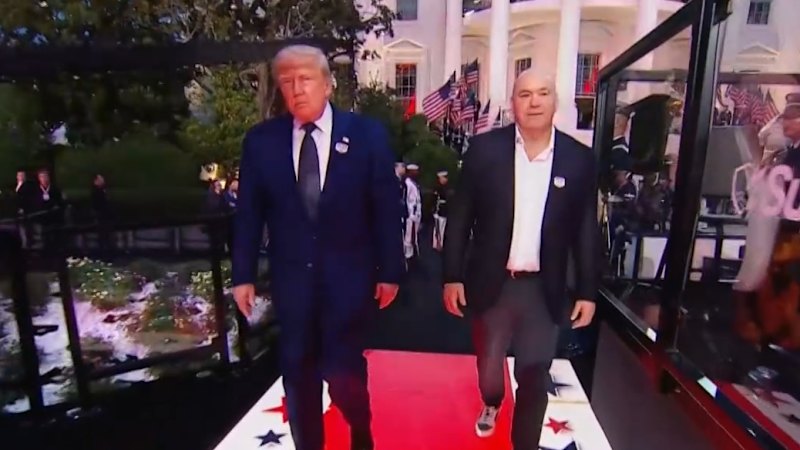
Federal authorities managed to stop a multi-state terror plot targeting the historic UFC Freedom 250 event on the White House South Lawn just days ago. The disclosure of unsealed court documents revealed a sophisticated, multi-tiered plan involving explosive-laden drones and coordinated snipers designed to maximize casualties among attendees, including high-profile government figures. While law enforcement successfully neutralized the cell before any blood was spilled, the operational realities of the conspiracy expose a critical vulnerability in modern domestic counter-terrorism. It demonstrates how rapidly internet-born radicalization can transform into an actionable military-style assault against the most heavily fortified real estate in the world.
The Tactics of the South Lawn Plot
A review of the federal criminal complaints unsealed by the Department of Justice outlines an attack strategy that relied heavily on asymmetric tactics. The plotters did not plan a traditional, direct breach of the heavily fortified White House perimeter. They understood that the physical security array on Pennsylvania Avenue is designed to halt ground-level intrusions immediately. Instead, the conspiracy sought to exploit the vertical dimension of the venue while leveraging the predictable psychology of a panicked crowd.
According to the FBI affidavit, the primary phase of the plan relied on weaponized commercial drones. The cell planned to deploy multiple unmanned aerial vehicles carrying unspecified explosive payloads over the north side of the White House grounds during the outdoor mixed martial arts matches. These drones were to be detonated directly above the temporary stadium structure, colloquially known as "The Claw," where thousands of spectators, corporate executives, and political officials had gathered.
The initial explosions were not intended to be the sole mechanism of mass casualty. They were designed as a lethal diversion. The conspirators anticipated that the aerial bombardment would trigger an immediate, chaotic evacuation of the South Lawn toward pre-determined exit corridors. It was at these bottlenecks that the secondary phase of the attack was positioned.
The cell planned to place snipers at elevated vantage points outside the secure perimeter, specifically targeting the exit routes. Fleeing attendees, funneled into tight spaces by Secret Service evacuation protocols, would have run directly into a prepared line of fire. The explicit objective of this two-stage assault, as stated by detained suspect Tycen Proper in federal law enforcement interviews, was to assassinate high-value targets and spark an immediate political revolution within the United States.
Behind the Radicalization Network
Understanding how five individuals from disparate geographical regions—spanning Ohio, California, Missouri, and Nebraska—coordinated an operation of this magnitude requires looking into their digital footprint. The genesis of the group occurred not in secretive, underground meetings, but on mainstream social media.
Initial communications began in March on TikTok within a specific public channel titled "Vanguard of the Old." This digital space served as an ideological funnel. In this environment, anti-government grievances, ultra-religious sentiments, and conspiracy theories regarding political compromise were openly shared and amplified. As certain members expressed a willingness to move beyond digital rhetoric toward physical action, the core group migrated their operations to Signal to utilize end-to-end encryption.
The federal investigation identified a highly structured communications network within the encrypted application. The primary channel consisted of roughly 19 individuals who focused on grand operational goals, tactical philosophy, and logistical needs, such as securing regional safe houses. Branching off from this main hub were smaller, siloed side chats used to deliberate on specific local tasks without alerting the entire network.
[Main Signal Hub: ~19 Users]
       │
       ├─► [Siloed Chat A: Reconnaissance & Mapping]
       ├─► [Siloed Chat B: Weapon Procurement]
       └─► [Siloed Chat C: Drone Logistics]
This decentralized structure allowed individuals like 31-year-old Abraham Hermosillo Alvarez of Nebraska, operating under the digital pseudonym "Shepherd," to issue precise instructions regarding movement routes, drone launch sites, and escape plans to co-conspirators hundreds of miles away. Meanwhile, Michael Alan Thomas of California acted as an explicit advisory figure, structuring the tactical framework of the cells to ensure the planned violence would directly challenge federal authority.
The Failure of Insurgent Countermeasures
The plot ultimately unraveled due to a fundamental flaw inherent in decentralized, internet-spawned extremist groups. They lack institutional discipline. Despite utilizing secure operational tools like end-to-end encrypted messaging apps, the conspirators failed to account for human variables and the vigilance of immediate family members.
The operational breakdown began on June 10, four days prior to the scheduled fight card, when the mother of 19-year-old Tycen Proper contacted local law enforcement in Ohio. Her intervention was prompted by concrete warning signs. Proper had engaged in a series of rapid firearm acquisitions and had grown increasingly explicit regarding his anti-government intentions in his home environment. When local officers intervened, they discovered an AR-style rifle, thousands of rounds of ammunition, and body armor intended for a rendezvous point in Fredericksburg, Virginia.
Proper’s immediate detention provided federal intelligence agencies with direct access to his mobile device, compromising the entire encrypted network. Within 48 hours, the FBI and partner agencies launched a coordinated multi-state sweep. They arrested Daniel K. Eskridge in Missouri and Bryan Omar Roa in California alongside Alvarez and Thomas. While Roa attempted to distance himself during interrogation by claiming his travel to Washington D.C. was merely intended as a peaceful protest, search warrants revealed he possessed intimate operational knowledge of the planned deployment zones.
The rapid unraveling of the conspiracy highlights a critical pattern in domestic counter-terrorism. While modern tech allows radical cells to organize across immense distances without physical contact, it also means the compromise of a single endpoint can instantly expose the entire network to federal surveillance.
Securing the Airspace of Major Public Events
The South Lawn conspiracy has forced a severe re-examination of how law enforcement protects high-profile gatherings from airborne threats. The White House possesses some of the most sophisticated anti-aircraft and electronic countermeasure systems in the world, yet consumer drone technology continues to present unique tactical challenges.
| Security Layer | Traditional Capability | Drone Defense Challenge |
|---|---|---|
| Physical Perimeter | Concrete barriers, heavy fencing, checkpoints | Completely bypassed via low-altitude flight paths |
| Radar Systems | Detection of aircraft and incoming missiles | Difficult to differentiate small drones from avian activity |
| Quick-Reaction Forces | Rapid deployment against ground threats | Ineffective against distributed aerial payloads |
Standard electronic jamming techniques can disrupt the radio frequencies used to pilot commercial drones. However, if a drone is programmed to fly autonomously via pre-mapped GPS coordinates without an active commercial controller signal, standard radio-frequency jamming becomes ineffective. This reality means security agencies must increasingly rely on kinetic interception methods, directed-energy weapons, or localized net-capture systems to neutralize low-flying threats in crowded urban spaces.
The logistical friction between the Secret Service and the FBI regarding the public disclosure of this investigation further emphasizes the complexity of these operations. Secret Service leadership publicly expressed frustration over the rapid social media announcements made by FBI Director Kash Patel, arguing that premature disclosure could have compromised ongoing monitoring of the remaining 23 identified affiliates in the broader network. This internal friction underscores the difficulty of managing high-stakes counter-terrorism operations when political optics and immediate public safety demands collide.
The Structural Reality of Asymmetric Threats
The prevention of the South Lawn attack is an undeniable victory for federal law enforcement, but it offers no room for complacency. The infrastructure required to plan a mass-casualty event has become entirely commoditized. Off-the-shelf drones, readily available encrypted communication platforms, and open-source mapping software have effectively democratized tactical planning, allowing loosely affiliated citizens to construct complex operations that once required state-sponsored backing.
The true challenge moving forward does not lie in identifying centralized command structures, because those structures no longer exist. Security agencies are now forced to monitor a diffuse, horizontal threat matrix where the line between online rhetoric and catastrophic physical violence can disappear in a matter of days. Law enforcement's ability to stop the next iteration of this threat will depend entirely on their capacity to intercept these networks at the precise moment digital intent attempts to cross over into physical logistics.