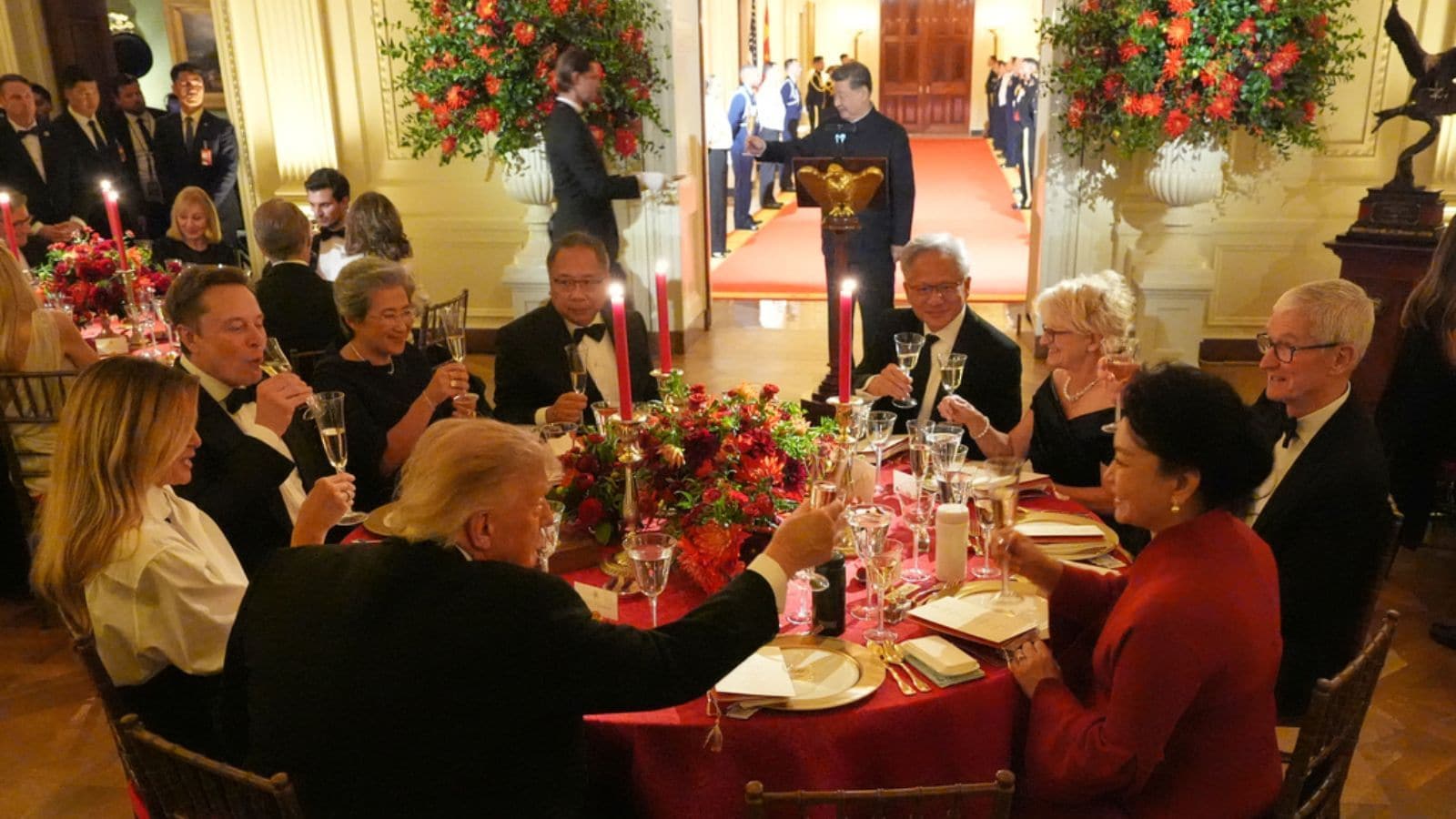
The media spent three days hyperventilating over the place settings. They obsessed over crimson drapery, the choreography of billionaires shaking hands under chandeliers, and a taxidermied bald eagle handed across a white tablecloth like a peace offering between rival empires. Observers framed the Trump-Xi state gathering with Silicon Valley heavyweights as a grand diplomatic breakthrough, a high-stakes alignment of corporate ambition and geopolitical statecraft where tech titans sat down to break bread and secure the future of global trade.
It was theater. Expensive, exquisitely produced, and entirely beside the point.
I have spent two decades watching boards of directors mistake proximity to power for actual influence. When you cram founders of trillion-dollar monopolies into a gilded room with two heads of state, the naive assumption is that policy gets written between the soup and the main course. The lazy consensus says this is where supply chains get untangled, antitrust threats get neutralized, and trade wars get paused.
That is not how great powers negotiate. Real economic boundaries are not redrawn while eating dry-aged beef on Limoges china. They are forged in quiet basement offices in Shenzhen and restricted export control committees in Washington, far away from flashbulbs and bald eagle props.
The Illusion of Access
Let us dismantle the core falsehood driving the coverage of this summit: the belief that face-to-face charm by chief executives alters macro-geopolitics.
Founders think personal rapport moves mountains. They spend decades building software empires where a single direct conversation can pivot a product roadmap or close a venture round. They project that internal logic onto sovereign nations. They assume that if they look a premier in the eye, explain supply chain vulnerabilities, and promise domestic job growth, the tariff walls will lower.
History shows the exact opposite.
When capital and state power collide, the state always eats capital for breakfast. Sovereign nations operate on internal security imperatives, military dominance, and domestic political survival. They do not care about your gross margins, your cloud infrastructure scalability, or your quarterly earnings call.
Imagine a scenario where a software titan convinces a visiting head of state to ease export restrictions on high-end silicon. Sounds like a win, right? Except the intelligence apparatus in both countries views that exact transaction through a national security lens. By morning, regulatory bodies in two capitals have already found three new compliance violations to slap on the company's ledger. The dinner was a pressure valve, a public relations exercise designed to placate jittery shareholders while regulators sharpened their knives behind closed doors.
I have seen companies blow millions on Washington lobbying firms and CEO junkets, walking away with nothing more than expensive photos for their corporate annual reports. Proximity is not power. Proximity is often just a leash.
The Real Agenda Was Domestic, Not Bilateral
Why did they show up then? Why fly private jets across continents to sit in a room where everyone is recording your every chew?
Because the audience was never the foreign delegation across the table. The audience was domestic.
For the tech executives in attendance, the dinner was a defensive shield against local antitrust scrutiny. If you are sitting at the right hand of power, it becomes politically inconvenient for prosecutors to drag your executive team in front of congressional hearings the following Tuesday. It signals alignment with national interests. It wraps corporate monopolies in the American flag while they quietly gobble up remaining market share.
For the political leaders, the dinner was a convenient backdrop to project strength. It tells domestic voters that leaders can command the lords of the digital age, forcing them to bow to state protocols, dress in black tie, and play nice for the cameras.
We mistook a photo op for a treaty.
Let us look at the structural reality of semiconductor supply chains. Silicon fabrication depends on deep, fragile networks spanning Dutch lithography machines, Taiwanese foundries, American software designs, and rare earth elements processed in interior provinces. None of those dependencies shift because two billionaires shared a toast. The geopolitical decoupling of the tech stack is structural, generational, and entirely indifferent to social calendar invites.
Stop Asking For Permission
The most dangerous habit of modern corporate leadership is seeking validation from the state.
Founders used to pride themselves on moving fast and breaking things, operating outside the friction of traditional bureaucracies. Now, they line up at state dinners like courtiers begging for royal favor, trading their independence for temporary regulatory forbearance.
If you run a high-growth enterprise, stop watching the red decor and the state visit recaps. Stop trying to read tea leaves from who sat next to whom. The rules are changing whether the billionaires are dining or not.
The companies that survive the coming fracture between Eastern and Western digital spheres will not be the ones with the best table manners in Washington. They will be the ones that engineered redundancy into their supply chains three years ago, divested from vulnerable jurisdictions before the mandates dropped, and stopped treating government relations as a substitute for actual business strategy.
The bald eagle was a gift. The bill is coming due, and nobody at that table is going to pay it for you.