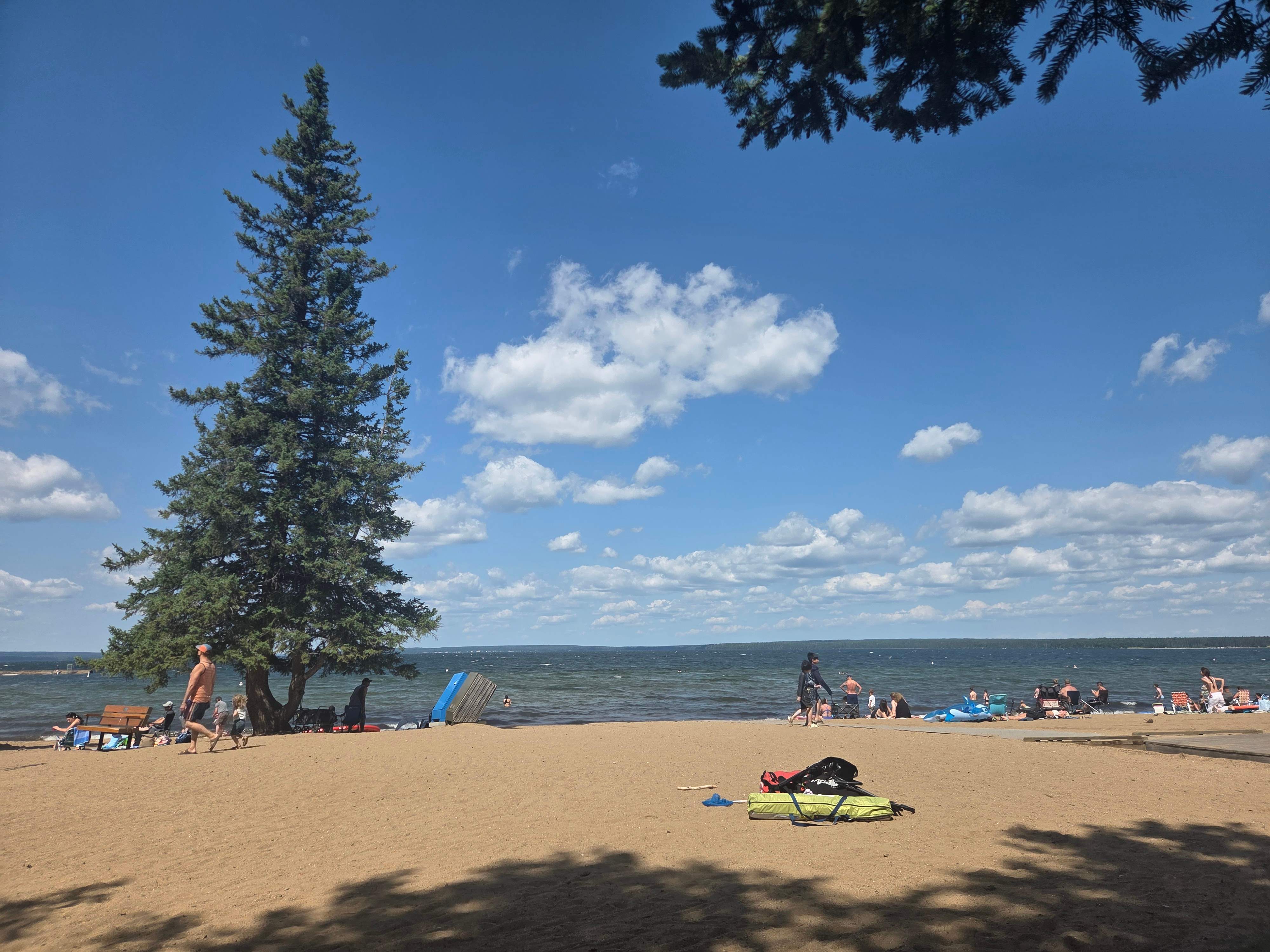
The mist off Waskesiu Lake does not merely rise; it lingers, clinging to the pine needles and wrapping around the empty wooden cabins like an old friend reluctant to leave. Dawn arrives slowly here, filtering through the thick canopy of Prince Albert National Park with a muted, cathedral-like reverence. For most of the year, this northern Saskatchewan sanctuary offers a quiet communion with nature. Visitors come seeking solitude. They come to breathe air that tastes like cold water and pine sap.
Then you hear it.
It is a sound that defies neat categorization, a haunting, raspy whistle that spirals upward through the morning fog, ending in a guttural grunt that vibrates straight down into your chestbones. It is the unmistakable call of a bull elk. And it is no longer echoing from the deep backcountry. It is coming from behind the local bakery.
If you stroll down the main thoroughfare of the Waskesiu townsite during the shoulder seasons, the illusion of human dominion dissolves instantly. You are not the master of this domain. You are a guest in a living room that happens to feature asphalt roads and picnic tables. Over recent years, the frequency of close encounters between humans and wapiti has ticked steadily upward, turning lazy summer strolls and autumn weekend getaways into high-stakes psychological chess matches between modern vacationers and prehistoric giants.
To understand why this is happening, you have to look past the irritation of closed-off hiking trails or the nervous laughter of tourists retreating to their rental cars. You have to understand a fundamental geographic irony. We did not build a town inside a park. We carved a park around a wildlife highway, and the elk never checked out.
Decades ago, when the boundaries of Prince Albert National Park were drawn, planners envisioned a neat division between human recreation and untamed wilderness. Nature would stay on the other side of the tree line. Humans would stay on the manicured lawns, the docks, and the paved pathways. But ecology is stubbornly blind to municipal zoning laws. Waskesiu sits squarely within prime winter and spring habitat for the local elk herds. The townsite offers lush, irrigated lawns, safety from wolves who prefer the deep forest cover, and an abundance of green space that looks to a browsing herbivore like an all-you-can-eat buffet.
Over generations, a cultural shift occurred within the herd itself. The animals learned that humans, while loud and erratic, generally do not shoot at them within city limits. They adapted. They became urbanized wild things, treating swing sets as scratching posts and flower beds as salad bars.
Consider what happens when a family from the city steps out of their cabin at dusk. They smell woodsmoke. They hear the quiet lapping of the lake. Suddenly, a colossal shadow detaches itself from the gloom near the community hall. It is a cow elk, easily weighing six hundred pounds, her ears flicking lazily as she strips the leaves from a roadside poplar.
To the untrained eye, she looks tranquil. She looks almost domestic, like a strange, long-legged horse that wandered off a farm. This is the great danger of Waskesiu. The proximity breeds a profound, dangerous complacency. People forget that a domestic cow has been bred for ten thousand years to tolerate human foolishness; an elk has been honed by evolutionary pressures to kill or outrun wolves.
Visitors reach into their pockets for smartphones. They step closer to get the frame just right for social media. They whisper to their children to wave. They do not see the subtle stiffening of the spine. They do not notice the ears pinning backward, a microscopic shift in posture that translates to a single, unspoken warning: You are too close.
The tension peaks during two distinct windows in the calendar. September brings the rut. The air cools, turning breath into visible plumes of steam, and the bull elk undergo a violent hormonal surge. Their necks swell to the thickness of oil drums. Their antlers, polished sharp against birch trunks, become crowns of raw aggression. During the rut, a bull elk does not care about your vacation itinerary, your national park pass, or your desire to walk your golden retriever. He cares only about dominance, territory, and passing on his genetic code.
Park wardens spend these autumn weeks holding their collective breath. They field frantic calls from campers trapped inside washroom buildings because a seven-hundred-pound monarch of the forest has claimed the gravel pathway as his personal harem.
Then comes spring. May arrives, wrapping the forest in fragile new green growth, and the pregnant cow elk slip silently into the townsite to calve. They seek out the quiet corners between rental cottages, behind public restrooms, and beneath the low-slung branches of spruce trees. They want a place hidden from predators. A human backyard feels safe to them.
It is a tragic collision of maternal instincts. A mother elk hiding her newborn calf views everything as an existential threat. A jogger wearing headphones rounded the corner too fast becomes an assassin. A family walking their dog on an extended flexi-leash becomes a mortal peril.
To an elk, a dog is not a pet. A dog is a wolf.
Every seasoned wildlife biologist in the region repeats the same exhausted plea, year after year, yet the message often shatters against the wall of human entitlement. Keep your distance. Keep your dogs on tight, short leashes. Respect the animal's space. Yet, every single season, human arrogance wins out. Visitors step between a mother and her hidden calf to snap a photograph, or they let their energetic spaniel chase a grazing yearling, triggering a violent defensive charge that ends in broken bones, shattered vacations, and, all too often, the death of the animal.
When an elk injures a human in a national park, the animal is almost always condemned. It is labeled a nuisance, an aggressive outlier, a danger to the public. But the animal is merely acting out its ancient blueprint in a space where humans have decided to crowd the margins. The tragedy of Waskesiu is not that the elk are becoming more aggressive. The tragedy is that we are forgetting how to coexist with things bigger and wilder than ourselves.
We want our wilderness sanitized. We want our wildlife to perform like animatronic attractions at a theme park—docile, predictable, and safely distant until we press record. When they refuse to cooperate, when they assert their boundaries with flashing hooves and heavy breath, we panic. We demand that park staff intervene. We demand fences, removals, and quiet zones.
Step back for a moment. Imagine standing on the quiet shore of the Narrows at midnight. The water is a sheet of black glass, reflecting a million stars that never pierce the smog of the city you left behind. The forest is dead silent except for the rhythmic drip of dew from a cedar branch.
That is when you hear the splash.
You turn your head. Out in the deep, dark water, a massive silhouette cuts through the surface, its powerful shoulders rolling effortlessly with each stroke. Water cascades from its massive rack. It is swimming across the lake under the cold northern lights, moving with an ancient, untamed grace that has nothing to do with us, our schedules, or our cameras.
That is Waskesiu. It is a place that demands humility. It asks us to remember that we are temporary visitors sharing a very narrow strip of earth with forces that were here long before our cabins were built, and that will remain long after our cars have rusted away.
The next time you hear that haunting whistle cut through the morning mist behind the bakery, do not reach for your phone. Do not step closer for a better look. Step back. Turn off your engine. Listen to the heavy silence of the woods, and let the wild keep its distance.