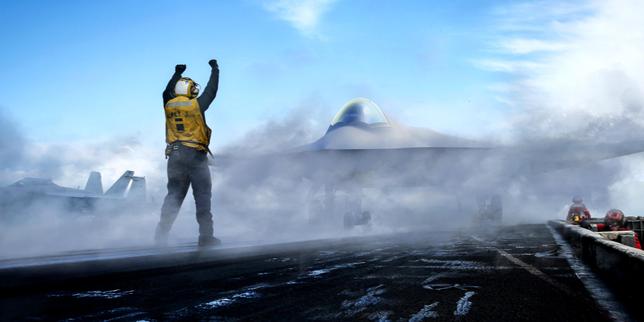
A headline announces that Boeing has been picked to build the future fighter jet for the U.S. Navy, and the crowd cheers like the war is already won.
It isn't.
A contract award is a starting gun, not a finish line. In naval aviation, the gap between winning a program and putting a combat-ready, sustainable aircraft on a pitching carrier deck is where reputations go to die and budgets get shredded.
The lazy consensus reads a selection announcement as a clean comeback story or a neat industrial coronation. One company gets the nod. The rival goes home. The fleet gets its future. Clean, tidy, and completely detached from how modern defense programs actually fail.
The real story is much uglier and far more interesting. Building a carrier fighter today means wrestling with brutal physics, fragile supply chains, shifting threat geometry, and contracting incentives that punish optimism. If you treat a manufacturing selection as settled history, you miss every single mechanism that determines whether the aircraft ever arrives on time, on budget, or in sufficient numbers to matter.
The Myth of the Victory Lap in Naval Aviation
Celebrate the press release if you want. Just don't confuse paper momentum with flight-deck reality.
Naval aviation is one of the most unforgiving operating environments humans have ever engineered. A land-based jet has a long concrete runway, spacious hangars, and a relatively benign atmosphere. A carrier fighter operates over saltwater, slams onto a moving deck at high sink rates, gets yanked to a halt by arrestor gear, blasts off under intense catapult loads, and gets folded and packed into tight spaces alongside dozens of other machines.
Salt air corrodes. Repeated high-G arrestments fatigue airframes. Every pound added for range, stealth, or internal weapons bays steals from deck space, fuel margin, or structural margins elsewhere. There are no free lunches over the ocean.
I have watched defense observers and corporate cheerleaders treat program milestones as if sheet metal were already flying patrols. In reality, early awards often mark the point where the hardest engineering trade-offs collide with commercial math. A design looks brilliant on a slide when assumptions are generous. Once wind-tunnel data, weight growth, thermal loads, and carrier-suitability requirements stack up, compromises become unavoidable.
Think about the mechanics of airframe engineering versus mission systems. For decades, prestige in fighter aviation attached to the airframe itself—the silhouette, the engines, the top speed, the radar cross-section. Those traits still matter. A carrier jet cannot survive or reach modern contested theaters without serious range, signature management, and payload capacity.
Yet the modern combat edge lives heavily in sensors, electronic warfare, networking, weapons integration, and open architecture. The airframe is the truck. What sits inside the truck—and how fast it can be updated without ripping out half the wiring harness—often decides relevance long before the structure wears out.
Imagine a scenario where a navy buys a sleek new manned fighter with exquisite aerodynamic performance, yet its mission software takes years to clear flight test and its maintenance hours per flight hour climb far past what a deployed carrier air wing can sustain. On paper, the fleet looks futuristic. On deployment, availability drops, sortie rates sag, and older jets carry the weight because they are familiar and maintainable. Winning the build contract does not solve sustainment. It just hands someone the bill for figuring it out.
What People Actually Get Wrong About Carrier Air Power
Most commentary around a Navy fighter selection orbits the wrong questions. People ask who won, when it will fly, and how it compares to older jets. None of those questions gets to the heart of naval air power in a contested maritime environment.
Does a Manned Carrier Fighter Still Sit at the Center of Naval Strike?
Yes, with a catch that makes traditionalists squirm. A manned fighter still brings human judgment, onboard sensor fusion, and flexible command authority into messy environments where communications can be jammed or degraded. A pilot can adapt when rules of engagement shift or when targets pop up outside pre-planned scripts.
The mistake is treating the manned jet as a solo act rather than the quarterback of a distributed team. Uncrewed collaborative aircraft, standoff munitions, tankers, and offboard sensors change the math of risk and mass. If a high-value manned fighter has to fly deep into dense air defenses alone just to drop a single weapon, the cost-exchange ratio turns grim fast. If it acts as a survivable node that directs cheaper or expendable assets and launches long-range weapons from safer stand-off envelopes, the value proposition looks very different.
Pretending the future is purely manned ignores affordability and attrition math. Pretending manned fighters are obsolete ignores how hard full autonomy still is in cluttered, contested, electronic-warfare-heavy airspace. The honest answer sits in the friction between the two.
Is Winning a Major Defense Contract Guaranteed Profit?
Not even close. Defense contracting has its own brutal economics, and winning a contest can hurt a company's balance sheet if the risk allocation is lopsided.
When programs lean toward fixed-price structures or aggressive cost targets early on, development overruns do not politely vanish into thin air. Someone absorbs them. A prime contractor can win prestige, backlog, and long-term industrial standing while bleeding cash during complex engineering, testing, and early production if costs outrun expectations.
Even when contract terms leave room for cost adjustments, fixed fees, schedule penalties, rework, and tied-up engineering talent carry real opportunity costs. Winning a flagship program pulls top engineers onto one massive effort and can starve other lines of business or slow internal reform. In defense, winning the bid is only half the deal; surviving the execution phase is the real test.
Why Do Legacy Primes Still Win Big Airframe Contests?
Because building a carrier-capable fighter requires an industrial ecosystem that cannot be spun up in a garage.
You need specialized tooling, deep metallurgy and composites expertise, carrier-arrestment and catapult integration experience, rigorous safety-of-flight certification processes, security clearances across thousands of suppliers, and decades of institutional memory on how naval fleets actually operate at sea. New entrants have shaken up software, small drones, space launch, and commercial concepts in remarkable ways, but building a heavy, carrier-rated combat aircraft from scratch remains a monumental barrier to entry.
That barrier explains why incumbent primes stay in the game. It does not excuse their flaws. Legacy giants often carry bloated overhead, slow internal decision loops, and brittle tier-two and tier-three supply chains. A prime is only as strong as its weakest specialty supplier for forgings, actuators, avionics chips, or coatings. Selecting the prime does not magically heal a strained supply chain.
Inside the Contracting and Execution Trap
To see why so many defense headlines age poorly, look at how large aerospace programs move from ink on paper to hardware on the flight deck.
First comes requirement creep and risk piling. Every stakeholder wants maximum range, maximum payload, top-tier stealth, cutting-edge sensors, rapid delivery, and low unit cost—all at once. Physics and budgets push back hard. When requirements stay overly ambitious while schedules stay tight, risk gets pushed downstream into flight test and production.
Second comes integration complexity. Modern fighter jets are flying data centers wrapped in stealthy, high-stress structures. Getting flight controls, radar, electronic warfare suites, weapons pylons, data links, and mission computers to work together reliably without software regression is often harder than bending metal. A minor change in one subsystem can ripple across cooling, power draw, or software stability in another.
Third comes production ramp friction. Going from a handful of test articles to steady serial production exposes every bottleneck in tooling, parts shortages, skilled labor, and quality inspection. Quality escapes or out-of-sequence work during assembly are expensive to fix once an aircraft is partially built. A single snag in a specialized subassembly can stall an entire line.
I have seen organizations in capital-intensive industries treat early technical optimism as proof that execution risks are minor. They rarely are. In high-complexity hardware, small misunderstandings early become expensive headaches later. When a program spans years or decades, political priorities, threat assessments, and technology baselines shift mid-stream, forcing redesigns and scope changes that test everyone's discipline.
That is why a smart observer watches the contract structure, testing milestones, and industrial health just as closely as the selection announcement itself. The announcement tells you who got the assignment. The execution tells you whether they can deliver.
Where This Contrarian Bet Can Still Backfire
Being contrarian for its own sake is lazy. If I tell you to view a major fighter contract award with skepticism, I owe you the honest case for where that skepticism can go wrong.
A chosen prime contractor might actually nail the execution. Leadership focus, lessons learned from past painful programs, tighter risk controls, and disciplined systems engineering can turn a skeptical outlook upside down. When a major manufacturer commits serious institutional weight to a flagship program and aligns closely with naval engineers, momentum can compound in a positive direction.
There is also the risk of over-indexing on drones and software while underestimating the enduring value of a capable manned platform. Uncrewed systems face their own hard limits: datalinks can be contested, autonomy can struggle with edge cases, and smaller platforms often carry less power, cooling, or payload than a larger crewed jet. If future maritime conflicts demand long-range, survivable, multi-role strike capacity that small systems cannot match, a dedicated carrier fighter could prove indispensable even at high cost.
Finally, industrial scale cuts both ways. Criticism of legacy defense contractors is often justified, yet dismissing large-scale manufacturing capacity is a mistake when a country needs hundreds of complex machines built to strict standards over many years. Startups and agile firms bring speed and fresh thinking, but scaling heavy naval aviation hardware is a marathon of discipline. If the prime manages its supply chain well and keeps requirements realistic, its scale becomes a decisive advantage rather than a burden.
How to Read Defense Wins Without Getting Fooled
Next time a major defense contract lands with fanfare, skip the celebratory spin and apply a sharper filter.
- Separate the award from the capability. Treat a contract selection as permission to compete through engineering and testing, not proof that the fleet's operational gap is closed.
- Watch the contracting terms and risk split. Look closely at how cost, schedule, and technical risk are shared. Aggressive targets sound great in briefings and hurt badly when reality pushes back.
- Track software and sustainment, not just airframe hype. Ask how easily the jet can be maintained on a crowded carrier deck and how quickly its mission systems can absorb upgrades without grounding the fleet.
- Audit the supply chain beneath the prime. A prime contractor is an integrator of thousands of parts and sub-systems. Watch raw materials, specialized components, and skilled labor bottlenecks—that is where schedules quietly slip.
- Measure value against the whole air wing. Judge a new fighter not in isolation, but by how well it pairs with tankers, uncrewed systems, sensors, and munitions to win fights at acceptable cost.
Stop treating defense procurement like a sports scoreboard where one team wins a trophy and the game ends. A fighter contract is a multi-decade engineering wager fought with metal, code, cash, and sea spray.
The real test does not happen on the day the contract is signed. It happens when the jet meets the carrier deck, the budget meets reality, and the threat meets the fleet.