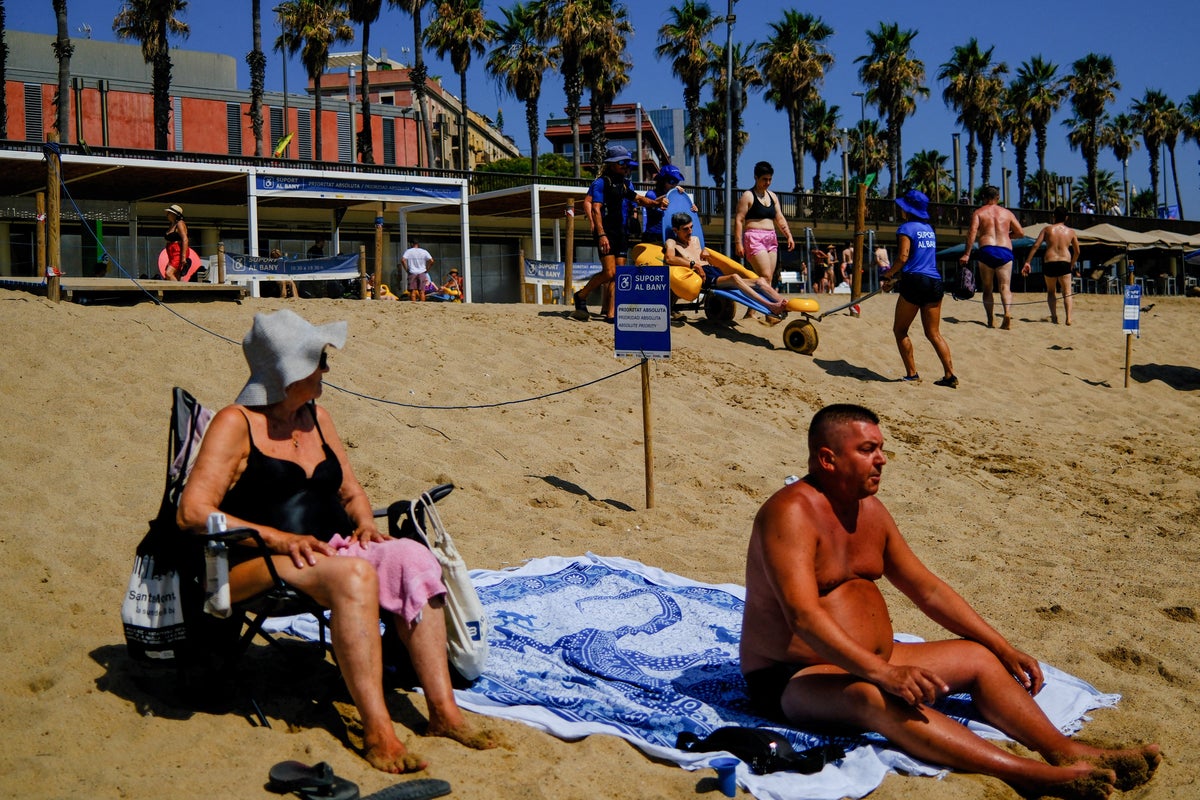
An atmospheric configuration shaped like the Greek letter Omega ($\Omega$) has immobilized the weather systems of Western Europe, forcing surface temperatures above 44°C and triggering a cascading infrastructure crisis across four nations. This phenomenon, known as an Omega block, represents a severe failure of typical mid-latitude west-to-east atmospheric transport. Instead of progressing dynamically across the Atlantic, the jet stream has buckled into a static, high-amplitude wave that traps a massive dome of high-pressure air between two flanking low-pressure troughs. The resulting meteorology is not merely a prolonged summer spell; it is a thermodynamic engine driven by continuous solar radiation and relentless adiabatic compression.
Understanding the mechanics of this system requires moving past the simplified descriptions of extreme summer weather. The operational and economic realities of this specific meteorological event reveal systemic vulnerabilities in energy grids, transit infrastructure, and public health systems that were built for a historical climatic baseline that no longer exists.
The Tri-Cylinder Thermodynamic Engine
The structural stability of an Omega block stems from its three-part geometry. A central core of anomalous high pressure sits anchored over Western Europe, flanked to the west over the Atlantic and to the east over Eastern Europe or Western Asia by deep low-pressure systems. This configuration locks the jet stream into a sharp, northward detour around the central ridge before plunging back southward.
Three distinct physical mechanisms drive the accumulation of extreme heat within this system:
- Atmospheric Subsidence and Adiabatic Heating: High pressure is characterized by sinking air. As upper-level air descends within the core of the ridge, it moves from areas of lower atmospheric pressure to areas of higher atmospheric pressure near the surface. This downward motion compresses the air mass. According to fundamental thermodynamic principles, compression performs work on the gas, raising its internal thermal energy without any external heat input. This adiabatic compression dries the air mass and creates a self-reinforcing loop of rising temperatures.
- Radiative Forcing and Shortwave Acceleration: Sinking air suppresses the vertical motion necessary for cloud formation. The resulting cloudless skies allow maximum incoming shortwave solar radiation to strike the earth's surface unimpeded. The dry soil absorbs this energy, rapidly heating the boundary layer of the atmosphere. Because there is little to no soil moisture left to evaporate in affected regions like southern France and northern Spain, solar energy cannot be dissipated via latent heat flux (evaporation). Instead, it translates directly into sensible heat flux, driving surface temperatures upward.
- Thermal Advection Lock: The high-amplitude wave geometry pulls hot, dry air masses directly from North Africa into the European continent. The stationary nature of the block prevents cooler marine air masses from penetrating inland, creating a closed system where heat accumulates day after day.
This setup means that heat does not simply arrive and linger; it multiplies. Data from Meteo-France confirms that surface temperatures peaked at 44.3°C in the southwestern town of Pissos, illustrating how localized thermodynamic compression amplifies a regional anomaly into an absolute historical record.
Infrastructure Demands and the Cooling Bottleneck
The immediate consequence of an extended Omega block is a direct assault on critical industrial infrastructure, particularly energy generation and transport networks. The standard operational models for these systems assume predictable thermal thresholds. When those thresholds are breached for consecutive days, physical limits alter the economics of energy and logistics.
The thermal bottleneck in nuclear power generation illustrates this vulnerability. In France, the utility EDF faces severe operational constraints at facilities along major river basins, including the Garonne. Nuclear reactors rely on massive volumes of river water to condense steam within their cooling loops. This water is subsequently discharged back into the environment. Regulatory frameworks enforce strict upper limits on the temperature of discharged water to prevent catastrophic ecological damage to aquatic ecosystems.
[Ambient Heat Wave] ──> [Elevated River Water Temp] ──> [Reduced Cooling Efficiency]
                                                               │
                                                               ▼
[Mandatory Regulatory Limits] ──────────────────────────> [Forced Reactor De-rating]
When ambient temperatures exceed 40°C, the baseline temperature of the river water rises significantly before it even enters the plant. The cooling efficiency drops. Plant operators are forced to de-rate reactors—reducing their total electrical output—precisely when regional demand for electricity spikes due to widespread air conditioning and refrigeration use. This mismatch creates an acute structural deficit in power availability, driving wholesale energy prices higher and forcing grid operators to seek emergency imports from neighboring grids.
Concurrently, transport networks experience physical degradation. Rail logistics face severe speed restrictions across the United Kingdom and France due to the risk of track buckling. Steel rails are laid with pre-set tolerances for thermal expansion. When rail temperatures surpass ambient air temperatures by 10°C to 15°C under direct solar radiation, the internal compressive stress within the steel exceeds the lateral resistance of the ballast supporting the track. The resulting alignment failure can cause immediate derailments. To mitigate this risk, operators reduce train velocities, which cuts the kinetic energy transferred to the tracks but introduces systemic delays across supply chains.
Public Health Trajectories and Sub-Optimal Adaptation
The human cost of an atmospheric block is unevenly distributed and highly predictable when analyzed through an epidemiological lens. The recent reported fatalities across Western Europe—including dozens of drownings in France and acute heatstroke deaths in Spain—highlight a failure of behavioral adaptation and structural cooling.
A critical factor governing heat mortality is the nocturnal baseline temperature. During a standard summer hot spell, the ground radiates heat back into space overnight, allowing ambient temperatures to drop and providing human cardiovascular systems a recovery window. Within an Omega block, the sheer mass of the compressed, heated air layer prevents significant nighttime cooling. In urban centers, this effect is compounded by the urban heat island dynamic, where concrete and asphalt retain heat energy. When nighttime minimum temperatures fail to drop below 25°C, cumulative physiological stress increases sharply, driving an escalation in emergency hospital admissions for dehydration, renal failure, and cardiovascular collapse.
The surge in accidental drownings reveals an unmanaged behavioral risk. As populations seek immediate thermal relief, they interact with unmonitored bodies of water without adequate acclimatization or safety infrastructure. This secondary mortality vector often rivals direct heatstroke during the initial phase of an extreme meteorological event.
Shifting Climatic Baselines and Frequency Anomalies
A fundamental point of contention among atmospheric scientists is whether global warming is directly increasing the frequency of Omega blocks, or if it is simply altering their impacts. The current consensus indicates that while the internal dynamics triggering atmospheric blocking are rooted in natural jet stream variability, the baseline atmosphere in which these blocks form has changed fundamentally.
The global average temperature has advanced approximately 1.3°C above pre-industrial baselines. Crucially, Europe is warming at more than twice the global average. This asymmetric warming skews the statistical distribution of weather events.
$$T_{final} = T_{baseline} + \Delta T_{blocking} + \Delta T_{climate}$$
An Omega block that would have produced a severe 38°C hot spell in the late twentieth century now operates on an elevated baseline, pushing the peak thermal output past 44°C. Research from institutional climate centers indicates that human-induced warming adds an estimated 2°C to 4°C to the peak intensity of these blocked systems. The underlying physical structure of the block remains identical, but the thermodynamic ceiling has been permanently elevated.
The extension of these extreme temperatures into high latitudes, including Scandinavia and Norway, serves as empirical confirmation of this shifting baseline. When regions near the Arctic Circle experience tropical-level temperatures during an atmospheric blocking event, it demonstrates that the thermal capacity of the entire mid-latitude troposphere has expanded.
Systemic Risk Mitigation and Strategic Plays
Managing the realities of frequent atmospheric stagnation requires a complete shift from emergency response to structural insulation. Relying on temporary warnings and ad-hoc cooling centers is an unsustainable approach to a recurring thermodynamic reality.
Industrial and municipal authorities must execute specific operational changes to maintain system continuity during future blocking events:
- Industrial Thermal Decoupling: Energy utilities must invest in dry-cooling towers and closed-loop cooling technologies for thermal power plants to eliminate reliance on river water volumes. While these systems require higher upfront capital expenditure and operate with slightly lower peak efficiency than wet-cooling systems, they insulate power generation from ambient hydrological conditions.
- Structural Transport Engineering: Rail network operators must recalibrate the stress-free temperature (SFT) profiles used when installing and tensioning tracks. Shifting the target SFT higher allows rails to tolerate extreme summer heat without buckling, though it requires precise management of winter contraction risks.
- Agricultural Shift Realignment: Agricultural operations must transition harvesting schedules permanently to nocturnal shifts during high-radiation blocks. This operational adjustment mitigates the dual risks of worker heat exhaustion and mechanical spark-induced crop fires.
- Urban Hydrological Interventions: Municipalities must replace conventional pavement with permeable, high-albedo materials and aggressively expand urban canopy layers. This reduces the sensible heat flux in dense residential zones, lowering the nocturnal baseline temperature.
The persistence of the current blocking pattern indicates that these disruptions will not dissipate cleanly. The immediate strategic requirement for European infrastructure operators is to budget for extended periods of reduced asset efficiency, higher peak input costs, and rigid environmental constraints. Stagnation is no longer an anomaly; it is a structural variable that must be hardcoded into every operational model.