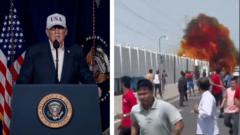
The security architecture of the Persian Gulf shattered at approximately 11:00 AM on Saturday when Iranian ballistic missiles slammed into the Naval Support Activity (NSA) Bahrain. This was not a localized skirmish or a proxy-led harassment. It was a direct, state-on-state kinetic assault on the nerve center of American maritime power in the Middle East. For decades, the presence of the U.S. Fifth Fleet in Manama was considered an insurance policy against open warfare. On February 28, that policy was cancelled in a hail of fire that damaged a 20-story civilian structure and sent smoke billowing over the Mina Salman port.
The strikes were part of a massive, multi-pronged retaliatory wave dubbed "True Promise 4" by Tehran. It followed a joint U.S.-Israeli operation—confirmed by President Donald Trump as "major combat operations"—that reportedly targeted Iranian nuclear sites, missile infrastructure, and even the symbolic heart of the regime in Tehran. While the Pentagon has spent years gaming out "The Big One," the reality on the ground in Manama proves that the gap between theoretical deterrence and actual defense is dangerously wide.
The Mirage of Total Interception
Military officials often speak of "layered defense," a concept where Aegis-equipped destroyers, Patriot batteries, and THAAD systems work in a synchronized dance to swat threats from the sky. On Saturday, that dance stumbled. While the Bahrain Defense Force claims multiple interceptions, local reports indicate that at least two projectiles pierced the shield.
The damage to a high-rise residential building near the base highlights the brutal physics of modern air defense. When an interceptor hits a ballistic missile over a densely populated capital like Manama, the debris doesn't simply vanish. Thousands of pounds of high-grade explosives and burning propellant must go somewhere. In this case, they fell on the doorsteps of the very people the Fifth Fleet is ostensibly there to protect.
A Failure of Tactical Deterrence
- The Scale: Iran launched waves of drones and missiles not just at Bahrain, but at Qatar, Kuwait, and the UAE simultaneously.
- The Targets: The "service center" of the Fifth Fleet was the primary bullseye, a facility critical for the logistics of every American carrier strike group in the region.
- The Result: Regional airspace is now a graveyard of commercial schedules. Saudia, Emirates, and British Airways have grounded flights, effectively severing the Gulf's connection to the global economy.
Why Bahrain Became the Lightning Rod
Bahrain is the smallest of the Gulf states, but it carries the heaviest strategic weight. It is the only country in the region to host a permanent U.S. naval base of this scale. By striking NSA Bahrain, Tehran is sending a message to every other Gulf Cooperation Council (GCC) member: hosting the Americans is no longer a shield; it is a target.
The timing of this escalation is critical. Only days before the strike, rumors surfaced of a massive 200 GB data breach within Bahrain’s National Security Agency. If the "TheAshborn" leak—offered on underground forums for a mere $2,500—is authentic, it suggests that the physical strike was preceded by a total collapse of the digital perimeter. An adversary that knows your operational records and internal communications doesn't need to fire a hundred missiles to hit a target; they only need one that the defense system isn't looking for.
The Political Miscalculation
The current administration's "raze it to the ground" rhetoric regarding Iran’s missile industry was intended to cow the IRGC into submission. Instead, it appears to have triggered a "use it or lose it" mentality in Tehran. If the Iranian leadership believes their silos are about to be obliterated by F-35s, they have every incentive to empty those silos as quickly as possible. Bahrain, sitting just 150 miles across the water, is the easiest place to land those blows.
The Economic Shrapnel
The geopolitical fallout is already visible in the shipping lanes. The "Gemini" shipping alliance, comprising Maersk and Hapag-Lloyd, has effectively abandoned the Suez Canal route once again. The Strait of Hormuz, the world’s most important oil chokepoint, is now a combat zone.
We are seeing the "weaponization of trade" in real-time. When insurance premiums for tankers skyrocket and ports like Khalifa Bin Salman suspend operations, the cost is not borne by the military—it is reflected in global energy prices and the sudden fragility of the "just-in-time" supply chain. The Gulf states, which have spent the last decade trying to diversify their economies through tourism and tech, now find themselves back in the 1980s: trapped in a "Tanker War" they cannot control.
Beyond the Damage Assessment
The smoke over Manama will eventually clear, but the psychological impact on the GCC will remain. For years, states like Qatar and the UAE tried to play both sides, maintaining economic ties with Iran while providing parking spots for U.S. jets. That era of "strategic ambiguity" died on Saturday.
If the U.S. cannot protect its own headquarters in the region from a direct hit, the junior partners in the Abraham Accords and the broader Gulf alliance are forced to ask a terrifying question: what happens to us when the real rain starts? The "nightmare scenario"—a synchronized attack by a desperate regime—is no longer a briefing slide. It is a reality that the Fifth Fleet must now navigate with a damaged deck and a compromised digital footprint.
Move your assets out of the impact zone or prepare for a prolonged siege. There is no middle ground left in the Persian Gulf.