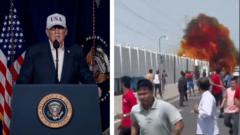
The initiation of Operation Epic Fury on February 28, 2026, marks the most significant decoupling of executive military action from legislative oversight in the post-Vietnam era. By executing a massive, coordinated strike with Israel against Iranian nuclear infrastructure and leadership—including the compound of Supreme Leader Ayatollah Ali Khamenei—the Trump administration has bypassed the traditional consultative framework of the War Powers Resolution of 1973. This maneuver does not merely represent a partisan rift; it functions as a stress test for the American constitutional architecture, pitting the President’s Article II Commander-in-Chief authorities against the Article I Congressional power to declare war.
The immediate reaction on Capitol Hill reveals a tripartite fragmentation of logic regarding the legitimacy and strategic utility of the strikes. To understand the trajectory of this conflict, one must analyze the specific mechanisms of congressional resistance and the statutory limitations that render most legislative responses symbolic rather than corrective.
The Tripartite Logic of Congressional Response
Congressional sentiment is currently governed by three distinct conceptual frameworks, each prioritizing different risks over the others.
1. The Constitutionalist Framework (Anti-Escalation)
Led by Senator Tim Kaine (D-VA) and Representative Thomas Massie (R-KY), this coalition argues that the "imminence" required for unilateral executive action was absent. They contend that while the administration cited Iranian ICBM development and nuclear enrichment, these represent latent threats rather than immediate kinetic triggers. The primary objective of this group is the reassertion of the War Powers Resolution, specifically the 60-day "clock" that mandates a withdrawal of forces unless Congress provides a formal Authorization for Use of Military Force (AUMF).
2. The Deterrence-First Framework (Pro-Action)
House Speaker Mike Johnson (R-LA) and Senate Majority Leader John Thune (R-SD) operate under a logic of "restoration of deterrence." Their position is that the cost of inaction—specifically allowing Iran to cross the nuclear threshold or finalize ICBM capabilities—exceeds the cost of military escalation. This group views the Gang of Eight briefing provided earlier in the week as sufficient fulfillment of the "consultation" requirement, arguing that tactical surprise is a functional necessity that precludes a full floor vote.
3. The Strategic Realist Framework (Endgame Skepticism)
Represented by figures like Senator Mark Warner (D-VA), this group acknowledges the Iranian threat but focuses on the Cost Function of Regime Change. They point to the President’s direct appeal for the Iranian people to "take over" their government as evidence of an undeclared policy of regime change. Their critique is centered on the absence of a "Day After" strategy, noting that decapitation strikes rarely result in stable transitions and instead create power vacuums that invite proxy interference.
The War Powers Resolution: Structural Bottlenecks
The push for a War Powers Resolution vote, scheduled to be forced by Representative Ro Khanna (D-CA) and Senator Tim Kaine, faces three structural bottlenecks that limit its efficacy as a check on executive power.
- The Veto Barrier: Even if a resolution to withdraw U.S. forces passes both chambers—a possibility given the "America First" alignment of some Republicans with the Democratic caucus—it remains subject to a presidential veto. Overriding a veto requires a two-thirds majority, a threshold currently unreachable in a polarized 2026 Congress.
- The Definition of "Hostilities": The administration may argue that the strikes were "discrete kinetic actions" rather than the "introduction of U.S. forces into hostilities." By characterizing the operation as a preemptive defensive strike, the White House creates a legal gray area that delays the activation of the 60-day statutory limit.
- The Intelligence Asymmetry: The executive branch maintains a monopoly on the underlying intelligence used to justify the "imminence" of the threat. Without a full declassification of the data regarding Iran's ICBM progress, Congress lacks the evidentiary basis to effectively challenge the administration's legal justification in the court of public opinion.
The Economic and Geopolitical Cost Function
The congressional debate is not occurring in a vacuum; it is tethered to a deteriorating regional security environment that creates a feedback loop for domestic policy.
| Variable | Immediate Impact | Congressional Pressure Point |
|---|---|---|
| Energy Markets | 15% spike in Brent Crude futures | Inflationary pressure on the 2026 mid-term cycle |
| Regional Retaliation | Missile strikes on U.S. assets in Qatar and Bahrain | Demand for increased defensive appropriations |
| Diplomatic Decay | Collapse of Omani-mediated nuclear talks | Elimination of the "Diplomatic Runway" for moderates |
The "America First" faction within the GOP, led by Representative Massie, highlights a specific contradiction: the administration’s focus on Middle Eastern regime change conflicts with the stated goal of reducing foreign entanglements and focusing on domestic economic stability. This creates a rare horizontal alliance between the progressive left and the populist right, targeting the "Forever War" narrative that dominated the early 2000s.
The Institutional Endgame
The current trajectory indicates that Congress will likely move toward a symbolic "referendum" vote on the war. While this will not physically halt Operation Epic Fury, it serves two critical functions:
- Limiting the Scope of Appropriations: Congress holds the "power of the purse." While they cannot easily stop an ongoing strike, they can refuse to authorize long-term funding for an occupation or a prolonged regime-change effort.
- Forcing Transparency: The demand for "all-senators" briefings and public testimony from Secretary of State Marco Rubio is designed to force the administration to define its "end state." Without a defined exit strategy, the administration risks a "Vietnam-style" credibility gap that could erode its support among its own base.
The strategic play for the legislative branch is not the immediate cessation of strikes—which is functionally impossible—but the imposition of fiscal and legal constraints that prevent the operation from expanding into a decade-long regional conflict. The next 72 hours of floor debate will determine whether the U.S. government maintains its system of checks and balances or shifts permanently toward an era of unrestrained executive warmaking.
Would you like me to map the specific voting blocks in the House and Senate to identify which swing votes will determine the outcome of the War Powers Resolution?