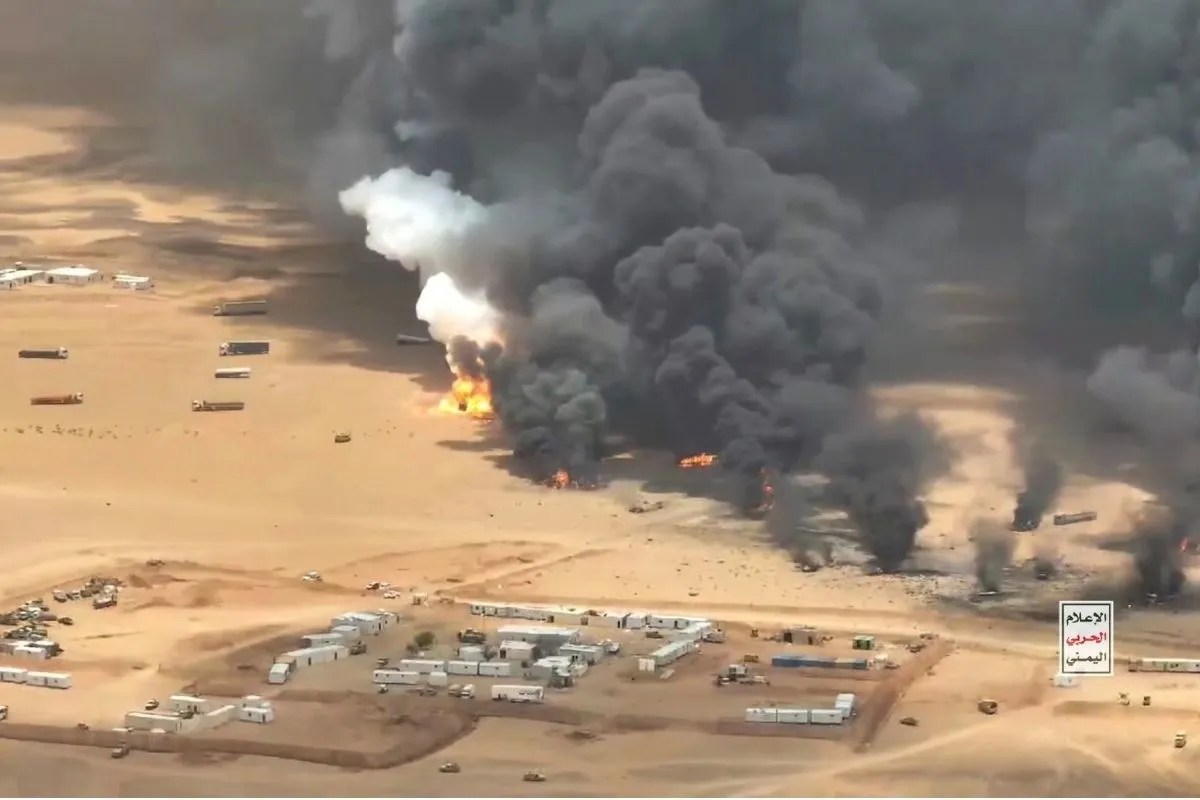
The war room in Riyadh operates under a relentless hum of fluorescence and digitized tension. Decades of military modernization, billions spent on Western-built hardware, and an absolute conviction in air supremacy have collided with a persistent, dug-in adversary. When Saudi-led coalition warplanes launched fresh waves of intensive airstrikes against Houthi military installations across Yemen, official bulletins framed the operation as a decisive enforcement of regional stability.
Reality paints a much grimmer, more complicated picture.
Surface-level reporting captures the raw scale of the bombardment: dozens of targeted sorties striking missile depots, drone-assembly workshops, and command nodes in Sana'a, Hodeidah, and Saada. Yet, treating these operations as isolated tactical victories misses the broader strategic stalemate. For years, aerial campaigns have destroyed high-value assets only for those same assets to be rebuilt, decentralized, or buried deeper beneath the rugged Yemeni terrain.
The Logistics of Attrition
Airpower alone has never broken a determined insurgency. Houthi forces have mastered the art of asymmetric survival, integrating supply lines into civilian infrastructure, utilizing mobile launchers that vanish minutes after firing, and manufacturing indigenous ballistic components with smuggled Iranian blueprints.
Every ton of ordnance dropped on a Yemeni ridge carries a staggering financial and political cost. While Riyadh fields state-of-the-art interceptors and strike platforms, the adversary fights an ultra-low-cost war of attrition. A modified delta-wing drone manufactured for a fraction of a typical missile's cost forces a multi-million-dollar defense response. This mathematical imbalance forms the quiet crisis haunting military planners across the Gulf.
Strategic analysts have long warned about the diminishing returns of punitive bombing campaigns. When infrastructure collapses, the civilian toll mounts, diplomatic pressure intensifies from Western capitals, and the underlying political grievances that fueled the Houthi rise remain unaddressed. The airstrikes may degrade offensive capabilities temporarily, but they fail to alter the geopolitical trajectory on the ground.
Inside the Command Miscalculation
The miscalculation lies in assuming that technological superiority translates directly into political outcomes. Modern air campaigns require clear end-states. If the objective is total eradication of Houthi military capacity through kinetic strikes, military history offers little comfort. Insurgent networks embedded in mountainous terrain and supported by popular mobilization or coerced local compliance adapt faster than remote sensors can track.
Consider the operational cadence of these recent strikes. Intelligence feeds identify a suspected drone storage facility; tactical aircraft scramble; ordnance is delivered with precision. Within forty-eight hours, secondary networks disperse remaining hardware into underground tunnels carved into the highlands. The cycle resets.
Meanwhile, diplomatic channels groan under the weight of competing priorities. International bodies push for permanent ceasefires and humanitarian corridors, while regional powers demand ironclad security guarantees against cross-border projectile fire. Riyadh finds itself trapped between the necessity of defending its sovereign borders and the realization that military solutions have hit a hard ceiling.
The Regional Spillover
Yemen is no longer a localized civil conflict. It functions as a testing ground for modern drone warfare and regional proxy dynamics, drawing in maritime security concerns across the Red Sea and the Bab el-Mandeb strait. Global trade routes shudder whenever shipping lanes face disruption from Yemeni shores, tying the security of Riyadh directly to the stability of international commerce.
Insurance premiums for vessels navigating the southern Arabian Peninsula spike after every major escalation. Supply chains thousands of miles away feel the immediate friction. The Houthi leadership understands this leverage intimately. They calculate that economic disruption in the West and regional exhaustion will eventually force concessions that battlefield victories alone could never secure.
Beyond the Smoke
The smoke clearing over bombed-out military camps in Sana'a reveals a stark truth. Superior firepower can suppress, disrupt, and delay, but it cannot legislate a peace settlement or dismantle an ideology born of decades of marginalization and war.
Until regional strategies pivot from cyclical bombardment to sustainable political architecture, the jets will keep scrambling from Riyadh airbases, the explosions will light up the night sky over Yemen, and the underlying conflict will remain entirely unresolved, waiting for the next spark.