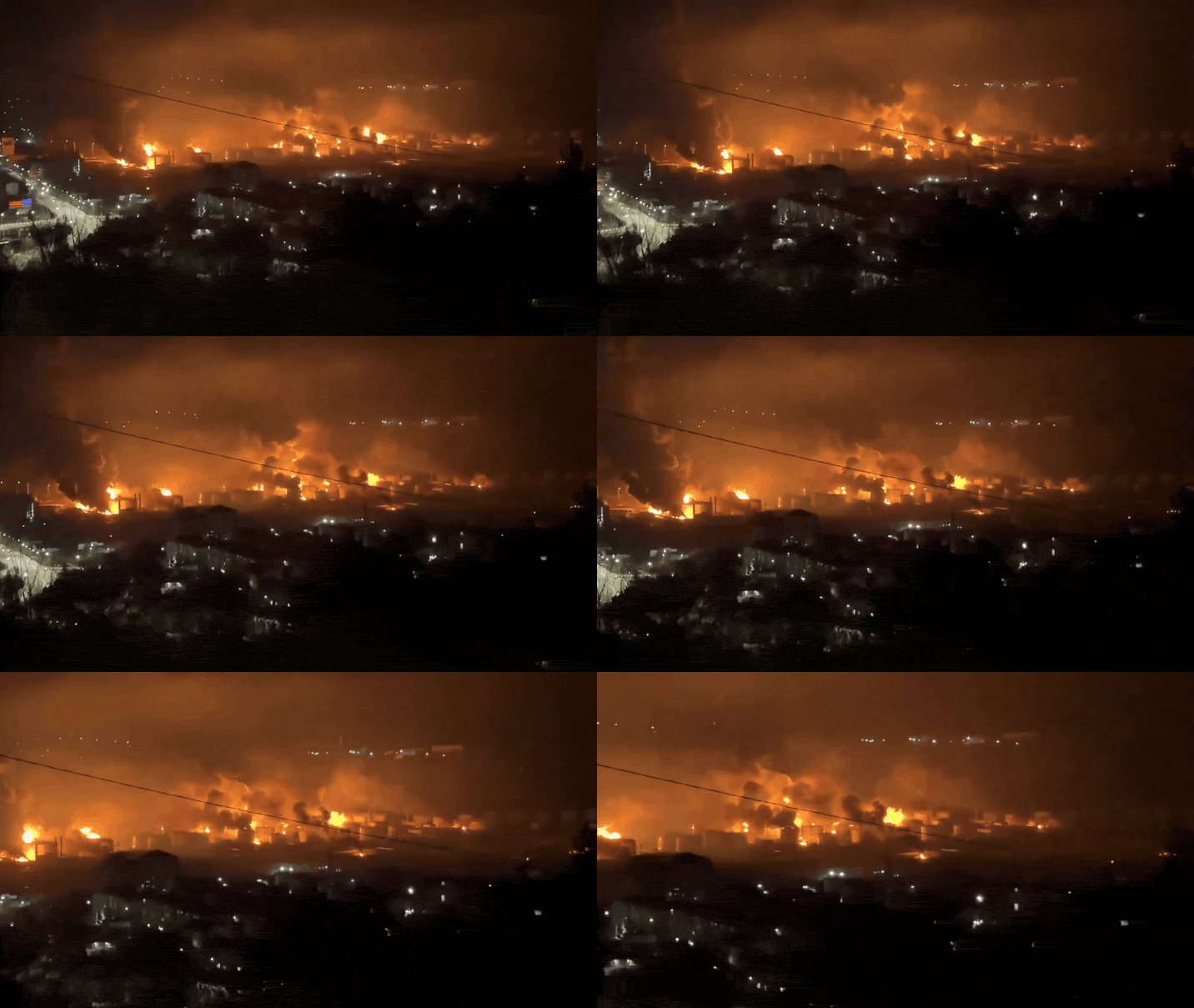
The fifty-second day of active hostilities involving US-Israeli operations and Iranian-aligned proxies marks a dangerous transition from tactical skirmishes to a broader strategic siege. What began as a series of contained responses has mutated into a high-stakes campaign to dismantle the logistical and financial networks that sustain Tehran's regional influence. At the heart of this conflict is no longer just the immediate security of borders, but a fundamental attempt to rewrite the security architecture of the Middle East by force.
While headlines often focus on the immediate damage of missile strikes or drone interceptions, the true weight of the fifty-second day lies in the shifting nature of the targets. We are seeing a move away from military outposts and toward dual-use infrastructure. This shift suggests a long-term plan to cripple the economic capacity of regional actors to wage prolonged asymmetric warfare. The logic is simple and brutal. If you cannot stop the ideology, you must starve the engine that powers it.
The Invisible Attrition of the Logistics Chain
Military analysts often obsess over the "flash" of the strike. They count the craters. They measure the payload. However, the more significant development on day 52 is the systematic degradation of the "Land Bridge"—the supply route stretching from the Iranian border through Iraq and into Syria.
Western intelligence suggests that recent sorties have focused on specific nodes that are difficult to repair. We aren't talking about simple asphalt roads. The targets are specialized storage facilities for precision-guided munition components and the technical personnel required to assemble them. By removing the specialists and the specialized parts, the opposition forces a regression in the capabilities of local militias. They are being pushed back toward "dumb" rockets and unguided projectiles, which are far easier to intercept.
The cost-benefit analysis for the US and Israel remains a gamble. Every precision strike costs millions of dollars. The targets being hit are often worth a fraction of that in raw materials. Yet, the value is not in the material destroyed, but in the time purchased. Every shipment intercepted is a month or more that a proxy group must spend scrambling to find an alternative.
The Iraq Pivot and Political Contagion
Iraq has become the most volatile theater in this fifty-two-day saga. Unlike Syria, where the lines of control are relatively stagnant, Iraq is a sovereign partner to the United States while simultaneously hosting groups that are actively firing on US positions. This creates an impossible diplomatic friction.
The current strategy involves a surgical separation. By targeting specific command-and-control centers within Iraq, the US-Israeli efforts are attempting to signal to the Iraqi government that their sovereignty is conditional on their ability to restrain these groups. It is a high-wire act. If the pressure is too light, the attacks continue. If it is too heavy, the Iraqi government could be forced by popular pressure to expel Western forces entirely, handing a strategic victory to Tehran without a single shot being fired in return.
The Red Sea Chokehold and Economic Blowback
While the land war dominates the news cycle, the maritime front has entered a phase of permanent disruption. On day 52, the cost of global shipping has not just increased; it has baked in a "risk premium" that is now considered the new normal.
Insurance premiums for vessels transiting the Bab el-Mandeb have surged by over 1,000% since the start of the conflict. This is not a temporary spike. It is a structural change in how global trade views the region. The US-led coalition, Operation Prosperity Guardian, has found that defensive warfare is exponentially more expensive than offensive disruption. It costs $2 million to fire a single interceptor missile at a drone that costs $20,000 to build.
The math is unsustainable.
Financial Warfare and the Banking Sector
Beyond the kinetic strikes, a shadow war is being fought through the international banking system. Intelligence agencies are tracking the movement of digital assets and traditional currency used to pay the salaries of tens of thousands of fighters across the region.
On day 52, we see evidence of increased pressure on exchange houses in Baghdad and Beirut. By tightening the "dollar tap," the US Treasury is attempting to trigger internal dissent within these organizations. When the money stops flowing, the loyalty of a mercenary force begins to evaporate. History shows us that an unpaid fighter is more dangerous to his commander than to his enemy.
The Intelligence Gap and the Risk of Miscalculation
The greatest danger after nearly two months of constant combat is the erosion of clear communication. In the early days of the conflict, there were back-channel messages—often relayed through intermediaries in Oman or Qatar—that established "red lines." Those lines have been blurred.
We are now in a period where both sides are guessing at the other’s breaking point. Israel’s objective appears to be a total degradation of the "Ring of Fire" strategy employed by its adversaries. Meanwhile, the Iranian strategy is one of strategic patience, hoping to bleed the Western powers through a thousand small cuts until the political cost of staying in the region becomes too high for domestic audiences in Washington.
The Technological Evolution of the Conflict
This conflict is a laboratory for the future of warfare. We are seeing the first large-scale use of AI-driven target acquisition and autonomous loitering munitions.
- Autonomous Swarms: The use of multiple low-cost drones to overwhelm sophisticated air defense systems.
- Electronic Warfare: Constant jamming that affects not just military hardware but civilian GPS and telecommunications.
- Cyber Sabotage: Attempts to disrupt the power grids and water supplies of regional capitals.
These are not just weapons of war; they are tools of psychological exhaustion. The goal is to make daily life so unpredictable and miserable that the civilian population demands an end to the conflict at any price.
The Domestic Pressure Cooker
Inside Israel, the fifty-second day is marked by a deepening divide. The initial unity seen after the start of the war is fraying under the weight of an indefinite mobilization. The economy is struggling with a massive labor shortage as reservists remain on the front lines. The social contract is being tested.
Similarly, in the United States, the political appetite for a "forever war" in the Middle East is at an all-time low. With an election cycle looming, the administration is desperate for a "win" that doesn't involve boots on the ground. This desperation can lead to one of two things: a rushed, flawed peace deal or a massive, decisive escalation intended to end the threat once and for all.
The Failure of Traditional Diplomacy
The United Nations and other international bodies have been relegated to the sidelines. The fifty-two days of conflict have proven that traditional diplomatic frameworks are ill-equipped to handle non-state actors who do not answer to the laws of nations.
When a militia in Yemen or Iraq can dictate the price of oil in London or New York, the old rules of engagement are dead. The current conflict is the first major war of the multi-polar era, where regional powers have the technology and the will to ignore the dictates of traditional superpowers.
Beyond the Fifty-Second Day
The conflict is moving into a "war of the warehouses." The side that can rebuild its stockpiles faster will eventually dictate the terms of the ceasefire. This puts the focus squarely on the manufacturing hubs. If the US and Israel decide that they must stop the flow of weapons at the source, the war will move from the outskirts of the Levant directly to the heart of the Iranian plateau.
That is the escalation everyone fears, and on day 52, it looks more likely than it did on day one. The "de-escalation" language used by diplomats is increasingly detached from the reality on the ground. You do not move this much hardware and spend this much political capital just to return to the status quo. The goal is a new reality, and the price of that reality is being paid in blood and broken infrastructure every single hour.
The regional powers are no longer looking for an exit ramp. They are looking for a finishing blow that will ensure they don't have to fight this same war again in five years. This mindset makes the prospect of a near-term peace almost impossible. The machinery of war has been cranked to a frequency that is hard to silence, and the strategic objectives of both sides have become mutually exclusive. Either the "Axis of Resistance" is dismantled, or the Western-aligned security structure in the Middle East collapses. There is no middle ground left to occupy.
Investors and analysts should stop looking for a date when this ends and start looking for the signs of what the region looks like after the dust settles. The geography will be the same, but the power dynamics will be unrecognizable.