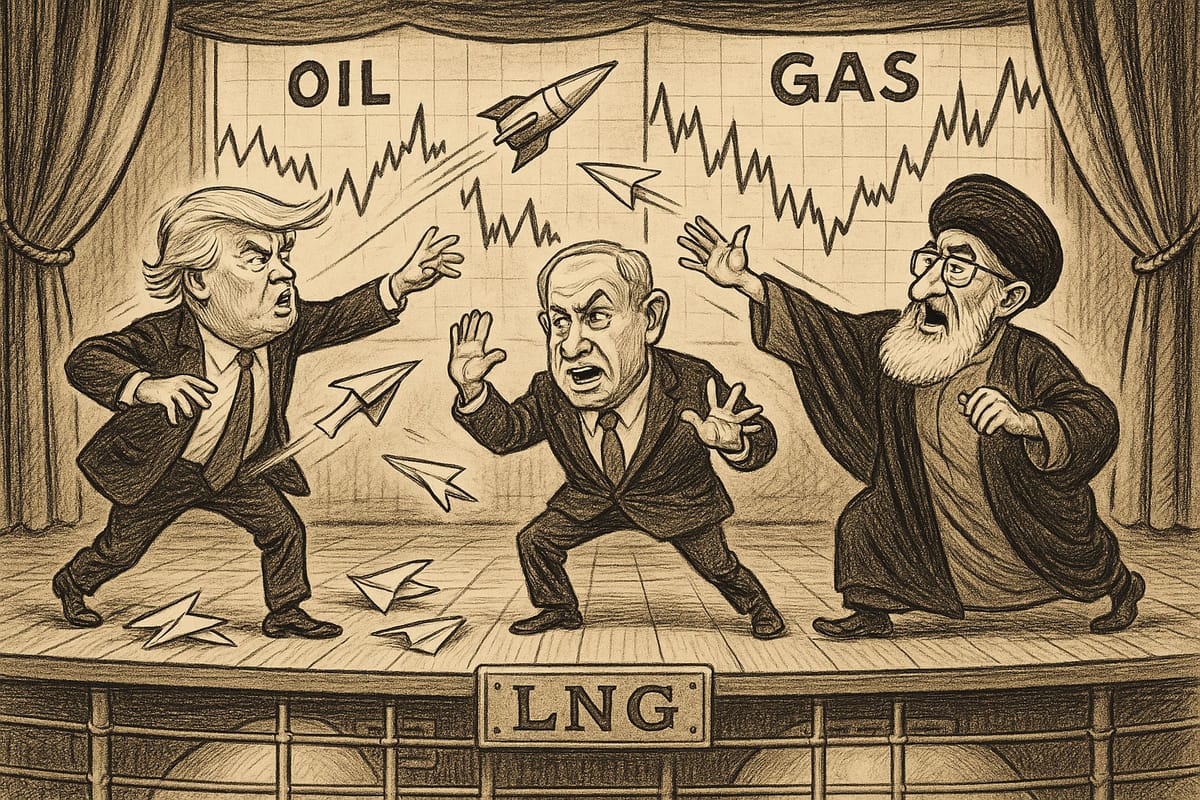
The map-makers are lying to you. When you see those red and blue arrows sweeping across the Middle East in the latest "escalation" graphics, you are being sold a narrative of looming Armageddon that ignores the cold, mechanical reality of modern theater. Most analysts treat the missile exchanges between Israel and Iran as a prelude to total war. They are wrong. This is not a prelude; it is a calibrated, high-stakes trade agreement written in ballistic trajectories and kinetic interception data.
Every time a siren wails in Tel Aviv or an explosion rattles an Isfahan factory, the "lazy consensus" screams that we are one step away from the brink. In reality, we are watching a highly choreographed ritual of domestic survival and industrial testing. These strikes are designed to be "absorbed." If either side actually wanted to start a regional conflagration, they wouldn't telegraph their launches three hours in advance or target empty sand dunes and secondary radar sites.
The Myth of the Unstoppable Escalation
The mainstream media loves the "clash of civilizations" trope. It sells ads. But if you look at the telemetry and the diplomatic backchannels, a different picture emerges. Iran and Israel are currently locked in a symbiotic cycle of "managed friction."
Consider the physics. When Iran launches a wave of Shahed-136 drones, they aren't expecting a miracle. They are providing Israel’s Rafael Advanced Defense Systems and the U.S. Raytheon with the most expensive live-fire training exercise in human history.
- The Cost-Exchange Ratio: Critics point out that Israel spends millions on interceptors to down drones that cost $20,000. They call this a strategic failure.
- The Data Harvest: They miss the point. Every interception is a data point for the next generation of AI-driven fire control. Israel isn't "losing" money; they are hardening their "Iron Dome" and "Arrow" systems against future threats while their adversaries reveal their launch signatures and flight paths.
The Telegraphed Punch
Real wars are won by surprise. The 1967 Six-Day War didn't start with a press release. Yet, the April and October 2024 exchanges were practically scheduled. Iran signaled through regional intermediaries exactly when and where the "retaliation" would occur. Israel, in turn, responded with "surgical" strikes that hit precisely what was needed to save face without decapitating the regime.
This is Geopolitics as Performance Art.
The Iranian leadership needs to show its "Axis of Resistance" that it can touch the "Zionist entity." The Israeli government needs to show its citizens that it is the only wall standing between them and annihilation. Both sides use the threat of the "Other" to suppress internal dissent and justify massive military budgets. If the conflict actually ended, both regimes would face far more dangerous enemies: their own disgruntled populations.
Why "Proportionality" is a Strategic Lie
You’ll hear UN bureaucrats and talking heads prattle on about "proportionality." This is a useless concept in modern warfare. In the Middle East, there is only the Redline Buffet.
Both Tehran and Jerusalem are constantly sampling which redlines they can cross without triggering a full-scale invasion.
- Cyber-Strikes: These happen daily. They are the background radiation of this conflict.
- Proxy Bleeding: Iran uses Hezbollah and the Houthis to provide plausible deniability.
- Direct Kinetic Hits: The new "normal." By moving from proxy wars to direct strikes, both nations have actually lowered the risk of accidental war. Why? Because the communication is now direct. There is no longer a risk of a rogue proxy commander making a mistake that drags the principals into a war they didn't want.
The Technological Mirage
The maps you see in the news often highlight the range of Iran’s Khorramshahr-4 or Israel’s Jericho III missiles. This focus on "range" is a relic of Cold War thinking. In the 2020s, the only metric that matters is Precision-to-Interception Probability.
Iran has transitioned from "dumb" rockets to precision-guided munitions (PGMs). This sounds terrifying, but it actually makes the world safer. Why? Because a regime with precision weapons can choose not to hit a hospital. They can choose to hit the parking lot next to a research facility to send a message. When your weapons are precise, your diplomatic signals are clearer.
The danger isn't the "escalation ladder"; it's the "accidental success." The greatest fear for Iranian planners isn't that their missiles miss—it's that one accidentally hits a high-value civilian target or a holy site, forcing an Israeli response that the regime cannot survive.
The Industry Insider’s Take: Who Actually Wins?
Follow the money. The real beneficiaries of these "strikes" aren't the generals in the bunkers. It's the global defense complex.
- The Laboratory Effect: The Negev desert and the skies over Isfahan have become the world’s premier laboratories for electronic warfare (EW).
- Export Potential: Every time an Arrow-3 interceptor hits a medium-range ballistic missile outside the atmosphere, its stock price—and the demand from countries like Germany—skyrockets.
- The Iranian Pivot: Tehran uses these conflicts to market their "low-cost, high-nuisance" drone tech to Russia and other pariah states. They aren't trying to win a war against Israel; they are building a brand as the "Amazon of Insurgent Tech."
I've seen defense contractors in Tel Aviv and observers in Washington privately marvel at the efficiency of these exchanges. It’s a closed loop. We provide the interceptors, Iran provides the targets, and everyone gets a promotion and a budget increase for the next fiscal year.
Dismantling the "People Also Ask" Nonsense
"Is World War III starting in the Middle East?"
No. Stop asking. Total war is bad for business and fatal for the ruling elites. The current status quo of "managed strikes" is far more profitable and stable for both the Ayatollahs and the Likudniks than a scorched-earth scenario that would leave both nations as radioactive glass.
"Can Israel destroy Iran’s nuclear program?"
With conventional missiles? Unlikely. Most of the facilities are buried under 60 meters of granite. A strike that fails to destroy the program but succeeds in killing scientists only accelerates the nuclear timeline. Israel knows this. The strikes you see are about optics, not denuclearization.
"Why doesn't the US stop the attacks?"
Because the US benefits from the data. The US military is getting a front-row seat to how Russian-influenced Iranian tactics fare against Western-style integrated air defense. It’s the ultimate stress test, paid for in shekels and rials.
The Brutal Reality of the "New Normal"
We have entered an era where "War" is no longer a binary state of On or Off. It is a sliding scale of kinetic activity used as a diplomatic tool.
The maps you see on the news are static images of a dynamic, fluid negotiation. Iran fires a salvo to say, "We are still here." Israel strikes back to say, "We can see you." It’s a high-stakes conversation conducted in the language of explosives.
If you want to understand the next "strike," stop looking at the maps and start looking at the internal polling and the defense contracts. The missiles are just the punctuation marks in a sentence about domestic political survival.
Stop waiting for the "Big One." This is the Big One—a perpetual, controlled, and highly lucrative state of mid-intensity conflict that serves everyone except the people living under the flight paths.
The next time you see a "Breaking News" alert about missiles over Tehran or Jerusalem, don't panic. Check the stock prices of Lockheed Martin and Israel Aerospace Industries. They’ll tell you more about the "attack" than any general ever will.
The arrows on the map aren't pointing toward a destination. They are running in a circle.