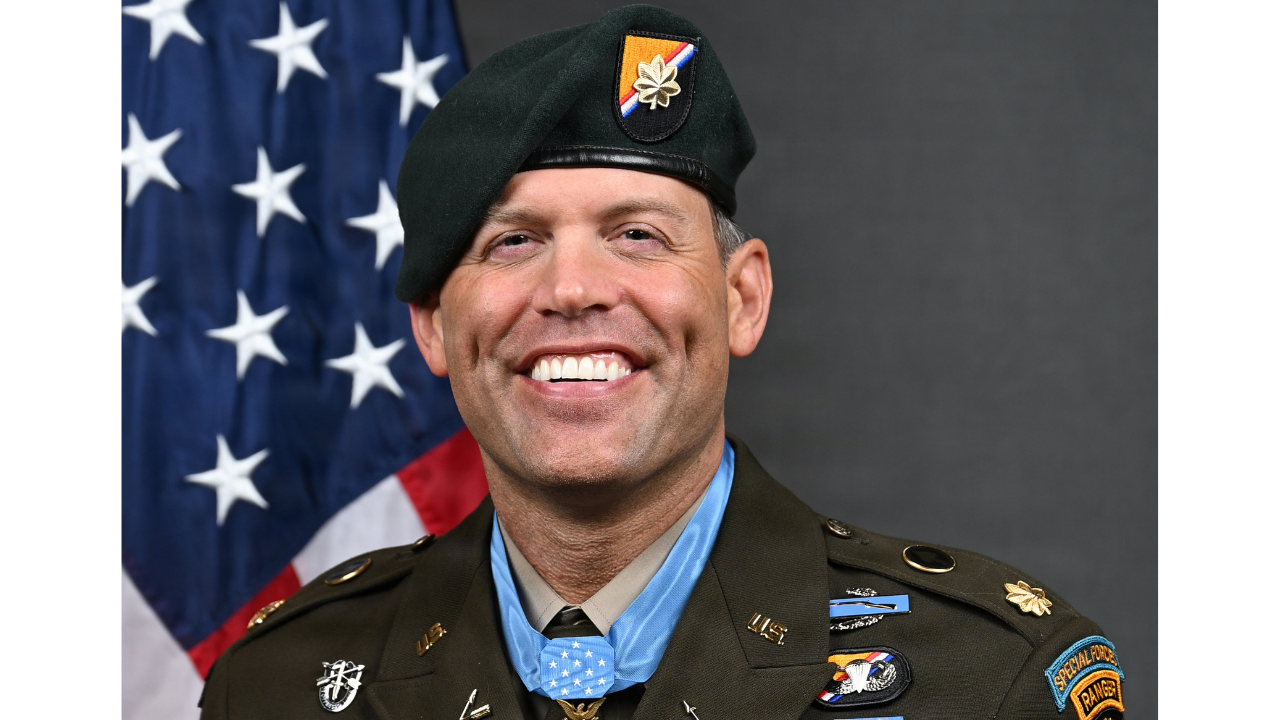
You think you know what a bad day looks like. Then you read about October 2, 2012, in the Kapisa province of Afghanistan.
An infantry platoon led by a 26-year-old Second Lieutenant named Nicholas Dockery walked straight into a hornets' nest. An estimated 150 Taliban fighters ambushed them. The math wasn't in America's favor. The enemy had machine guns, heavy rifles, and rocket-propelled grenades. They had the high ground and the element of surprise.
What happened over the next few hours sounds like a Hollywood script, but every single detail is etched into military history. Every single soldier in Dockery’s immediate unit was wounded during that firefight. Yet, every single one of them walked away alive.
On June 18, 2026, President Donald Trump placed the Medal of Honor around the neck of Retired Major Nicholas Dockery at the White House. It was an upgrade of a Silver Star he received years ago, a correction of history that took over a decade to finalize. If you want to understand what absolute, unyielding leadership looks like under the absolute worst conditions, you need to look at what Dockery did in that compound.
The Chaos in Kapisa Province
When the ambush started, the Afghan national forces and U.S. troops were fractured under a hail of lead. Dockery didn't hide. He sprinted across 100 yards of completely open terrain, bullets kicking up dirt around his boots, just to reach a group of isolated soldiers.
He heard a soldier was wounded inside a nearby building. The problem? The building was actively crawling with Taliban fighters.
Dockery didn't wait for backup. He organized the few men he had and went to work clearing the structure. Room by room. Floor by floor. They cleared six rooms in a multi-level compound. Dockery killed one fighter at close range with his carbine and detained two others.
Then the heavy explosives started flying. An enemy grenade thumped onto the floor right next to his team. Instead of diving away to save himself, Dockery grabbed a fellow soldier and shoved him behind cover, absorbing the brunt of the blast momentum himself.
Dazed, bleeding, and dealing with a concussion, he kept moving. He didn't check his own wounds. He gathered four men to clear the courtyard. That's when a rocket-propelled grenade (RPG) detonated right in the middle of them.
Two Taliban Fighters and a Missing NCO
The RPG blast knocked out the remaining soldiers, leaving them completely exposed to direct enemy fire. Dockery was wounded again. Through the smoke and dust, he saw two Taliban fighters emerging from an alley. They weren't just trying to kill an American soldier; they were actively dragging away an unconscious U.S. Army non-commissioned officer, Sergeant Jack Hansbro.
The Taliban wanted a prisoner. They wanted propaganda.
Dockery charged the two fighters alone. He neutralized both of them in close-quarters combat, breaking the enemy's grip on the unconscious sergeant. When he checked Hansbro, the sergeant wasn't breathing. Dockery didn't just pull him to safety; he knelt in the dirt while taking fire and performed CPR, pumping the soldier's chest until his lungs filled with air again. He saved the man's life twice in a span of three minutes.
By this point, the entire team’s position was destroyed. Their cover was gone. Every single man was bleeding.
The Roof and the Aftermath
Apache gunships were circling overhead, but they couldn't help. The fighting was so close, and the positions were so tangled, that the pilots couldn't tell friend from foe. If they fired, they risked wiping out the American platoon.
Dockery knew the only way out was up. He climbed onto the completely exposed roof of the compound. He became the biggest target in the valley. Standing in the open, he fired smoke grenades to mark his exact position so the helicopters could map out the enemy locations and rain down suppressive fire. He stayed up there, firing back, acting as a human beacon so his wounded men could be evacuated.
He was the last man to leave the battlefield.
The Long Road to the Medal of Honor
Why did it take until 2026 for Dockery to receive the Medal of Honor? The bureaucracy of military awards is notoriously slow. Dockery originally received a Silver Star for his actions that day. In fact, throughout his career, he became the only U.S. Army officer in the post-9/11 era to earn two separate Silver Stars for valor. His second came later as a Green Beret captain in the 7th Special Forces Group, where he again braved suicide bombers and RPG fire to save ten trapped soldiers.
The push to upgrade his first Silver Star to the Medal of Honor was driven by the very men who survived that day in Kapisa. For over a decade, his platoon mates lobbied, wrote statements, and refused to let the system forget. Legislation like the Nicholas Dockery Medal of Honor Act had to clear Congress unanimously before the President could finally present the medal.
Dockery didn't let the trauma of that day define his exit from the world. He graduated from West Point, became a Special Forces officer, earned a Master of Public Policy from Yale University as a Downing Scholar, and served as a White House Fellow.
What We Take From This
True leadership isn't about giving orders from a safe distance. It’s about being willing to take the hit so the person next to you doesn't have to. Dockery’s story isn't just military history; it’s a masterclass in accountability under pressure.
Next time you face a high-stress situation at work or in life, put it in perspective. You aren't clearing six rooms in a foreign compound, and nobody is throwing a grenade at your feet. Keep your head down, protect your team, and execute the job.