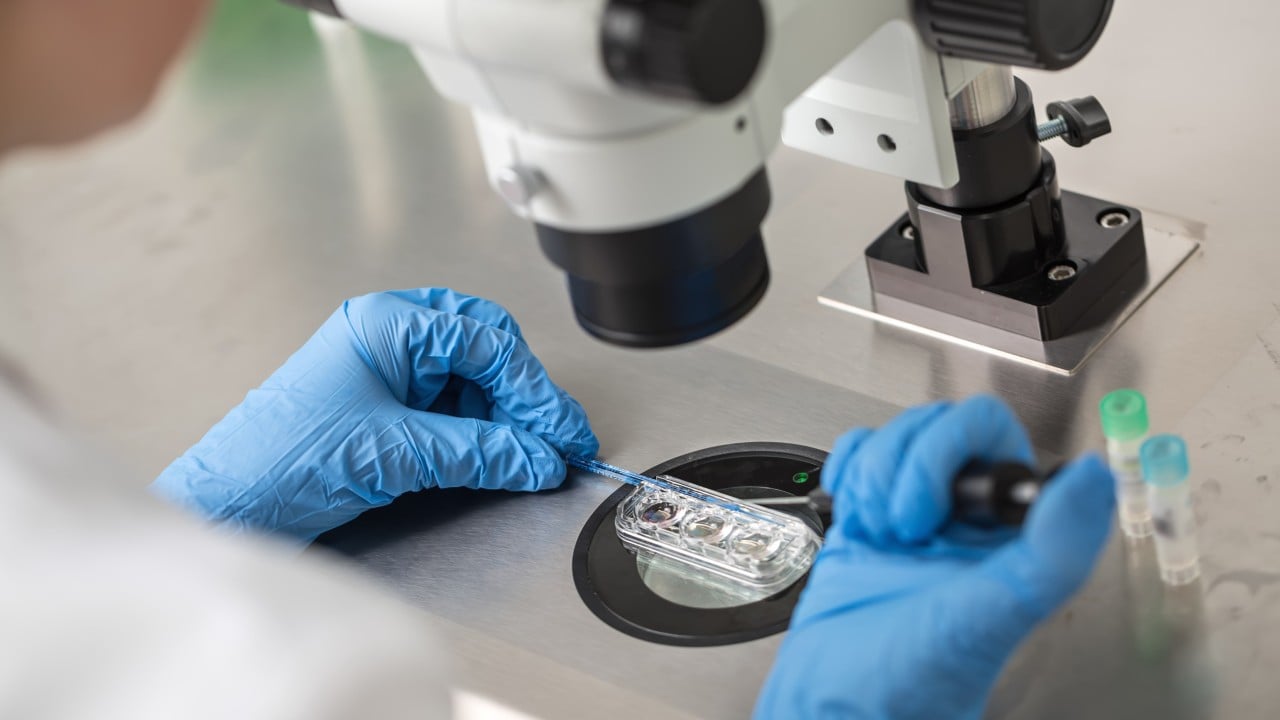
The traditional bottleneck in assisted reproductive technology (ART) is not the scarcity of genetic material, but the subjective margin of human error in embryo selection. Current In Vitro Fertilization (IVF) success rates stagnate globally between 25% and 35% per cycle, largely because embryologists rely on morphological grading—a visual assessment of an embryo’s symmetry and cell density that is prone to intra-observer variability. By integrating deep learning algorithms with high-throughput chromosome testing, specifically Preimplantation Genetic Testing for Aneuploidy (PGT-A), Chinese biotech firms are transitioning from a craft-based medical model to an automated industrial pipeline. This shift aims to maximize "Live Birth per Transfer" (LBPT) while minimizing the "Time to Pregnancy" (TTP), the two primary KPIs governing the $25 billion global fertility market.
The Three Pillars of Algorithmic Embryo Selection
To understand how AI-powered chromosome testing disrupts the status quo, one must categorize the intervention into three distinct technical layers. Meanwhile, you can find other stories here: The Anthropic Pentagon Standoff is a PR Stunt for Moral Cowards.
- Computer Vision for Morphokinetic Analysis: Instead of static "snapshot" checks, AI systems analyze time-lapse imaging (TLI) of a developing zygote. The algorithm identifies the exact millisecond of cleavage events (e.g., $t_2, t_3, t_5$). Deviations from the optimal developmental timeline act as early indicators of chromosomal instability.
- Genomic Data Fusion: The system cross-references visual morphokinetics with Next-Generation Sequencing (NGS) data. By training on datasets of millions of embryos with known birth outcomes, the AI identifies subtle visual "signatures" of euploidy (normal chromosome count) that the human eye cannot detect.
- Predictive Outcome Modeling: The final layer moves beyond biology into probability. It calculates a "viability score" that accounts for maternal age, uterine receptivity markers, and the embryo’s genetic profile to rank embryos for transfer.
The Cost Function of IVF Failure
The economic impetus for this technology is rooted in the high "churn" rate of IVF patients. A failed cycle is not merely a clinical setback; it is a financial and psychological barrier that often prevents patients from pursuing subsequent rounds.
The Total Cost of Care (TCC) in IVF is defined by the equation:
$$TCC = (C_c + C_m + C_p) \times N$$
Where: To see the full picture, we recommend the recent report by Wired.
- $C_c$ = Cost of clinical procedures and labor.
- $C_m$ = Cost of gonadotropin medications.
- $C_p$ = Cost of genetic screening (PGT-A).
- $N$ = Number of cycles required for a live birth.
By using AI to identify the most viable embryo in the first cycle, firms reduce $N$. While the upfront cost of AI-integrated testing ($C_p$) increases, the reduction in $N$ significantly lowers the total cost for the consumer and increases the throughput capacity for the clinic. In the high-volume Chinese market, where single clinics often perform over 15,000 cycles annually, a 5% increase in efficiency translates to hundreds of additional successful births and millions in reclaimed operational margins.
Mechanistic Advantages Over Manual PGT-A
Standard PGT-A requires a highly invasive biopsy of the trophectoderm (the cells that become the placenta). This process carries a non-zero risk of damaging the embryo. AI-powered testing introduces two potential paths for optimization:
Enhanced Interpretation of Mosaicism
Human embryologists often struggle with "mosaic" embryos—those containing a mix of normal and abnormal cells. These are frequently discarded as a precaution. AI models trained on longitudinal data can differentiate between "high-level" and "low-level" mosaicism, identifying embryos that are likely to self-correct in utero. This expands the pool of transferable embryos, effectively increasing the "raw material" yield of a single egg retrieval.
The Shift Toward Non-Invasive PGT (niPGT)
The ultimate goal of the current technological trajectory is the elimination of the biopsy entirely. AI is being trained to analyze the "spent media"—the liquid in which the embryo grows. This liquid contains trace amounts of cell-free DNA (cfDNA). While cfDNA is often fragmented and difficult for humans to interpret, deep learning excels at finding patterns in noisy genomic data.
Structural Bottlenecks and Data Integrity
The transition to AI-managed fertility is hindered by two primary constraints: the "Black Box" problem and data siloization.
The Black Box problem refers to the lack of interpretability in deep learning. If an algorithm de-ranks an embryo that a senior embryologist deems "perfect," the clinical staff faces a liability dilemma. Without a transparent causal link between a specific genetic marker and the AI's score, adoption remains cautious.
Furthermore, the efficacy of these models depends on the diversity of the training data. A model trained exclusively on a Han Chinese population may lose predictive accuracy when applied to patients of different ethnicities due to variations in genetic polymorphisms and maternal age baselines.
The Probability of Genetic Commodification
As these platforms scale, the definition of "success" risks shifting from the presence of life to the optimization of traits. When an AI can accurately predict chromosomal health, the marginal cost of scanning for polygenic risk scores (PRSs)—which estimate the likelihood of complex traits like diabetes, heart disease, or even height—drops toward zero.
This creates a market bifurcating into two segments:
- Corrective ART: Using AI to overcome infertility and achieve a baseline healthy pregnancy.
- Enhancement ART: Using the same infrastructure to select for "superior" genomic profiles.
The regulatory environment in China currently permits aggressive implementation of the former, but the infrastructure being built is inherently capable of the latter. This dual-use nature of the technology necessitates a rigorous distinction between clinical necessity and consumer-driven eugenics.
Quantifying the Competitive Edge
For biotech firms, the competitive moat is no longer the hardware (the sequencers or microscopes), but the proprietary dataset. A firm that controls the end-to-end data—from the initial hormone stimulation protocols to the 5-year health outcomes of the children born—can refine its algorithms to a level of precision that smaller clinics cannot match.
This results in a "flywheel effect":
- Higher success rates attract more patients.
- More patients generate more developmental data.
- More data improves the AI’s predictive power.
- Improved power further increases success rates, consolidating the market.
Strategic Realignment for Clinical Operators
The immediate strategic priority for fertility providers is the digitization of the embryology lab. Any clinic operating on manual logs or analog imaging is accumulating technical debt that will soon become insurmountable.
The move toward automated chromosome testing requires:
- API-First Lab Equipment: Ensuring that incubators and imaging systems can stream data directly to a centralized ML engine.
- Standardization of "Spent Media" Collection: Preparing for the shift to non-invasive testing by preserving samples for retrospective AI training.
- Redefining the Embryologist’s Role: Transitioning staff from manual cell graders to data validators and patient-facing consultants who interpret AI-generated risk profiles.
The integration of synthetic intelligence into the start of human life is not a distant possibility but a current operational upgrade. The firms that successfully quantify the "biological noise" of embryo development will dominate the next decade of reproductive medicine, turning the most volatile stage of human biology into a predictable, high-yield industrial process.