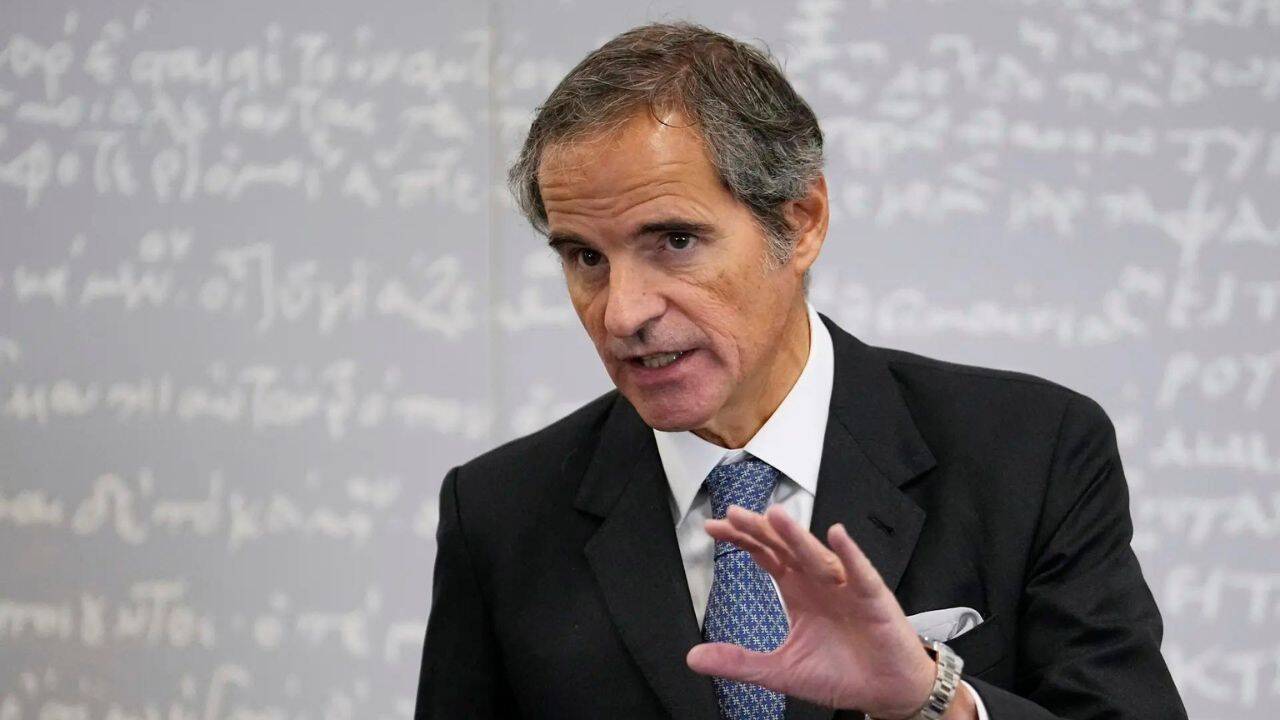
The room where the future of global security is debated smells faintly of stale coffee and industrial carpet. It is thousands of miles away from the desert plains of Natanz or the fortified mountain facility at Fordow. Yet, the air in Vienna is thick with a different kind of tension. It is the weight of bureaucracy colliding with the brink of nuclear capability.
Rafael Grossi, the head of the International Atomic Energy Agency (IAEA), steps to the microphone. His face carries the exhaustion of a man whose job description requires him to stand between two heavily armed, deeply distrustful sides and demand that they let his team look inside their most sensitive rooms.
Outside the briefing hall, the headlines scream of a deadlock. Washington claims one thing about Iran's advancing nuclear program. Tehran flatly denies it, pointing the finger back at broken American promises. The political rhetoric is loud, blinding, and designed to obscure. But beneath the noise of diplomacy lies a quiet, physical reality: the blue-capped inspectors who must pack their bags, board flights, and walk into the concrete heart of the world’s most scrutinized facilities.
They are the world’s eyes. If they are blinded, the guardrails of the modern world erode.
The Geography of Suspicion
To understand why a routine inspection matters, you have to understand what an inspector actually sees.
Imagine a massive, pristine white room buried deep underground. The noise is a constant, deafening high-pitched whine. That sound comes from thousands of centrifuges, spinning at supersonic speeds, separating isotopes of uranium. To the untrained eye, it looks like a sci-fi movie set. To an IAEA inspector, it is a giant math problem.
They are not looking for a completed bomb. They are looking for discrepancies. They count seals. They check the tamper-proof cameras that beam encrypted data back to Vienna. They swipe small pieces of cloth across surfaces to collect microscopic dust particles. Those swipes are later analyzed in labs to detect the exact enrichment level of the uranium.
Uranium Enrichment Levels & Uses:
[0.7%]  --> Natural State (Found in the earth)
[3.5%]  --> Low-Enriched (Standard nuclear power plants)
[20%]   --> Medium-Enriched (Medical research reactors)
[60%]   --> Highly Enriched (Current Iranian stockpiles)
[90%]   --> Weapons-Grade (Military application)
The difference between a nuclear power plant providing electricity to a city and a facility churning out material for a warhead is a matter of microscopic percentages. When politics stall, the access to these machines becomes a bargaining chip.
A History Written in Broken Seals
This is not a new dance. The friction between international oversight and national sovereignty has been grinding gears for decades.
Consider the decades-long standoff. Every time relations between Washington and Tehran sour, the inspectors are the first to feel the squeeze. When the United States pulled out of the 2015 nuclear deal, the delicate architecture of transparency began to crumble. Iran, arguing that the treaty had already been violated by the West, began turning off cameras and revoking the visas of some of the agency's most experienced inspectors.
It is a game of chicken played with invisible particles.
Grossi’s recent announcements are an attempt to halt this slide into total darkness. Despite the conflicting claims coming from both capitals—with the US warning of rapid enrichment and Iran insisting its intentions remain entirely peaceful—the IAEA is insisting on its right to look. The agency’s position is clear: we do not take sides, we take measurements.
But taking measurements requires permission to cross the threshold.
The Human Cost of Blindness
What happens when the inspectors are locked out?
The danger is not an immediate, catastrophic explosion. The danger is the vacuum of information. In international politics, a lack of data is always filled by fear. If the West cannot verify what is happening inside the centrifuges, military planners begin to assume the worst-case scenario. If Iran feels an attack is imminent because of those assumptions, its leadership may decide that full weaponization is their only survival strategy.
Trust takes decades to build. It vanishes in the time it takes to cut a plastic security seal.
The men and women who do this work are fully aware of the stakes. They do not wear military uniforms. They carry clipboards, spectrometers, and sample bags. They know that a single misreported decimal point or a missed alteration in a pipe configuration could trigger a geopolitical crisis. They work in the shadows of giants, hoping their presence is enough to keep those giants from moving.
The Thin Line of Verifiable Truth
The current standoff will not be resolved by a single press conference or a fiery speech at the United Nations. It will be resolved, or at least managed, in the tedious, unglamorous work of verification.
Grossi’s assertion that inspections will proceed despite the diplomatic crossfire is a reminder that international law only works if someone enforces the mundane details. The political theater will continue to dominate the evening news, with leaders trading threats and ultimatums across oceans.
Meanwhile, a technician in a blue cap will adjust a camera lens in a concrete corridor beneath the Iranian desert, ensuring the world can still see.