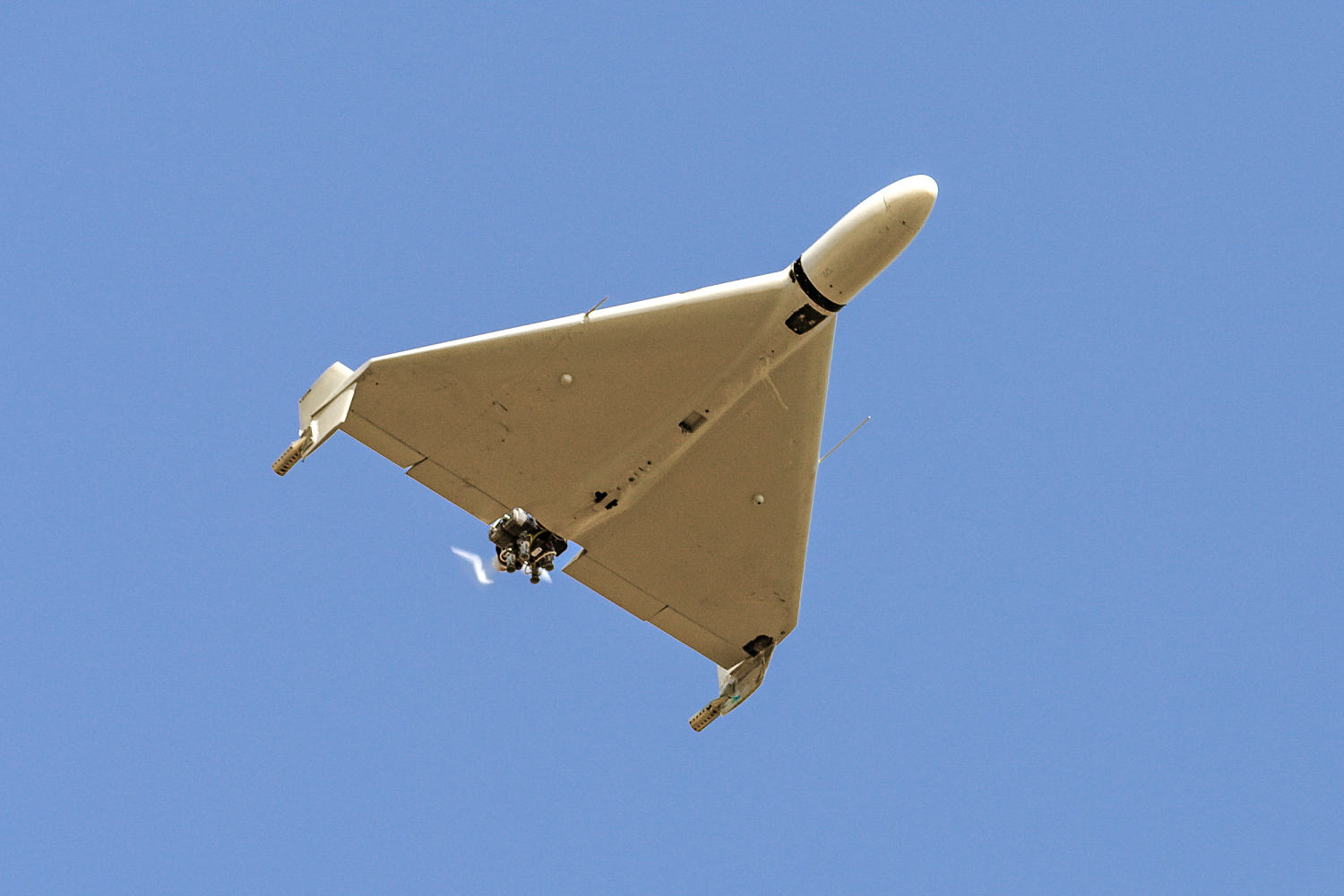
The Shahed-136 does not belong in a modern high-tech war. It is loud, slow, and built from parts you can find in a high-end RC hobby shop. Yet, this "flying lawn mower" has successfully rewritten the rules of aerial attrition. By flooding the skies with disposable, low-cost loitering munitions, Iran has forced Western powers and their allies into a math problem they cannot solve. We are currently trading million-dollar interceptors for wooden-propped drones that cost less than a used sedan. This is not just a tactical headache. It is a fundamental shift in how air superiority is bought and maintained.
The primary query isn't whether these drones are "good" in a traditional sense. They aren't. They are effective because they are cheap enough to be irrelevant to the sender’s treasury while remaining dangerous enough to demand an expensive response from the defender. In similar news, we also covered: The Hollow Classroom and the Cost of a Digital Savior.
The Brutal Math of Attrition
Modern air defense was designed to stop sophisticated threats. Systems like the Patriot or the NASAMS were built to intercept fast-moving jets and ballistic missiles. When you fire a PAC-3 interceptor, you are launching roughly $4 million into the sky. If that missile is chasing a Shahed-136, it is chasing a target that likely cost the manufacturer $20,000 to $30,000.
This is the "asymmetric gap." Even if the defense maintains a 100% intercept rate, the defender loses the economic war. Russia has capitalized on this by launching massive swarms of these drones into Ukrainian airspace. The goal isn't always to hit a power plant. Often, the goal is simply to be shot down. Every Shahed destroyed by a high-end missile is one less missile available to stop a cruise missile or a fighter jet later that night. The Verge has also covered this fascinating topic in extensive detail.
Simple Components and Sanction Busting
If you tear apart a downed Shahed, you won't find proprietary, top-secret Iranian chips. You will find Texas Instruments processors, Altera FPGAs, and internal combustion engines modeled after German designs from the 1980s. These are dual-use components. They are bought through front companies in the UAE, Hong Kong, and Turkey.
The engine, often an MD550 or a Chinese clone, is a simple four-cylinder two-stroke. It produces a distinct "buzzing" sound that has become a psychological trigger for civilians in targeted zones. Because the engine is small and the airframe is made of carbon fiber and honeycomb materials, the radar cross-section is surprisingly low. Radars calibrated to ignore birds sometimes ignore the drone until it is too late.
Iran has mastered the art of the "good enough" weapon. They didn't try to build a stealth bomber. They built a guided artillery shell with wings that can fly for 1,500 miles.
The Failure of Electronic Warfare
There is a common misconception that these drones can simply be "jammed" out of the sky. In the early stages of the conflict, that was frequently true. However, the hardware has evolved. Newer iterations of the Shahed have been seen with CRPA (Controlled Reception Pattern Antennas).
These antennas allow the drone to ignore jamming signals coming from the ground and focus only on the clean signals coming from satellites overhead. Furthermore, if the GPS signal is lost entirely, the drone reverts to Inertial Navigation Systems (INS). While INS is less accurate over long distances, it is more than enough to get the drone into the general vicinity of a city-sized target.
Once it reaches its pre-programmed coordinates, it dives. There is no remote pilot. There is no data link to sever. It is a fire-and-forget weapon in the truest sense. This lack of a constant radio link makes it nearly invisible to traditional signals intelligence (SIGINT) equipment that looks for operator transmissions.
The Resurgence of the Anti Aircraft Gun
Because missiles are too expensive, the world is seeing a frantic return to "flak." Systems like the German Gepard—a twin 35mm autocannon mounted on a tank chassis—have become the most prized assets on the battlefield. The cost of a 35mm shell is negligible compared to a missile.
But there is a catch. Bullets have a limited range. To protect a nation, you need thousands of guns, whereas a few missile batteries can cover a much larger area. This creates a "coverage hole." If the drones are routed around the gun placements, they reach the interior of the country where the only thing left to stop them is a multi-million dollar missile or a lucky soldier with a machine gun.
Domestic Production and the Russian Shift
The alliance between Tehran and Moscow has moved beyond simple shipping containers. Satellite imagery and leaked documents confirm the establishment of a massive production facility in the Alabuga Special Economic Zone in Tatarstan. Russia isn't just buying drones anymore; they are mass-producing a localized version called the Geran-2.
This shift is critical because it removes the bottleneck of Iranian logistics. By 2025, the projected output of this facility is expected to reach thousands of units per year. They are experimenting with different finishes—specifically black, radar-absorbent coatings—to make them harder to spot with searchlights and optical sensors during night raids.
The Western Response Gap
Western defense contractors are currently scrambling to build "Coyote" interceptors and laser-directed energy weapons. These are promising, but they are years away from being deployed at the scale needed to counter a swarm of 100 drones at once.
Lasers, in particular, face the "weather problem." Fog, rain, and smoke degrade the beam's effectiveness. Until a reliable, all-weather, low-cost-per-shot solution exists, the advantage remains with the drone. The current strategy of using $2 million Sextants to find $20,000 needles is a path to bankruptcy.
Strategic Implications for the Pacific
While the world watches Eastern Europe, naval planners in the Pacific are taking notes. The Shahed model proves that you don't need a carrier group to deny access to a coastline. A swarm of 500 low-cost drones launched from shipping containers on a merchant vessel could theoretically overwhelm the Aegis combat system of a modern destroyer.
The "Shahed-ization" of warfare means that middle-tier powers—and even non-state actors—now possess long-range precision strike capabilities. The monopoly on "smart" weapons is over.
We are entering an era where quantity has a quality all its own. If you can build 10,000 drones for the price of one F-35, and 100 of those drones manage to hit the F-35 while it’s on the tarmac, you win. The math is that cold, and that simple.
Find out if your local defense procurement strategy includes "hard-kill" kinetic solutions or if they are still betting on expensive, dwindling missile stockpiles.