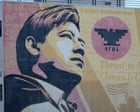
California stands at a volatile cultural crossroads as lawmakers and labor icons grapple with a movement to strip Cesar Chavez’s name from the state holiday established in his honor. The push follows a series of disturbing allegations involving historical patterns of emotional and physical abuse within the upper echelons of the United Farm Workers (UFW) during Chavez’s leadership. For decades, Chavez has been the untouchable saint of the American labor movement, but the current legislative scrutiny suggests that even the most cemented legacies can crumble under the weight of modern accountability.
The core of the conflict centers on whether a state should continue to officially sanctify a figure whose private conduct, according to recent testimonies and archival research, diverged sharply from his public image of non-violent resistance. This is not merely a debate about a calendar date. It is a fundamental interrogation of how we choose our heroes and whether the benefits of their activism can ever outweigh the harm of their personal transgressions.
The Cracks in the Saintly Veneer
For those who grew up in the shadow of the Delano grape strike, the name Cesar Chavez is synonymous with the "Si Se Puede" spirit. Yet, beneath the hallowed ground of the movement, former organizers and family members of farmworkers have begun to voice long-suppressed accounts of a darker reality. These accounts describe a leader who, in his later years, became increasingly paranoid and authoritarian.
The most damaging reports involve "The Game," a psychological interrogation technique borrowed from the Synanon cult, which Chavez allegedly implemented to maintain control over UFW staff. During these sessions, individuals were subjected to hours of verbal abuse, humiliation, and threats. Survivors describe an environment where dissent was treated as treason and where the emotional well-being of workers was sacrificed for the preservation of Chavez's absolute authority.
The Legislative Firestorm in Sacramento
The movement to rename the holiday did not emerge from a vacuum. It is the result of a quiet but steady accumulation of evidence that has finally reached a tipping point in the California State Legislature. Lawmakers who once viewed Chavez as an unimpeachable figure are now forced to reconcile their political identities with these revelations.
A proposed bill, currently navigating the committee process, suggests replacing "Cesar Chavez Day" with "Farmworker Appreciation Day." The logic is simple. By shifting the focus from an individual to the collective body of workers, the state can honor the labor movement without tethering its moral standing to a single, flawed man. This shift mirrors similar movements regarding statues of Confederate generals or explorers, but the stakes here are different. Chavez is a modern hero, and many of his contemporaries are still alive to defend or denounce him.
The Defense of a Legacy
Predictably, the UFW and its allies have mounted a fierce defense. They argue that judging a mid-twentieth-century leader by the shifting social standards of 2026 is a form of historical revisionism that ignores the tangible gains Chavez achieved. Under his leadership, farmworkers gained collective bargaining rights, protection from toxic pesticides, and a sense of dignity that had been denied to them for generations.
"You cannot erase the fact that thousands of people are no longer dying in the fields because of the structures Cesar built," says one veteran labor lawyer who requested anonymity to speak freely about the internal rift. This perspective posits that a leader’s greatness should be measured by the "net good" they provided to society. If the movement saved lives, does the psychological scarring of a few dozen inner-circle members invalidate the entire enterprise?
The Synanon Connection and the Culture of Fear
To understand the severity of the allegations, one must look at the late 1970s, when Chavez became infatuated with Synanon, a drug rehabilitation program that evolved into a violent cult. Chavez didn't just admire the group; he integrated their "Game" into the UFW’s headquarters at La Paz.
This wasn't a minor lapse in judgment. It was a systematic shift in organizational culture. Participants were forced to sit in a circle while others screamed insults and accusations at them for hours on end. The goal was to "strip away the ego," but the result was often broken spirits and a climate of intense fear. When critics point to "sexual abuse allegations" in the context of this renaming movement, they are often referring to the predatory nature of these power dynamics, where boundaries were nonexistent and the leader’s whim was law.
The Economic Reality of the Farmworker
While the political elite in Sacramento argue over names and holidays, the people currently working the soil in the Central Valley face a different reality. For many of these workers—many of whom are undocumented—the name on the holiday is secondary to the wages in their pockets.
There is a palpable irony in the fact that the debate is being led by people who have never picked a grape in their lives. If the state renames the day to "Farmworker Appreciation Day," does it come with a mandate for better heat protections? Does it include a pathway to citizenship or expanded healthcare? Critics of the renaming effort argue that the move is "performative politics" at its worst—a way for politicians to look progressive without having to challenge the powerful agricultural lobby that still dictates much of California’s economy.
A Pattern of Disillusionment
The fall of Cesar Chavez’s reputation follows a pattern seen with other 20th-century icons. We are living in an era where the private lives of public figures are no longer protected by a complicit press or a deferential public. The archives are open, and the survivors are speaking.
Historical evidence suggests that Chavez’s later years were marked by a tragic irony. The man who fought for the freedom of the workers ended up creating a miniature police state within his own union. He purged some of his most loyal lieutenants, including those who had been with him since the beginning, often based on unfounded suspicions of "Communist" infiltration or personal disloyalty. This internal rot contributed to the eventual decline of the UFW's membership and influence, a decline from which the union has never fully recovered.
Comparing the Costs of Hero Worship
When we name a day after a person, we are telling the next generation that this individual represents our highest values. If those values include non-violence, transparency, and the protection of the vulnerable, then the allegations against Chavez present a significant logical hurdle.
Consider the alternatives. Figures like Dolores Huerta, who co-founded the UFW and has remained a consistent advocate for human rights without the baggage of "The Game," are frequently mentioned as more appropriate symbols for the movement. However, even Huerta has faced criticism for her long-standing silence regarding Chavez’s behavior during the La Paz years. This highlights the difficulty of finding a "pure" hero in the messy trenches of social revolution.
The Risk of Erasure vs. The Necessity of Truth
There is a legitimate fear that by removing Chavez’s name, the state risks erasing the history of the Chicano movement itself. Chavez was more than a labor leader; he was a cultural symbol of Mexican-American pride and political awakening. To many, removing his name feels like a direct assault on that identity.
But truth is not an assault. It is a foundation. A movement built on the suppression of its own members' suffering is a movement built on sand. If the California labor movement is to have a future, it must be willing to look at its past without blinkers. The renaming of the holiday could be seen not as an erasure of Chavez, but as an evolution of the cause he helped start—a recognition that the "cause" is always greater than the man.
The Mechanics of the Renaming Process
The legislative path to changing a state holiday is fraught with bureaucratic hurdles and public hearings. Each hearing becomes a theater for competing versions of history. In recent sessions, the testimony has been polarized. On one side, elderly farmworkers tearfully recount how Chavez gave them a voice. On the other, former UFW staffers describe the trauma of being "Gamed" and the subsequent decades of therapy required to undo the damage.
The financial cost of the change is negligible—updating signs, websites, and official documents. The political cost, however, is massive. Governor Gavin Newsom, who has long cultivated a relationship with the UFW, faces a difficult choice. To sign the bill is to alienate a core constituency; to veto it is to signal that the state is willing to overlook abuse if the perpetrator is sufficiently famous.
The Global Context of Statue Toppling
California’s struggle is part of a global phenomenon. From Bristol to Richmond, societies are re-evaluating their public monuments. This is a healthy, albeit painful, sign of a maturing democracy. It suggests that we are finally moving past the need for infallible demigods and are becoming capable of appreciating a person’s work while simultaneously condemning their actions.
The "Great Man" theory of history is dying. In its place is a more complex, nuanced understanding of how change happens. Change isn't the result of one man's will; it is the result of thousands of people working in concert, often in spite of their leaders' flaws.
Moving Toward a Collective Identity
If California moves forward with "Farmworker Appreciation Day," it sets a precedent for how we handle other controversial figures in our history. It suggests that our loyalty belongs to the principles—justice, fair pay, safety—rather than the personalities.
The focus must remain on the material conditions of the people who feed the country. If a name change serves as a catalyst for actual policy reform, it is a victory. If it is merely a way for the state to wash its hands of a complicated history while leaving the current exploitation of farmworkers unchecked, it is a failure of leadership.
The legacy of Cesar Chavez is currently in the hands of the California public. We are the jury, and the evidence is mounting. The question is no longer whether Chavez was a hero—he was—but whether he is the hero we want to represent us in the 21st century.
Demand that your local representatives show you the specific labor protections that will accompany any symbolic name change.