The Deepest Silence
Sound travels through water at roughly 1,500 meters per second. That is more than four times faster than it travels through the air you are breathing right now. In the pitch-black pressure cookers of the world's oceans, sound is not just a sensory experience. It is vision. It is survival. To be heard is to die.
For decades, the standard playbook of naval warfare relied on a simple premise: we could hear them coming. The sonar operators sitting in darkened rooms aboard American or allied attack submarines wore headphones like stethoscopes, listening to the distinct, mechanical heartbeat of the ocean. They listened for the rhythmic chug of a propeller, the high-pitched whine of a steam turbine, the sudden metallic clang of a dropped wrench three hundred miles away. Every ship had a voice. Every submarine had a signature as unique as a fingerprint.
Then, the ocean went quiet.
Consider a hypothetical sonar technician. Let’s call him Miller. He is twenty-four years old, sitting in the belly of a Virginia-class submarine somewhere in the Western Pacific. His eyes are locked on a waterfall display, a cascading screen of green light that visualizes audio frequencies shifting over time. For six hours straight, Miller listens to the background radiation of the sea: the clicking of snapping shrimp, the mournful songs of humpback whales, the distant rumble of commercial oil tankers.
Suddenly, a faint, unnatural line appears on his screen. It flickers for a fraction of a second, then vanishes. It does not look like a submarine. It looks like nothing at all. Just a momentary absence of background noise, a ghost passing through a graveyard.
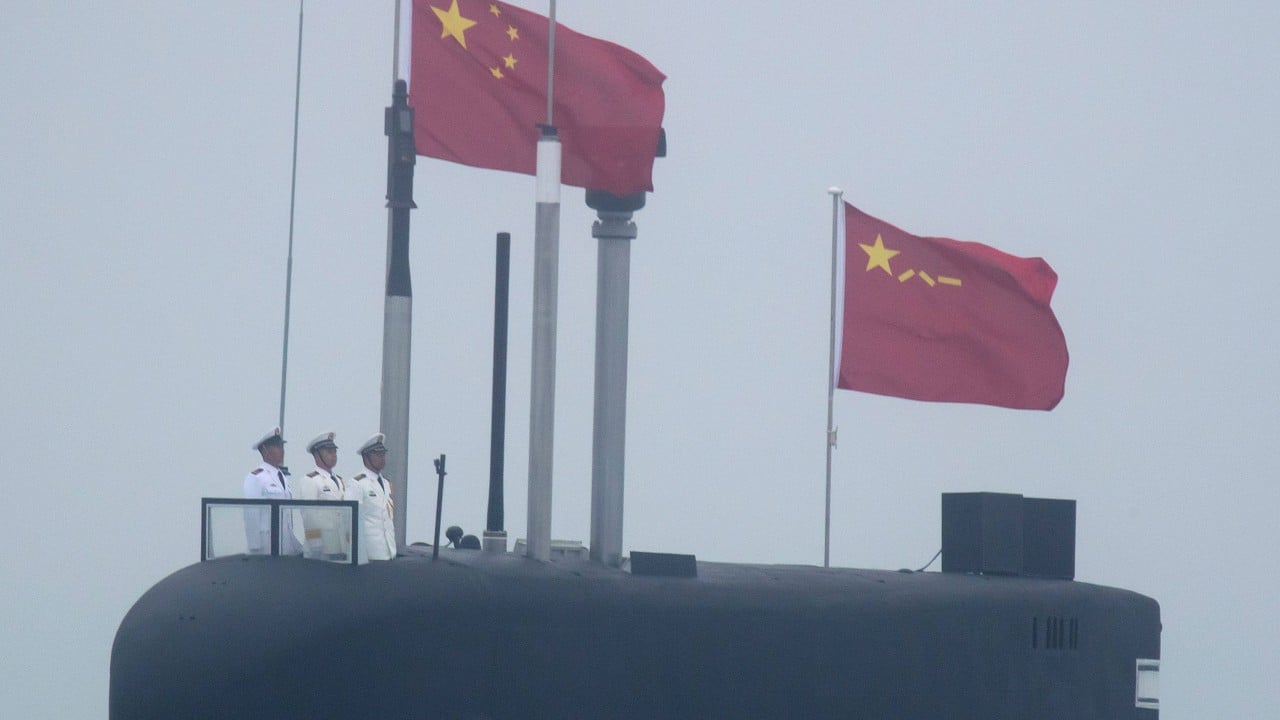
This is the reality of China’s newest naval evolution. It is not just about building more ships; it is about rewriting the physics of underwater evasion. The People’s Liberation Army Navy (PLAN) is deploying a new breed of stealth submarine designed specifically for "hunt-and-kill" missions. It is a vessel engineered to erase its own footprint, turning the vast expanse of the South China Sea into a one-sided hunting ground.
The stakes are entirely invisible, hidden beneath millions of tons of saltwater, but they are higher than they have been since the bleakest days of the Cold War.
The Geometry of Disappearance
To understand how a multi-thousand-ton steel tube becomes invisible, you have to understand what makes a submarine loud in the first place.
Traditionally, a submarine is a massive acoustic echo chamber. Inside, you have nuclear reactors, diesel generators, cooling pumps, and massive drive shafts spinning heavy bronze propellers. Every one of these moving parts vibrates. Those vibrations transfer to the steel hull, which acts like the cone of a massive loudspeaker, broadcasting sound waves directly into the water.
For years, Western intelligence agencies held a comfortable lead. Soviet and early Chinese submarines were notoriously loud—affectionately referred to by Western sailors as "floating rock bands." You could hear them coming from across an ocean basin.
But technology never stays stagnant. The new Chinese attack submarines utilize a radical departure in naval engineering: a pump-jet propulsion system housed inside a shrouded duct, rather than a traditional exposed propeller.
Think of it this way. Imagine riding a bicycle through a puddle. The spinning spokes and the tires fling water everywhere, creating a loud, chaotic splash. Now imagine a high-tech water jet protector encasing that wheel, smoothing out the flow, forcing the water through a tightly controlled funnel. The splash disappears. The turbulence vanishes.
By eliminating the cavitation—the microscopic bubbles formed by spinning propeller blades that pop with the force of tiny explosions—the pump-jet allows a submarine to accelerate to high speeds while remaining as quiet as the surrounding thermal layers of the ocean.
But the silence goes deeper than the propulsion. The hull of this new class of vessel is coated in advanced anechoic tiles—rubbery, rubber-reinforced synthetic blocks engineered to absorb incoming sonar waves rather than bouncing them back. When an enemy surface ship sweeps the water with active sonar, sending out a metallic ping, the sound doesn't echo back to betray the submarine's location. The tiles swallow the sound whole. It is the aquatic equivalent of a black hole, absorbing light and letting nothing escape.
The Hunt and the Kill
Why does this specific upgrade matter so much to global military analysts? The answer lies in a shift of strategic philosophy.
For the past two decades, China’s naval strategy focused primarily on "anti-access/area denial" (A2/AD). It was a defensive posture. The goal was to build a ring of missile batteries, radar stations, and surface ships that could keep the United States military at arm's length, preventing foreign intervention in the event of a regional conflict.
This new stealth submarine represents a pivot from a shield to a spear.
This is a hunter. Its primary objective is not to hide near the coast and defend territory, but to venture deep into the blue water of the Philippine Sea and the wider Pacific to hunt down enemy ballistic missile submarines and aircraft carrier strike groups.
Let us look at how a hunt-and-kill engagement actually unfolds in the modern era. It bears no resemblance to the cinematic, tension-filled shouting matches of old Hollywood movies. It is cold, calculated, and excruciatingly slow.
If a Chinese stealth sub detects an allied carrier group, it will not rush in with torpedoes blazing. It will slip beneath a thermal layer—a boundary in the ocean where water temperatures change drastically, bending and distorting sonar waves like a funhouse mirror. Hidden beneath this acoustic blanket, the submarine becomes a phantom spotter.
It deploys a towed-array sonar, a mile-long cable bristling with ultra-sensitive microphones dragged far behind the ship, away from its own minimal machinery noise. It listens. It maps the precise location of every ship in the carrier strike group.
Then, it communicates without making a sound. Using localized, directional blue-green lasers or ultra-high-frequency acoustic modems, it can transmit targeting data to a satellite or a land-based missile battery without ever giving away its position. The first indication an enemy force has that a submarine is in the area is when long-range anti-ship cruise missiles drop out of the sky from over the horizon.
If the submarine chooses to strike directly, it uses wire-guided wake-homing torpedoes. These weapons do not look for the sound of a ship. They sniff out the physical disturbance left in the water behind a moving vessel, tracking the churning wake like a bloodhound on a scent trail. They are almost impossible to decoy.
The Human Friction
It is easy to get lost in the cold jargon of naval architecture—cavitation indices, decibel reductions, acoustic signatures, hydrodynamic drag. But these machines are ultimately inhabited by human beings, and the psychological weight of this new silent warfare is staggering.
Imagine life aboard one of these new vessels. You are locked inside a windowless cylinder for ninety days at a time. The air you breathe is manufactured by machines, smelling faintly of amine and ozone. Day and night lose all meaning, dictated only by the shifting colors of the overhead LED lights that mimic a artificial sun cycle.
The pressure is not just physical; it is psychological. In a world where absolute silence is the only armor, the human element becomes the weakest link. A single mistake—a cook dropping a heavy stainless-steel pot in the galley, a mechanic overtightening a valve without a rubber isolation gasket—can broadcast a acoustic spike that spells instant death for everyone on board.
The crew lives in a state of hyper-vigilance. They wear soft-soled shoes. Doors are fitted with magnetic latches to prevent slamming. Every piece of machinery is mounted on heavy rubber rafts to isolate the vibration from the hull. The silence inside the ship is heavy, oppressive, and mandatory.
For the adversaries trying to counter this threat, the psychological toll is equally severe. For a generation, Western naval supremacy was an accepted axiom. The oceans belonged to the most technologically advanced fleets. But when the technological gap closes, confidence morphs into anxiety.
Sonar operators like our hypothetical Miller face a terrifying paradox. If they turn on their active sonar—sending out that massive, powerful ping to illuminate the darkness—they will find the enemy. But they will also turn themselves into a giant, glowing neon sign in a dark room. They reveal exactly where they are.
So, they sit in the dark, straining to hear something that has been engineered not to make a sound. The mental fatigue is exhausting. The eyes play tricks. The ears invent patterns in the static. Every thermal shift, every passing school of fish, looks like the beginning of an ambush.
The New Map of the Pacific
This silent revolution alters the geopolitical map of Asia without a single shot being fired.
The geography of the Western Pacific is defined by what strategists call the First Island Chain—a delicate archipelago stretching from Japan through Taiwan down to the Philippines. For decades, this chain acted as a natural barrier. The deep-water choke points between these islands were easily monitored by underwater hydrophone networks permanently fixed to the ocean floor.
An older, louder submarine attempting to pass through the Miyako Strait or the Bashi Channel would trigger alarms instantly. It was trapped inside its own geographic sandbox.
The new, ultra-quiet propulsion systems change that calculus entirely. These vessels can slip through the gaps in the island chain undetected, moving out of the shallow waters of the East and South China Seas and into the deep, cavernous trenches of the open Pacific.
Once a stealth submarine reaches those depths, finding it becomes statistical anomaly work. The ocean is incomprehensibly massive, and a quiet submarine can hide indefinitely in the millions of cubic miles of dark water.
This creates what military strategists call a "fleet in being" effect. Even if China’s stealth submarines never fire a single torpedo in anger, their mere existence forces an opponent to change everything. Every aircraft carrier movement, every supply convoy, every amphibious exercise must be conducted under the assumption that an invisible hunter is sitting just outside the defensive perimeter, watching, listening, and waiting.
The cost of countering this capability is astronomical. It requires billions of dollars spent on maritime patrol aircraft, automated acoustic tracking buoys, and drone surface ships designed to spend months at sea tracking ocean anomalies. It forces an arms race where the currency is not firepower, but computational processing power and acoustic sensitivity.
The Echoes of Tomorrow
We are accustomed to thinking of conflict through the lens of noise—the roar of fighter jets, the thunder of artillery, the chaotic visual barrage of explosions on a screen. But the most dangerous military paradigm shift of the twenty-first century is defined by the complete and total absence of noise.
The development of these advanced vessels signals that the era of uncontested naval dominance is over. The balance of power in the Pacific no longer belongs simply to the side with the biggest ships or the most advanced missiles. It belongs to the side that can best command the shadows.
As the tech continues to evolve, the line between machine and environment blurs. Engineers are already experimenting with artificial intelligence algorithms designed to mimic the exact acoustic frequencies of biological life, allowing a multi-thousand-ton warship to mask its movements behind the collective sound of a migrating pod of whales or the chaotic static of a shifting coral reef.
Down in the depths, the silence will only deepen.
Somewhere right now, beneath the rolling swells of the Western Pacific, two submarines are likely moving through the darkness. They are miles apart, separated by currents, thermal layers, and immense pressure. The crews cannot see each other. They cannot hear each other. They are moving like ghosts through an underwater forest, each waiting for the other to make a sound, each hoping they have mastered the art of becoming nothing at all.