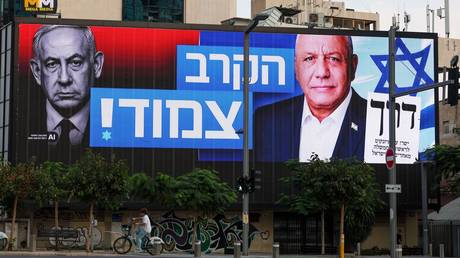
Framing an Israeli legislative election as a binary referendum on Benjamin Netanyahu obscures the underlying mechanics of a hyper-fragmented parliamentary system. While surface-level reporting treats polling day as a direct plebiscite on a single leader's political survival, the actual outcome is determined by mathematical thresholds, coalition-building game theory, and demographic voting blocs operating within a pure proportional representation framework. Understanding the election requires stripping away the personality-driven narrative and analyzing the institutional architecture that converts raw vote totals into governing majorities.
The Institutional Architecture of Proportional Representation
Israel operates under a closed-list, nationwide proportional representation system with a single electoral district. Unlike majoritarian systems where geographic districts filter voter preferences into a two-party equilibrium, the Knesset allocates all 120 seats based on each party's share of the national valid vote. This institutional design creates a low barrier to entry, incentivizing ideological factionalism over broad-tent consensus building.
The primary gatekeeping mechanism in this system is the electoral threshold, currently set at 3.25 percent of the total valid votes. This threshold equates to roughly four seats in the 120-seat parliament. The threshold functions as a non-linear cliff in seat allocation:
- Below 3.25 percent: A party receives zero representation, and its votes are effectively discarded from the denominator used to calculate the remaining seat distribution.
- At or above 3.25 percent: A party immediately secures four seats, instantly altering the coalition math for both the incumbent bloc and the opposition.
Because no single party has ever won an outright majority of 61 seats in Israeli history, governance relies entirely on post-election coalition formation. The president does not automatically task the leader of the largest single party with forming a government; rather, the mandate goes to the candidate who secures the highest number of formal recommendations from elected party leaders, demonstrating the most viable path to a 61-seat bloc.
Deconstructing the Referendum Fallacy
Mainstream media narratives routinely reduce these elections to a simple binary: pro-Netanyahu versus anti-Netanyahu. While accurate as a description of voter sentiment and campaign rhetoric, this framing fails as an analytical model for predicting governance. In a multi-party system, voter intent is filtered through two distinct layers of friction before a government is formed.
The first layer of friction is intra-bloc cannibalization. When voters within the anti-Netanyahu camp shift their support from a centrist party to a smaller left-wing or right-wing anti-Netanyahu faction, the total size of the opposition bloc does not increase. Instead, the shift risks pushing smaller parties below the 3.25 percent threshold. If a party polling at 3.5 percent drops to 3.1 percent on election day, tens of thousands of anti-Netanyahu votes vanish, artificially inflating the seat count of the opposing bloc without Netanyahu gaining a single new voter.
The second layer of friction is ideological incompatibility within the opposition. The anti-Netanyahu bloc is not a unified ideological movement; it is a negative coalition bound solely by opposition to one individual. It spans secular centrists, traditional left-wing Zionists, right-wing nationalists who broke with Likud over personal or legal disputes, and non-Zionist Arab parties. While these factions can agree on blocking Netanyahu from reaching 61 seats, they lack the policy alignment required to pass a state budget, manage security escalations, or legislate on religion-and-state issues.
The Four Structural Variables Governing Coalition Math
To evaluate the true trajectory of an Israeli election, analysts must track four operational variables rather than relying on top-line horse-race polling.
1. Surplus-Vote Agreements (Bader-Ofer Law)
Under the Bader-Ofer method, leftover votes that do not add up to a full seat are distributed among parties that have signed pre-election surplus-vote agreements. Two allied parties pool their remaining fractions of votes to capture an extra seat that neither could win independently. Failing to sign an optimal surplus-vote agreement—or signing one with a partner that fails to cross the electoral threshold—frequently costs a bloc its 61st seat.
2. Differential Turnout Across Demographic Blocs
National turnout figures mask massive variances between distinct societal sectors, each functioning as a semi-autonomous voting bloc:
- The Ultra-Orthodox (Haredi) Sector: Characterized by disciplined, rabbinically directed voting and turnout rates consistently exceeding 80 percent. Because their vote share is structurally stable, their relative parliamentary weight fluctuates inversely with the turnout of the secular majority. When secular turnout drops, Haredi seat counts rise automatically.
- The Arab-Israeli Sector: Historically marked by lower and more volatile turnout rates, often ranging between 45 and 65 percent depending on whether the predominantly Arab parties run as a unified list or fracture into competing factions. A 10-percentage-point swing in Arab turnout shifts three to five seats, directly determining whether the right-wing religious bloc can reach a 61-seat majority.
- The Secular Center-Left: Exhibits high sensitivity to perceived political efficacy. Repeated election cycles without a decisive governing outcome induce voter fatigue, depressing turnout in core urban strongholds like Tel Aviv and central Israel.
3. The Legal-Institutional Overhang
The criminal indictments against Netanyahu—spanning charges of bribery, fraud, and breach of trust—introduce an institutional constraint that overrides normal political bargaining. Under Israeli law, a prime minister is not legally required to resign until convicted and all appeals are exhausted, whereas cabinet ministers must resign upon indictment. This creates an asymmetric incentive structure: Netanyahu requires the prime minister's office to maintain institutional shielding and control over judicial appointments, while rival right-wing leaders refuse to sit under him due to the legal overhang, freezing normal ideological coalition-building.
4. The Security-Economy Feedback Loop
Voter behavior in the final 72 hours before polls close is heavily conditioned by immediate external shocks rather than long-term policy platforms. Escalations in Gaza, friction in the West Bank, or shifts in regional diplomacy trigger a flight-to-safety dynamic that historically benefits incumbent security-oriented messaging. Conversely, sustained inflation, housing costs, and cost-of-living pressures fracture working-class support for the incumbent party, driving voters toward populist economic alternatives within the same ideological camp.
Strategic Scenarios Post-Ballot
Once the ballot boxes close and the Central Elections Committee begins tabulating physical paper ballots—a manual process that delays final verification of marginal seats for up to 48 hours—the political system enters a game-theoretic bargaining phase governed by three primary outcomes.
Scenario A: The 61-Seat Right-Religious Equilibrium
If Netanyahu's Likud party, combined with its traditional ultra-Orthodox allies (Shas and United Torah Judaism) and the far-right Religious Zionist faction, secures exactly 61 or more seats, coalition formation is rapid. This bloc possesses high ideological cohesion on judicial reform, settlement policy, and state funding for religious institutions. The operational risk in this scenario is internal blackmail: in a 61-seat coalition, any single backbencher holds an effective veto over legislation, forcing the prime minister to grant disproportionate ministerial budgets to marginal partners to prevent government collapse.
Scenario B: The Anti-Netanyahu Blocking Majority
If the opposition prevents the right-religious bloc from reaching 61 seats, it does not automatically yield a stable alternative government. Because the opposition relies on the external support or active participation of Arab parties to block Netanyahu, forming a proactive governing coalition requires bridging irreconcilable gaps between right-wing nationalists and progressive factions. Such a government can pass a basic budget to survive, but it remains paralyzed on macro-strategic issues, rendering it vulnerable to defections by single members of Knesset lured back to the right-wing camp.
Scenario C: Institutional Paralysis and Repeat Elections
If neither bloc secures a functional 61-seat coalition within the statutory 28-day mandate (plus a potential 14-day extension), and no alternative candidate can assemble a majority within the subsequent 21-day period, the Knesset automatically dissolves. In this state, the incumbent prime minister remains in office as the head of a caretaker government with broad executive authority and minimal parliamentary oversight until the next election cycle.
Tactical Framework for Interpreting Election Night Data
Observers tracking the election returns must ignore initial television exit polls, which frequently misjudge the final distribution of the last three to four seats due to sample bias in mixed cities and military ballot boxes (double envelopes). Instead, evaluate the real-time returns through a strict three-step sequence:
- Audit the Threshold Survivors First: Before counting bloc totals, verify whether the smallest parties on both sides—specifically left-wing Zionist factions, split Arab lists, and fringe right-wing parties—have cleared the 3.25 percent line. A single party falling at 3.20 percent invalidates every seat projection built on national polling averages.
- Track the Double-Envelope Ballots: Approximately 6 to 8 percent of all votes are cast in special double envelopes by soldiers, diplomats, hospital patients, and prisoners. These are counted last and skew significantly younger and further to the right than the general population, routinely shifting one to two seats from the center-left to the right-religious bloc 36 hours after polls close.
- Map the Defection Incentives: Once the 120 seats are finalized, ignore campaign pledges regarding who will sit with whom. Identify the two or three individual lawmakers positioned closest to the ideological center of gravity whose political survival depends on avoiding another election, as their willingness to cross bloc lines dictates the final coalition math.