Cold.
That is what I remember most about the November morning in 1983 when I sat under a pine desk in a third-grade classroom in northern Virginia, my knees pressed against my chest, staring at the scuff marks on my sneakers while a siren wailed across the Potomac. We were practicing for the end of everything. Even at eight years old, smelling the lemon floor wax and feeling the grit of dried mud on the linoleum, I knew the thin veneer of plywood above my head would not stop a thermonuclear blast. We all knew. Yet we tucked our heads anyway, because that was the ritual required to keep breathing in a world held hostage by two superpowers.
Forty-three years later, the sirens are quiet, the plywood desks are gone, and the terror has become invisible. We stopped looking up at the sky. We went back to worrying about mortgage rates, grocery bills, and the erratic weather outside our windows.
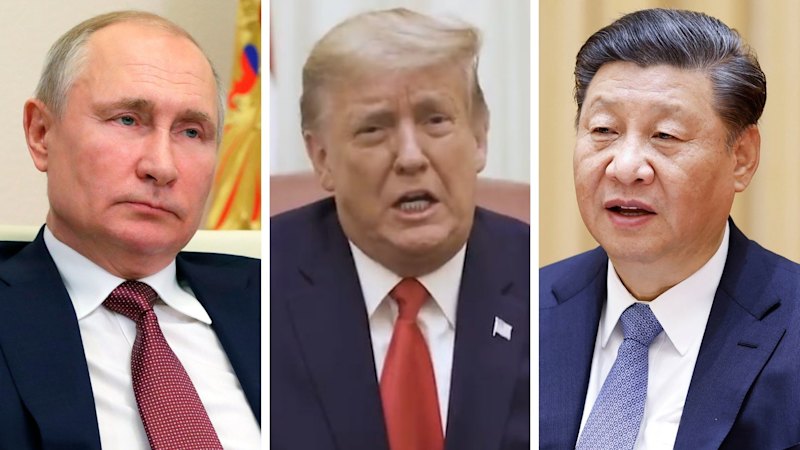
Then comes a single diplomatic dispatch that pulls the curtain back. Donald Trump is preparing to sit across from Vladimir Putin and Xi Jinping in a rare trilateral meeting, putting nuclear arms cuts squarely on the table.
On paper, this reads like standard geopolitical theater—another summit, another round of handshakes, another set of talking points for cable news panels to dissect until the next news cycle washes it away. Strip away the diplomatic jargon, however, and you are looking at the single most consequential negotiation of the twenty-first century. For the first time since the dawn of the atomic age, the fate of human civilization does not rest on a two-player chessboard. It rests on a three-sided table where the rules have expired, the referees have gone home, and the stakes are measured in billions of lives.
The Architecture of a Three-Way Standoff
To understand why a meeting between Trump, Putin, and Xi carries so much weight, you have to understand how dangerously brittle the current nuclear order has become.
For half a century, global stability relied on a grim, bilateral math problem known as mutually assured destruction. Washington and Moscow pointed thousands of warheads at each other, locked in a terrifying embrace that paradoxically kept the peace because neither side could strike first without guaranteeing its own annihilation. They built guardrails to manage that terror. Treaties like SALT, START, and New START established strict limits, permitted on-site inspections, and created hotlines so a flock of geese on a radar screen wouldn't trigger Armageddon.
That architecture is now rubble.
New START, the last remaining bilateral nuclear arms control treaty between the United States and Russia, expired in February 2026. Right now, for the first time since Richard Nixon and Leonid Brezhnev signed the first strategic arms limits in 1972, there are zero legally binding caps restricting the world’s two largest nuclear arsenals. None.
At the exact moment those guardrails vanished, a third giant stepped onto the field. For decades, China maintained a policy of "minimum deterrence"—keeping a relatively small arsenal of a few hundred warheads, just enough to survive an attack and strike back. That era is over. According to Pentagon assessments and independent satellite tracking, Beijing has embarked on the fastest peacetime nuclear expansion in modern history, racing toward more than 1,000 operational warheads by 2030 and roughly 1,500 by 2035.
Imagine—as a purely hypothetical illustration of the math—two gunfighters standing ten paces apart in a dusty street. They have spent years agreeing on how many bullets each can load into his cylinder. Suddenly, a third gunfighter walks onto the porch with a rifle, refuses to say how many rounds he is carrying, and the original two fighters throw away their bullet-counting rules. Nobody blinks. Nobody holsters their weapon. If one flinches, all three shoot.
That is the strategic reality Trump, Putin, and Xi inhabit today.
| Nation | Estimated Total Nuclear Warheads | Treaty Status | Current Trajectory |
|---|---|---|---|
| United States | ~5,044 | No active bilateral caps | Modernizing triad ($1.5T+ over 30 years) |
| Russia | ~5,580 | Suspended / Expired | Deploying new tactical & exotic delivery systems |
| China | ~600+ (Rapidly growing) | Never bound by bilateral treaties | Expanding silos, submarines, and bombers toward 1,500 |
What Happens Inside the Room
When Donald Trump brings up nuclear arms reductions with Vladimir Putin and Xi Jinping, he is attempting something no American president has ever successfully pulled off—dragging three deeply suspicious, fiercely nationalist leaders into a single framework of mutual restraint.
Each man walks into that room carrying entirely different baggage, fears, and leverage.
Consider Trump’s position. Throughout his political career, he has viewed multilateral treaties with skepticism, often arguing that bilateral deals left the United States tying one hand behind its back while China built up its arsenal unchecked. During his first term, his administration insisted that any extension of New START had to include Beijing—a demand China flatly rejected at the time. Now, facing a world without any treaty limits at all, Trump is betting that personal diplomacy and leader-to-leader dealmaking can achieve what traditional arms-control bureaucrats could not. He wants a grand bargain: a historic reduction in nuclear stockpiles that saves hundreds of billions of dollars in modernization costs while cementing a legacy as the president who tamed the three-way nuclear race.
Putin arrives at the table from a place of both desperation and defiance. Russia’s conventional military has been ground down by years of attritional warfare in Ukraine, leaving its vast nuclear arsenal as the ultimate guarantor of its superpower status. Without nuclear parity with the United States, Moscow is merely a regional power with a struggling economy and a shrinking population. Putin knows that an unrestrained arms race with both Washington and Beijing would bankrupt the Russian state, just as Ronald Reagan’s defense buildup helped break the Soviet Union. Yet he refuses to give up his tactical nuclear advantage or accept deep cuts unless the United States also limits its missile defense shields and conventional precision weapons—systems Moscow fears could neutralize its retaliatory strike.
Then there is Xi Jinping, holding the most complicated hand of all. For years, Beijing’s diplomats repeated a simple mantra whenever Washington asked them to join arms control talks: When you cut your arsenals down to our size, we will gladly join you. That argument worked when China had 300 warheads and the U.S. and Russia each had over 5,000. It is far harder to sustain when satellite imagery reveals hundreds of new missile silos sprouting across the deserts of Gansu and Xinjiang. Xi views nuclear parity not as a desire for conquest, but as insurance—a shield to deter American intervention in the Indo-Pacific, particularly over Taiwan. Asking Xi to freeze or cut his arsenal before it reaches parity with Washington and Moscow feels, to Beijing, like asking China to lock in permanent strategic inferiority.
The Invisible Tax on Every Kitchen Table
It is easy to look at numbers like 5,000 warheads and let your eyes glaze over. After all, once you have enough firepower to incinerate every major city on earth ten times over, what difference does another thousand bombs make?
The difference shows up in places that have nothing to do with mushroom clouds.
Meet Elena, a fictional composite of the millions of ordinary citizens living in the shadow of this standoff. She teaches high school chemistry in Ohio, drives a twelve-year-old sedan, and spends Sunday evenings balancing her family’s grocery budget against rising utility costs. Elena never thinks about intercontinental ballistic missiles. She does not know what a hypersonic glide vehicle is, nor could she tell you the difference between a strategic warhead and a tactical one.
Yet every single month, Elena pays a silent tax to keep those weapons primed.
The United States is currently in the middle of a thirty-year overhaul of its entire nuclear triad—land-based missiles, nuclear submarines, and strategic bombers—at a projected cost exceeding $1.5 trillion. Russia is pouring a massive share of its national budget into exotic nuclear delivery systems like nuclear-powered torpedoes and cruise missiles. China is diverting vast sums of capital into concrete silos, enriched uranium facilities, and stealth bombers.
Every dollar poured into a missile silo in Montana, a shipyard in Severodvinsk, or a testing range in Lop Nur is a dollar pulled away from bridges, hospitals, cancer research, and classrooms. Even if not a single warhead is ever launched in anger, an unchecked nuclear arms race bleeds the living standards of ordinary families dry. When Trump, Putin, and Xi sit down to discuss arms cuts, they are not merely debating abstract military doctrine. They are deciding whether the next generation of human wealth will be spent building cities or building machines designed to vaporize them.
The Mechanics of Verification and Trust
If this trilateral summit is going to produce anything more durable than a photo opportunity, it has to solve the hardest problem in human statecraft: how do three rivals verify that the others aren't cheating?
Arms control does not run on trust. As Reagan famously borrowed from a Russian proverb, Doveryai, no proveryai—trust, but verify.
In the old bilateral world, verification was a grueling, mechanical science. American inspectors flew to Russian missile bases with radiation detectors to count the warheads sitting atop individual rockets. Russian inspectors visited American bomber bases to watch B-52s get chopped into pieces by giant guillotines, leaving the hulks out in the open so spy satellites could confirm they would never fly again.
Bringing China into that equation turns a difficult math problem into a Rubik's cube.
Beijing operates behind a veil of opacity that makes Cold War Moscow look transparent. China has never publicly declared the exact size of its nuclear stockpile. Its underground tunnel networks—dubbed the "Underground Great Wall"—stretch for thousands of miles beneath mountains, designed specifically to hide mobile missile launchers from American satellites. For Xi Jinping to agree to verifiable arms cuts, he would have to allow foreign inspectors inside China’s most guarded military installations—a concession that runs counter to decades of Chinese strategic culture.
At the same time, modern technology has blurred the lines between nuclear and conventional weapons. A missile flying toward a target at ten times the speed of sound looks identical on radar whether it is carrying a conventional high-explosive warhead or a thermonuclear bomb. During a crisis, a military commander has roughly six to twelve minutes to decide whether an incoming speck on a screen is a localized strike or the opening salvo of civilization’s end.
Imagine sitting in a bunker deep underground at three in the morning, staring at an amber screen while alarms blare, knowing that if you wait five minutes to be sure, your command center is vaporized, and if you launch immediately based on a false alarm, you kill hundreds of millions of innocent people. That is not a movie script. It nearly happened in September 1983, when a Soviet officer named Stanislav Petrov stared at a satellite warning screen showing five incoming American missiles and had to decide, on gut instinct alone, that the computer was lying. He was right. We are alive today because one man refused to follow protocol.
A trilateral agreement doesn't need to abolish every nuclear weapon overnight to pull us back from that cliff. Even modest steps—establishing a three-way crisis hotline, banning cyberattacks against nuclear command-and-control networks, agreeing to advance notifications of missile tests, or placing an overall ceiling on deployed warheads—would dramatically reduce the odds of an accidental apocalypse.
The Gamble at the Table
There is no guarantee this works. History is littered with diplomatic summits that collapsed under the weight of ego, domestic politics, and mutual paranoia.
Critics in Washington will warn Trump that Putin cannot be trusted to honor any signature he puts on paper, pointing to Moscow’s violation of the Intermediate-Range Nuclear Forces Treaty and its suspension of New START. Hardliners in Beijing will whisper to Xi that slowing down China’s nuclear buildup now will only invite American pressure in the South China Sea. Hawks in Moscow will argue that Russia’s nuclear shield is the only thing keeping NATO from dictating terms to the Kremlin.
They are not entirely wrong to be skeptical. Geopolitics is not a charity exercise, and none of the three men walking into that room is a pacifist. Each is driven by fierce self-interest, domestic political survival, and a deep desire to project unyielding strength to his own public.
Yet it is precisely that self-interest that makes a deal possible.
Nixon went to China precisely because his anti-communist credentials made him immune to charges of weakness. Reagan nearly abolished all nuclear weapons with Mikhail Gorbachev at Reykjavik in 1986 because both men looked into the abyss of thermonuclear war and realized that winning one was impossible. When strongmen decide that survival and economic sanity outweigh the vanity of endless stockpiling, history moves fast.
Back Under the Desk
I sometimes think back to that third-grade classroom in Virginia, the smell of lemon wax, and the quiet terror of children who understood far more than adults gave them credit for. We grew up believing that the adults in charge had a handle on the machinery of destruction—that somewhere in Washington and Moscow, serious people were keeping their hands on the brakes.
For the past few years, nobody’s hands have been on the brakes. The treaties expired, the inspectors went home, and the factories kept humming, turning uranium and plutonium into silent, waiting fire.
Now, three men who hold the power to turn green continents into glass are going to sit in the same room and talk about putting the brakes back on. The diplomats will argue over warhead counts, throw-weights, and telemetry encryption. The pundits will score who looked tougher at the podium.
Forget the podium. Forget the scoring. Outside that room, eight billion people are simply trying to live their lives—raising children, planting crops, building homes—while the ceiling above their heads grows heavier by the day.