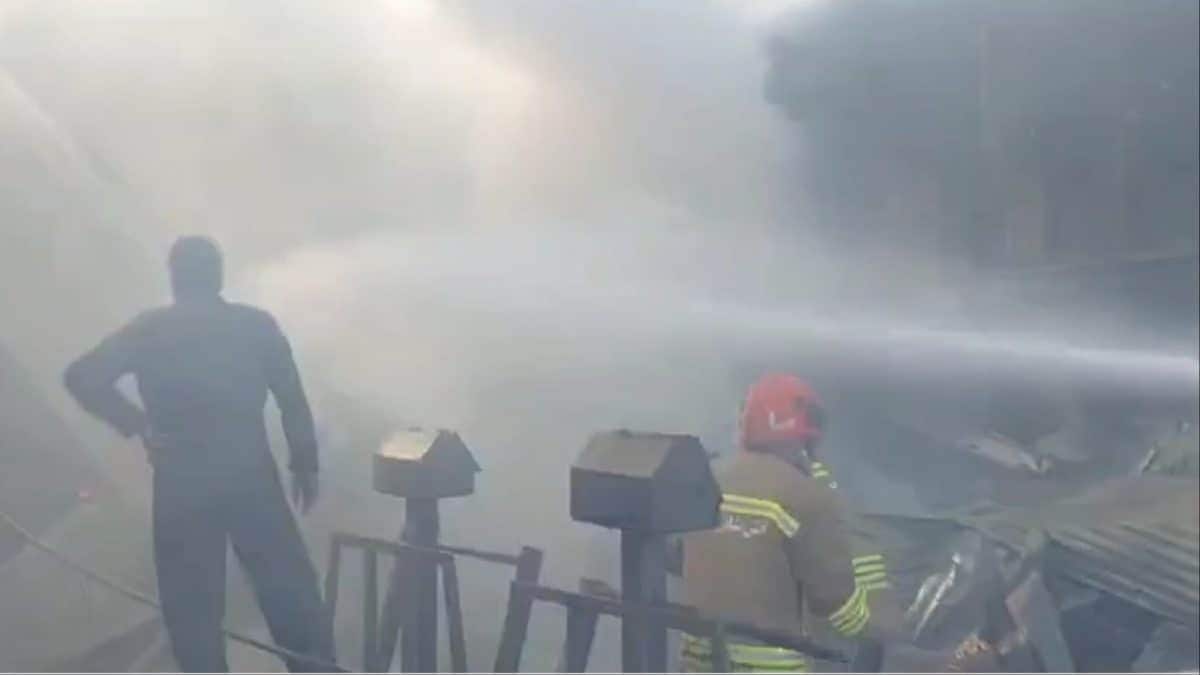
A Bell 212 helicopter, a relic of an era when the Shah’s Iran was the primary Western proxy in the Middle East, plummeted into a crowded market in Isfahan province this week. Four people are dead. While the official narrative from Tehran points toward "technical difficulties" and localized misfortune, the smoke rising from the wreckage tells a more systemic story of mechanical exhaustion and the failure of a desperate aviation strategy. This was not a random accident. It was the predictable result of a military aviation sector operating on borrowed time and cannibalized parts.
The crash occurred during a routine transport mission, but in the Iranian theater, nothing is truly routine. When an aircraft hits a civilian market, it exposes the thin margin of safety that Iran’s Army Aviation (Havaniroz) maintains. The immediate aftermath saw the usual scramble of emergency responders and the somber tally of the deceased, but the deeper investigation reveals a fleet that is more museum-piece than modern military asset.
Mechanical Exhaustion and the Sanctions Trap
The Bell 212 is a workhorse, a twin-engine evolution of the Vietnam-era "Huey." Under normal circumstances, it is a reliable platform. However, the airframes currently flying in Isfahan and across Iran were largely delivered before the 1979 Revolution. These machines are nearly half a century old. Flying them requires a constant supply of specialized components—turbine blades, transmission gears, and rotor hubs—that are officially blocked by international sanctions.
Iran has managed to keep these birds in the air through a combination of black-market procurement and domestic reverse-engineering. This is known as "self-sufficiency," but in the cockpit, it translates to high-stakes gambling. When a part is reverse-engineered without the original metallurgical blueprints, its fatigue life is an unknown variable. A bolt might look identical to the American original, but if its crystalline structure fails under the heat and vibration of a desert flight, the result is what we saw in the Isfahan market.
The "technical difficulty" cited by state media is a euphemism for structural failure. This isn't just about poor maintenance. It is about the physical limits of metal. You can only patch a fuselage so many times before the airframe loses its integrity.
The Geography of Risk in Isfahan
Isfahan is the heart of Iran’s military-industrial complex. It isn't just a province; it is a sprawling hub of nuclear facilities, missile plants, and airbases. The density of military traffic in the region is high, and the flight paths often intersect with expanding urban centers.
When an engine fails over a rural desert, a skilled pilot might manage an autorotation—a maneuver where the falling helicopter uses its own upward airflow to keep the rotors spinning and cushion the landing. In a dense market environment, that option vanishes. The pilot is forced to choose between a vertical plunge or a desperate attempt to find a gap in the rooftops. The four lives lost in this incident represent the human cost of a strategic decision to maintain high-tempo military operations over civilian areas using equipment that would be grounded in any other nation.
Cannibalization as a Maintenance Strategy
To keep one Bell 212 flying, Iranian technicians often have to strip parts from two others. This practice, known as cannibalization, creates a cascading effect of unreliability. Every time a part is pulled, re-installed, and stressed in a new environment, the risk of human error or hardware mismatch increases.
The Iranian aviation industry claims to have reached a level of "indigenous production" that bypasses the need for Western support. They point to the Saba-248 or the Toufan as proof of their prowess. Yet, look closely at the architecture of these "new" helicopters and you will see the skeleton of the Bell 206 and Bell 212. These are not new designs; they are recycled platforms with new skins and updated, often substandard, avionics.
This creates a false sense of security. The military leadership projects an image of a modern, self-reliant force, while the pilots are left to manage the reality of "Frankenstein" aircraft. The Isfahan crash is a data point in a trend of increasing domestic aviation incidents that Tehran struggles to sweep under the rug.
The Failed Pivot to Eastern Hardware
One might ask why Iran doesn't simply scrap the aging American fleet and move entirely to Russian or Chinese platforms. They have tried. The Mi-17, a Russian heavy-lifter, is common in the Iranian inventory. But the transition is not as simple as swapping keys.
- Infrastructure: The entire maintenance infrastructure in Isfahan and Shiraz was built around American standards.
- Training: Pilots trained on Western cyclic and collective controls face a steep learning curve when moving to Soviet-designed systems.
- Cost: Despite the political rhetoric, buying a new fleet of Russian Ka-52s or Mi-28s is prohibitively expensive for an economy strangled by inflation.
Consequently, the Iranian military is stuck in a middle-ground purgatory. They cannot afford to replace the old fleet, and they cannot safely maintain it. They are forced to fly the Bell 212 until the rotors literally fall off. In Isfahan, they finally did.
The Human Element in the Cockpit
We must consider the pilots. The men flying these missions are often highly experienced, yet they are being asked to perform tasks that exceed the safety parameters of their equipment. In the Isfahan incident, witnesses reported hearing a "sputtering" sound before the craft banked sharply and dropped. This suggests a total power loss in at least one engine, followed by a failure of the second—likely due to a shared fuel or transmission fault.
A pilot in that situation has seconds to react. If the flight controls are unresponsive due to a hydraulic leak—another common issue in aging Bell fleets—the aircraft becomes a multi-ton brick. The fact that the death toll was not higher may actually be a testament to the pilot’s final, desperate efforts to steer away from the thickest part of the crowd.
The Global Implications of Local Failures
This crash serves as a warning for other nations operating under long-term sanctions or those relying on "gray market" aviation. It proves that there is no such thing as a "good enough" part when it comes to vertical flight.
The international community often views these crashes as isolated military accidents. They are not. They are indicators of a crumbling domestic infrastructure. If Iran cannot safely fly a basic transport helicopter over its own territory, it raises serious questions about the maintenance and reliability of more sensitive assets, including its fleet of aging F-14 Tomcats and even its transport of high-level government officials. We saw a similar story play out with the crash that killed President Ebrahim Raisi; the common thread is a refusal to acknowledge that 1970s technology cannot be sustained indefinitely with 2120s ingenuity and duct tape.
The Reality of the Isfahan Market
The market in Isfahan is a place of daily survival, a vibrant center of trade that now bears the scars of a military failure. The wreckage has been cleared, and the official mourning period will pass, but the underlying cause remains unaddressed. There will be no mass grounding of the Bell 212 fleet. There will be no sudden influx of new, certified parts from the manufacturer.
The Iranian government will likely blame the pilot or "unforeseen weather," despite clear skies. They will continue to prioritize the appearance of military strength over the mechanical reality of their equipment. For the residents of Isfahan and other cities near major airbases, the sound of a helicopter overhead is no longer a sound of protection. It is a sound of potential catastrophe.
Investors and geopolitical analysts should watch the frequency of these "technical" failures. They are the most honest metric we have for measuring the actual impact of isolation on Iran’s internal stability. A military that cannot keep its engines running is a military that is rotting from the inside out.
The next time a Bell 212 takes off from an Isfahan runway, it will be carrying the same recycled parts and the same inherent risks. The question isn't whether another one will fall, but where. In a system that values ideology over engineering, the pavement of a public market is often where the truth finally lands.
Stop looking at the official reports and start looking at the flight logs of these aging machines.