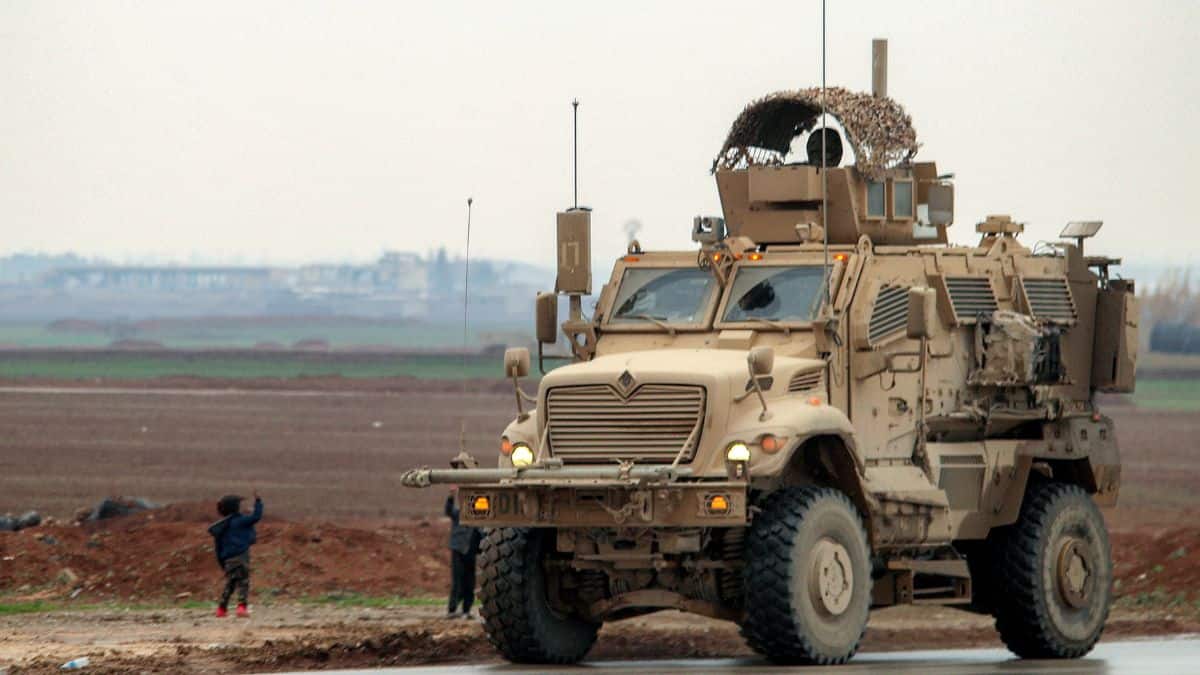
The Pentagon is preparing to shutter its operations in Northeast Syria within thirty days, ending a decade-long military presence that redefined the geopolitical map of the Levant. While the official narrative frames this as a "mission accomplished" moment against the Islamic State, the reality on the ground suggests a hasty retreat dictated more by political exhaustion in Washington than by stability in Al-Hasakah. This withdrawal does not just remove boots from the dirt. It removes the primary buffer preventing a regional free-for-all between Turkish forces, Iranian proxies, Russian mercenaries, and the remnants of a caliphate that has spent years learning how to survive in the shadows.
For ten years, the U.S. presence at sites like the Al-Tanf garrison served as a logistical cork in a very volatile bottle. By occupying strategic highway intersections and supporting the Syrian Democratic Forces (SDF), the American military successfully hindered the establishment of a "land bridge" connecting Tehran to the Mediterranean. Now, that cork is being pulled. The immediate concern is not just the resurgence of sleeper cells, but the abandonment of tens of thousands of hardened fighters and their families currently held in detention camps like Al-Hol. Don't forget to check out our earlier post on this related article.
The Al Hol Pressure Cooker
If you want to understand where the next conflict starts, look at the wire fences of Al-Hol. This is not a refugee camp in any traditional sense. It is a sprawling, open-air finishing school for radicalization. Roughly 40,000 people, mostly women and children, live in conditions that defy basic humanitarian standards. The SDF, who have been the boots on the ground for the American air power, have repeatedly warned they cannot hold these gates alone.
Once the American logistical tail disappears, the SDF will be forced to shift its focus. They will no longer prioritize guarding prisoners; they will be fighting for their own survival against a Turkish military that views them as an extension of the PKK. When the guards leave the towers to defend the northern border, the gates of Al-Hol will not stay closed. History shows us that these movements do not disappear; they mutate. The 2011 withdrawal from Iraq provided the oxygen for the initial rise of ISIS. We are watching the same movie, just with a different set of actors and a more shattered backdrop. To read more about the background of this, BBC News provides an excellent summary.
The Technological Failure of Remote Containment
The modern military apparatus loves the idea of "over-the-horizon" capabilities. It is a seductive theory. The idea is that we can pull our troops out but keep our drones, satellites, and signals intelligence active enough to strike any threat before it matures. But high-altitude surveillance is a poor substitute for a sergeant on the ground with a relationship with a local village elder.
Intelligence is a human business. When the U.S. exits, its network of local informants will evaporate overnight. Why would a local source risk their life to provide data to an American handler who is sitting in an air-conditioned office in Qatar or Nevada? They won't. They will make deals with the new landlords—be they the Syrian regime or Iranian intelligence—to ensure their family's safety. The "unseen eye" of the drone program becomes blind when there is no one on the ground to verify the targets.
This technological hubris assumes that we can manage a war like a video game. It ignores the physical reality of territory. If you do not hold the ground, you do not own the outcome. We are trading a physical deterrent for a digital one, and in the brutal math of Middle Eastern warfare, a Reaper drone cannot hold a checkpoint or prevent a suicide bomber from entering a crowded market in Raqqa.
The Iranian Land Bridge and the Russian Gambit
With the Americans gone, the primary obstacle to Iranian regional hegemony vanishes. For years, the U.S. presence at Al-Tanf was a strategic thorn in the side of the Quds Force. It effectively blocked a direct supply route from Baghdad to Damascus. Without that roadblock, the flow of advanced weaponry, including precision-guided munitions and drone components, will accelerate. This is not a theoretical threat to Israel; it is a mathematical certainty.
Russia, meanwhile, is waiting to play the role of the "honest broker." Moscow has mastered the art of filling the voids left by Western retreat. They will offer the Kurds a deal: "Submit to Damascus, and we will protect you from Turkey." It is a deal written in blood, but for the SDF, it may be the only way to avoid ethnic cleansing. The result is a strengthened Bashar al-Assad, a more entrenched Russian presence in the Eastern Mediterranean, and an Iran that can finally project power from the Persian Gulf to the borders of the Golan Heights without interruption.
The Economic Fallout of a Forced Departure
The Syrian economy is a wreck, but the Northeast was its breadbasket and its oil patch. By controlling these resources, the SDF had a shred of leverage. A sudden U.S. withdrawal collapses that leverage. The oil fields will likely become the site of a three-way scramble between the regime, local tribes, and various militias. This isn't just about revenue; it’s about the basic ability of the region to feed itself.
When the American dollar leaves the local economy, the vacuum is filled by black markets and war profiteering. We have seen this cycle before. The lack of stable governance leads to a reliance on illicit trades—captagon smuggling, human trafficking, and protection rackets. These are the lifeblood of insurgencies. By leaving without a political settlement, we aren't ending a war; we are simply changing who gets paid to fight it.
A Masterclass in Tactical Success and Strategic Failure
The defeat of the territorial caliphate was a genuine tactical achievement. The cooperation between the U.S. Air Force and the SDF was a model of low-footprint, high-impact warfare. But tactical success is meaningless without a strategic anchor. We spent billions of dollars and years of effort to reach a stalemate, and now we are walking away from that stalemate without a plan for what happens on day thirty-one.
The withdrawal is being framed as a move to save American lives and resources. That is a short-term calculation. The cost of returning to suppress a resurgent threat three years from now will be exponentially higher than the cost of maintaining a small, stabilizing force today. We are essentially opting for a "quick save" in a game where the hardware is about to crash.
The soldiers on the ground know this. The Kurdish commanders, who lost 11,000 fighters in the battle against ISIS, know this. They are currently looking at the horizon, watching for the dust clouds of the retreating American convoys, and they are making their own plans. Those plans do not involve Western interests. They involve survival.
Monitor the movement of the 13th and 15th Divisions of the Syrian Arab Army toward the Euphrates. Their arrival will be the first concrete sign that the handover has begun, and the first indicator of how much territory the U.S. is willing to cede to its rivals in exchange for a quiet exit.